
When Emma Lazarus wrote The New Colossus in 1883, she had no idea that her work would become immortalized by being engraved at the base of the Statue of Liberty.
Her words captured the very essence of the American Dream, to come as the downtrodden to be lifted up by Liberty:
"Give me your tired, your poor,Your huddled masses yearning to breathe free,The wretched refuse of your teeming shore.Send these, the homeless, tempest-tost to me,I lift my lamp beside the golden door!"--Emma Lazarus
The newest debates on immigration are far from welcoming to people outside of our country -- instead, it seems that the goal is primarily to find better ways to keep them out.
We are a nation of immigrants, a melting pot of people who came to this continent in pursuit of a better life for themselves and their families.
However, the current argument goes something like, "But these immigrants didn't follow the rules to get here..." With that in mind, a brief review of American history should be done before we get to taking down Lazarus' bronze plaque.
1. Prior to the Civil War, Immigration was left to the States.
While Article 1, Section 8 of the Constitution gives Congress the power to define citizenship, it really wasn't broadly interpreted as the right to set immigration policy. SCOTUS placed immigration under the complete control of the federal government to eliminate multiple immigration policies during many of its federalization rulings of the Civil War era.
Unfortunately, this doesn't make much sense. Some states have always had a glut of citizens, some never enough for all the jobs to be filled. Leaving these decisions at the state level gave states better control over their immediate needs, something the federal government has never done too well.
2. Prior to the 1920s, citizenship was determined on a case-by-case basis.
With the exception of a few "crisis" periods of legislation, immigration to the United States prior to the 1920s was characterized by "showing up at the borders" to be let in. In general, there were few disqualifications (see point 4, however) -- namely, tuberculosis infection or other infirmities that would keep the person from supporting themselves.
This is the immigration most of us envision when we picture Ellis Island and the thousands of people waiting to enter the United States.
3. After 1920, strict quotas governed immigration.
This is where we really get it set into the American psyche that you need permission to come to our country. These new quotas set a limit of two percent maximum on new immigration per year -- primarily targeting the influx of Southern European immigrants.
Even with these quotas, there were no limits to immigration from countries south of the border -- none!
4. There have always been classes of people with forbidden or limited immigration.
Of course, this serves as proof to the current argument, but only goes to show that we really haven't come as far as we would like to think when it comes to race relations.
Throughout American history, numerous laws have been passed to prevent or prohibit immigration by "non-whites" from Africa, the Middle East, and Asia.
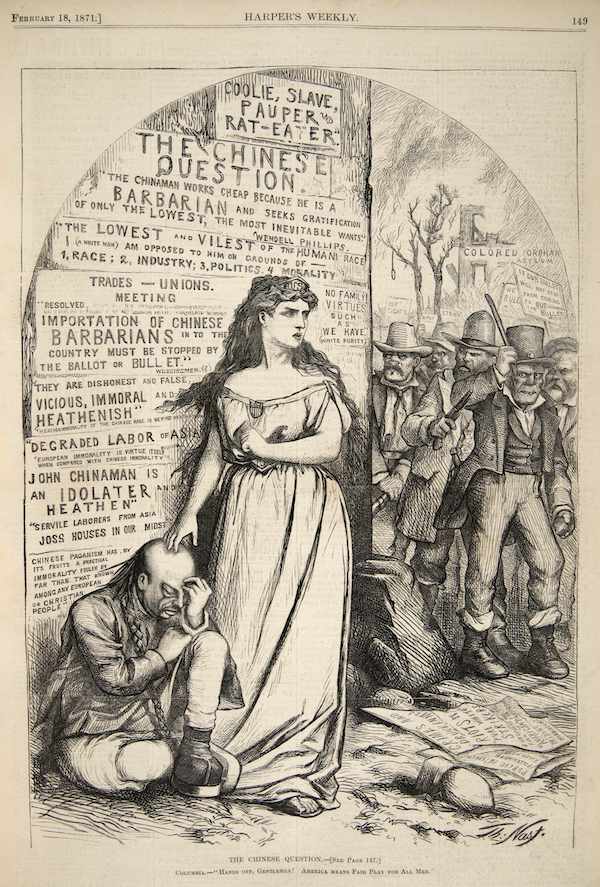
Laws were passed in various states fining employers for hiring Chinese immigrants -- and street mobs "self-patrolled" this immigration policy (sound familiar?). Harper's Weekly caricatured this in their February 18, 1871 edition:
Where is America heading with its immigration policy?Are we becoming a nation with closed doors -- or perhaps just closed doors to those south of the border?
There is no doubt that the federal government needs to regulate immigration, but the attitudes presented in the current debate border on isolationism and racism.
Immigration keeps our society vibrant with a fresh injection of "hope."
But we need an immigration policy that makes sense -- one that fills the economic needs of our industry, while maintaining our cohesiveness and identity as a nation.
Photo Credit: Delpixel / shutterstock.com