
Abdication (noun): a failure to fulfill a responsibility or duty.
How the World Was Won
One of the most consequential, yet overlooked achievements of the past 100 years was the successful implementation of the Marshall Plan in the wake of World War II.
Not only did the Marshall Plan facilitate the rehabilitation of Western European states like France and Germany, who were ravaged by years of total war, but it also stumped Communist expansion from the Soviet Union.
After the Second World War concluded, a tense diplomatic standoff between France, the United States, Great Britain, and the USSR ensued, with the USSR angling toward broadening its sphere of communist influence.
It is often forgotten that the Soviet Union made perhaps the greatest sacrifice of any nation in the fight against Nazi Germany, with a top end estimate of 27 million casualties, or 13.4% of their total population. For context, the top end estimate of German and American casualties is 7.4 million and 419,000, respectively.
As such, the USSR was seeking Western reparations that would help them bolster their economy and allow them to expand of their sphere of influence into Western Europe.
In the end, however, the United States led the effort to successfully rehabilitate Western Europe via $13 billion (equivalent to roughly $140 billion today) of humanitarian aid. This aid allowed Western Europe to feed and resettle their war-torn people, rebuild their infrastructure, and revive their economy.
A side note I find interesting is how, through the Marshall Plan, the economies of France and Germany were rebuilt to be dependent on one another, ensuring that the two previous enemies of both world wars would never again be on opposing sides of a conflict.
At any rate, the greatest success of the Marshall Plan was not any of the tangible achievements listed above, but rather, an ideological breakthrough.
For the first time in Europe’s history, they had embraced the same model of government that had sustained the United States for the 200 preceding years: that is, a Democratic Republic.
In other words, gone from Western Europe were the monarchs and dictators. Finally, the world saw that democracy was the most optimal form of governance, one in which individual rights and ingenuity trumped collectivism and nationalism.
Of course, this ideological struggle culminated in the Cold War, when the USSR attempted to counter the growing preference for democracy with intimidation and coercion tactics so often associated with Communism.
With the fall of the Berlin Wall in 1989, the West had defeated the suppressive ideology of the USSR, paving the way for a new era of prosperity.
ROI
When an investor is set to deploy capital toward a certain project, the first question that they ask is one concerning the return on their investment, known as the ROI.
For the United States, the return on our Marshall Plan investment was an entire world order centered around the American values of democracy, stability, and open markets.
This is not to be understated. The Marshall Plan quite literally put the United States at the center of the universe.
By the late 1980s, the United States had settled into their role as the unquestioned leader of the world. China was still finding its way after escaping the thralls of Maoism, and the Soviet Empire had collapsed, leaving a deeply weakened Russia behind.
Once again, these circumstances did not arise merely from coincidence, we can point to the Marshall Plan as an inflection point that brought us to an era of unipolarity, where the United States held considerable sway around the world while also serving as an example to all other democratic nations.
Today? To say the world is different would be a gross understatement.
Whereas the United States invested in the prosperity of their allies (and even adversaries like Germany) in the wake of World War II, we now are led by an inward-looking protectionist.
This trend of American abdication began in earnest during the Obama years, but has metastasized tremendously since Donald Trump came into office.
This dynamic, where the United States has willingly ceded power and influence cannot possibly be rationalized. We created an entire international order, and now we want to abandon it?
While American abdication is still in its early stages, the impacts are already harrowing.
Here Comes China
Take China, for example, who has made the (correct) calculation that American abdication gives them an opportunity to gobble up influence around the world.
This plan has been put into action by Xi Jinping, whose term limits have now been removed, allowing him to act as dictator for life.
When the US president was asked about this, he remarked that Xi was a great leader, and even joked that the United States should try that in the future. This is hardly standing up to the values that have sustained our prosperity since the end of World War II.
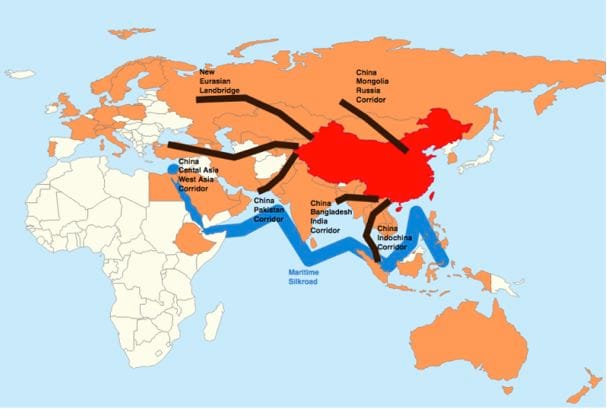
China’s One Belt and One Road initiative is investing $1 trillion in emerging markets in Southwest Asia, Africa, and Europe. This money will go toward building out infrastructure that facilitates more trade with China.
In turn, this will lead to more countries having a greater economic dependence on China instead of the United States, which then leads to greater Chinese influence across the globe.
Surely, the United States sees this as a national security threat and has responded, right?
Actually, no.
American Abdication
Almost as soon as he took office, Donald Trump pulled out of the Transpacific Trade Partnership, which was designed to counter China’s One Belt One Road initiative.
To add insult to injury, the Trump administration recently announced broad tariffs that impact more allies than enemies.
So, while China is investing $1 trillion to facilitate trade with the world, the United States is locking itself into a cold, dark room.
It is also important to note why these tariffs are such bad policy.
International trade is defined by consumer markets: where can we sell our goods?
In the late 1980s, the United States was far and away the largest consumer market on earth. This meant that every other country on earth saw our country as the most lucrative place for them to sell their goods, since no other country on earth had anywhere close to the number of consumers that we did.
This gave the United States considerable power; because if a foreign power were to be cut off from our consumer markets, their economy would suffer tremendous harm.
In this era, tariffs could have been a strong negotiating tool.
Today, however, China is quickly ascending toward the top of the list of largest consumer markets, so it is increasingly easy for other countries to swap out economic activity with the United States for economic activity with China.
This was not possible 30 years ago, but it is possible, and happening, right now.
So, when the United States threatens to levy tariffs on allies like Canada and the European Union, they are not going to quiver in their boots as Donald Trump would like.
Instead, they will simply turn to China. This is happening in more areas than just trade: leaders with nationalistic, autocratic tendencies rapidly gaining popularity around the globe indicates that the world is looking toward China’s system of government as a better alternative than the United States.
This is not opinion; it is fact.
That the United States is so willing to abdicate itself from the world order that it created continues to mystify me. It bears repeating that no other nation has benefited more from the post-World War II order than the United States, and when you build something, it is up to you to maintain it.
We built this world order, and it is therefore incumbent upon us to protect it. If we do not, China will continue to remake the world in their vision.
So while the costs of action surely are high, somebody should warn the current administration that the costs of inaction are immeasurably higher.
Photo Credit: eamesBot / shutterstock.com