Skip to content
Subscribe

What Americans Fear Post 9/11

What Americans Fear Post 9/11
Published:

Since September 11, 2001, defending the nation against terrorism has steadily remained a high priority for Americans; an attack is something we very opening fear.

Three months after the attack, which killed nearly 3,000 people, most could have guessed that both political parties, Republicans, and Democrats,  would almost mirror each other in wanting national defense from terrorism at the top of the list of congressional and presidential priorities.

The Partisan Approach to Terror: Then vs Now

Immediately following the attack, 90% of Republicans and 82% of Democrats agreed that safety and protection for us all came first, and around 7-in-10 have named it as a top priority throughout the 17 studies conducted by Pew Research Center since.

Cut to 2018, and while 73% of American still place defense against terrorism as the top priority, the partisan difference is stark, with 89% of Republicans making it a high priority, compared to 64% of Democrats. (As you might guess, independents were left out of the survey.) This partisan divide is generally the rule when talking about military and anti-terrorism measures, including funding them.

However, this contrasting number might point to something important, now and for the future.

Enter Edward Snowden

Nearly 20 years, the perception of what national protection actually is has evolved in the public consciousness.

In 2013, Americans were more likely to say the government was eating away at civil liberties more than it was protecting them from an attack, and it was nearly a bipartisan agreement on the issue. To that point, this hadn’t been seen in the post-9/11 era.
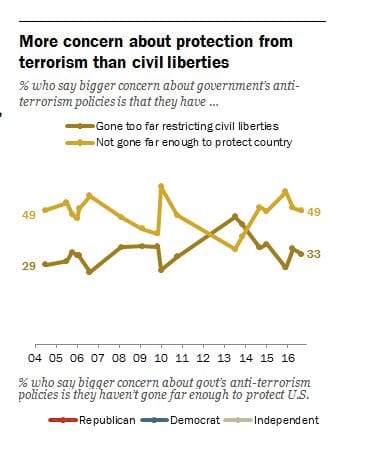
What would make people say such a thing? Well, the study was conducted around the time that the National Security Administration's domestic spy programs were revealed by the contractor Edward Snowden.

Those fears have not gone away, either. In the fall of 2016, right around election time, a third of Americans said they were more concerned about encroachment on a person’s civil liberties than on outright terrorist protection.

Big Money

The number of people worried about civil liberties has jumped since Snowden's revelations and has remained high as our knowledge of data breaches and personal data sales have increased.

In private sector security breaches alone, billions have been affected, and much of this information could easily be used to attack this country:

  • The Equifax breach affected 143 million people;
  • The Yahoo breach affected 3 billion worldwide;
  • The eBay breach affected 145 million; and
  • Facebook has sold its user data for huge profits, compromising not only our personal security, but national security as well.

Nearly two decades after the towers fell, it is important to remember that attacks now come in all shapes and sizes.

Some Notes from Internet Users

Erase: 86%  have attempted to get rid of their ‘digital footprints’

Avoid: 55% avoid observation by governments, organizations, and people.

No Control: 91% of adults agree or strongly agree we have lost control of our data.

Theft: 11% have had personal information stolen (e.g. Social Security numbers, credit cards, or bank account information).

Check out more facts here.

Adhere to the IVN etiquette

By posting a comment, you agree to adhere to our etiquette rules: No partisan attacks, no personal attacks, substantiate your sources, no self-promotion.

Contact IVN

Questions about this article or our coverage? Send us a message. A free IVN member account is required.

Message sent

Thanks, we’ll review it and get back to you if needed.

Message not sent

Sorry, something went wrong. Please try again.

Sign in to send a message

Messages are tied to your IVN member account. Signing in is free and takes a few seconds.

Republish this article

Republishing guidelines

Republish IVN articles for free. Independent Voter News articles may be republished online or in print under a Creative Commons BY-NC-ND 4.0 license, on these terms:

  1. Credit the author and IVN. Keep the byline ("By Author Name, Independent Voter News") and the attribution note at the end, which links to the original.
  2. Keep the meaning. You may update time and place references and apply your house style. You may trim for length, as long as the cuts don't change the meaning or misrepresent the author. Keep the headline. Mark any additions as your own (for example "Additional reporting by ...").
  3. Translations are welcome. Translate faithfully, add "Translated from English by [your outlet]", and tell us at editor@ivn.us.
  4. Keep the links, including the link to the original article.
  5. Keep the tracking image. The HTML includes a 1-pixel image that counts readers on your page. It collects no personal information.
  6. Photos and illustrations. Images credited to IVN may be used with this article only. Images credited to others (AP, Getty, Unsplash, Wikimedia and so on) stay under their owners' terms. Secure the rights or switch "Include images" off.
  7. Don't sell it. You can't sell our articles or sell ads specifically against them. Your normal site advertising is fine.
  8. No implied endorsement. Don't suggest that IVN or the author endorses you, your candidates or your causes, or that donations to you support IVN.
  9. Keep labels. Opinion or analysis pieces keep that label.
  10. Point search engines to the original. Where your CMS allows, set the canonical URL to the original IVN article.
  11. No bulk or automated republishing, and don't submit our articles to aggregators (Apple News, Google News, MSN) as your own.
  12. Corrections and removals. Update your copy when we correct it, and remove it promptly if we ask. We'll contact you at the email you give us.
  13. Questions or print republication: editor@ivn.us.
Preparing the article

What Americans Fear Post 9/11

Choose a format
  • HTML
  • Email HTML
  • Markdown
  • Formatted (.docx)
  • Plain text
  • WordPress blocks
  • PDF
Choose a platform

Photos credited to others need their owners' permission.

Republishing somewhere else? Questions? editor@ivn.us