Skip to content
Subscribe

Study Finds Most Americans Want Limited Gov't Role in Morality

Study Finds Most Americans Want Limited Gov't Role in Morality
Published:

Credit: studentsforliberty.org

For the first time since the data has been tracked, a decisive majority of Americans believe government should not favor any set of values. According to Gallup, fifty-two percent of Americans believe it is not the government’s role to promote moral values, while forty-four percent support an emphasis on traditional values.

The survey, which Gallup has conducted since 1993, is part of the organization’s annual polling on governance. It questions Republicans, Democrats, and independents on the government’s role in morality and passing legislation that favors what is commonly referred to as “traditional values” over any other set of values.

It is no surprise that the biggest gap between people who favor traditional moral values and those who believe the government should have a limited role in matters of morality is with Republicans. The Republican Party, consisting of many social conservatives, has traditionally supported social and domestic policies that adhere to a particular moral structure.

According to the poll’s results, sixty-five percent of Republicans surveyed said they believe traditional values have a role in how elected officials govern. However, Gallup pointed out a dramatic shift that has occurred within the Republican Party. In eight years, that figure has dropped fourteen percentage points. It is the largest decline of the three voting groups.

Independent voters are more likely to disagree with the notion that the government should push through policy and legislation that favors a set of moral values than they are to agree with such an idea. In 2004, the division was 51-44. Today, the figure has changed slightly to 54-41.
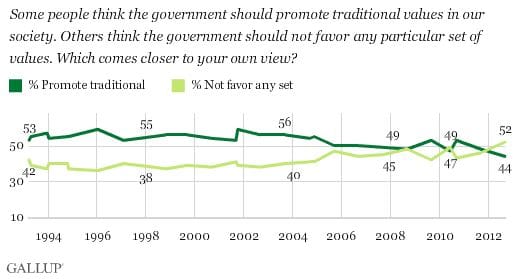
Overall, support for the traditional values position has been on the decline since 2002 with a few bumps here and there. The support for traditional values reached fifty percent in 2005 and has risen over that threshold only twice since then -- in 2009 and 2010. The figure has decreased sharply over the course of two years.

Does this mean Americans are becoming more amoral? Absolutely not. Morality has always been a subjective construct and what society deems as right and wrong; inappropriate and appropriate, has changed significantly in the last decade alone. What people are seeing is a shift in how people perceive the role of government in society and people’s lives.

The results of the poll are consistent with trends on various issues, including increased support nationwide for same-sex marriage and the legalization of marijuana. More people are leaning towards the idea that government should take less of a role in societal issues and people's private lives.

Adhere to the IVN etiquette

By posting a comment, you agree to adhere to our etiquette rules: No partisan attacks, no personal attacks, substantiate your sources, no self-promotion.

Contact IVN

Questions about this article or our coverage? Send us a message. A free IVN member account is required.

Message sent

Thanks, we’ll review it and get back to you if needed.

Message not sent

Sorry, something went wrong. Please try again.

Sign in to send a message

Messages are tied to your IVN member account. Signing in is free and takes a few seconds.

Republish this article

Republishing guidelines

Republish IVN articles for free. Independent Voter News articles may be republished online or in print under a Creative Commons BY-NC-ND 4.0 license, on these terms:

  1. Credit the author and IVN. Keep the byline ("By Author Name, Independent Voter News") and the attribution note at the end, which links to the original.
  2. Keep the meaning. You may update time and place references and apply your house style. You may trim for length, as long as the cuts don't change the meaning or misrepresent the author. Keep the headline. Mark any additions as your own (for example "Additional reporting by ...").
  3. Translations are welcome. Translate faithfully, add "Translated from English by [your outlet]", and tell us at editor@ivn.us.
  4. Keep the links, including the link to the original article.
  5. Keep the tracking image. The HTML includes a 1-pixel image that counts readers on your page. It collects no personal information.
  6. Photos and illustrations. Images credited to IVN may be used with this article only. Images credited to others (AP, Getty, Unsplash, Wikimedia and so on) stay under their owners' terms. Secure the rights or switch "Include images" off.
  7. Don't sell it. You can't sell our articles or sell ads specifically against them. Your normal site advertising is fine.
  8. No implied endorsement. Don't suggest that IVN or the author endorses you, your candidates or your causes, or that donations to you support IVN.
  9. Keep labels. Opinion or analysis pieces keep that label.
  10. Point search engines to the original. Where your CMS allows, set the canonical URL to the original IVN article.
  11. No bulk or automated republishing, and don't submit our articles to aggregators (Apple News, Google News, MSN) as your own.
  12. Corrections and removals. Update your copy when we correct it, and remove it promptly if we ask. We'll contact you at the email you give us.
  13. Questions or print republication: editor@ivn.us.

IVN staff: fill in who you're inviting above, then create the invite.

Preparing the article

Study Finds Most Americans Want Limited Gov't Role in Morality

Choose a format
  • HTML
  • Email HTML
  • Markdown
  • Formatted (.docx)
  • Plain text
  • WordPress blocks
  • PDF
Choose a platform

Photos credited to others need their owners' permission.

To for

Republishing somewhere else? Questions? editor@ivn.us