Skip to content
Subscribe

Are Independent Voters Prepared to Ride Out Tariff Uncertainty?

For millions of independent voters, short-term pain isn’t just uncomfortable—it’s unsustainable.

Are Independent Voters Prepared to Ride Out Tariff Uncertainty?
Photo by Getty Images on Unsplash. Unsplash+ License obtained by editor.

Editor's Note: This piece originally published on The Independent Center's website and has been republished on IVN with permission from the organization.

‍The stock market has been extremely volatile following President Trump’s new tariff regime. As Wall Street reacts with sharp declines, the administration defends the move as a necessary step to address what it calls a trade deficit “emergency.” Prominent Republicans have echoed this justification, framing the turmoil as a temporary setback in pursuit of long-term economic benefits.

Zooming In

But for millions of independent voters, short-term pain isn’t just uncomfortable—it’s unsustainable. A 2024 survey found that nearly half of all Americans agree or somewhat agree with the statement: “I am living paycheck to paycheck.” Surprisingly, this includes about 20% of households earning more than $150,000 annually. That statistic reveals a deeper issue: financial precarity is now a reality for a significant slice of the population, not just lower-income earners.

In the words of the late economist John Maynard Keynes, “In the long run, we are all dead.” Waiting for long-term gains may not be a viable option for those already struggling to get through the month.

Key Facts

  • The new tariffs are projected to raise the prices of essential goods, from groceries to household items.
  • CNBC estimates show price hikes across items Americans rely on daily, tightening the squeeze on already stretched budgets.
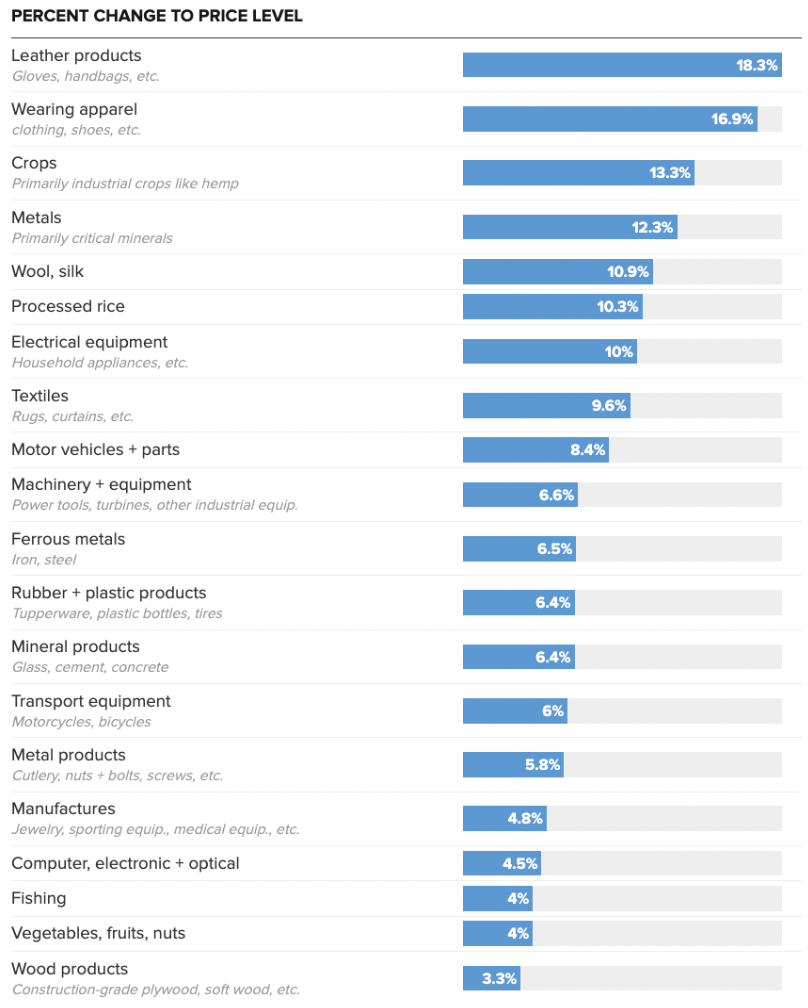
Projected cost hikes under tariffs.
  • Small businesses, which account for a large portion of U.S. employment, often lack the cash reserves to weather economic turbulence. When market uncertainty rises, they suffer from delayed contracts and hesitant customers.
  • The 2024 survey underscores the fragility of American household finances, even among high earners.

Independent Lens

The irony is hard to ignore: the GOP’s electoral success was built in part on promises to fix affordability issues. Americans voted for a government they believed would ease the cost of living, not exacerbate it.

The domestic fallout from tariffs is already being felt in wallets and balance sheets across the country. For a population where a significant share lives on the financial edge, the promise of “long-term gain” feels like a gamble they simply cannot afford.

How long Americans are willing—or able—to wait for that promised payoff is the real question. For many, the answer may be not long at all.

Adhere to the IVN etiquette

By posting a comment, you agree to adhere to our etiquette rules: No partisan attacks, no personal attacks, substantiate your sources, no self-promotion.

Contact IVN

Questions about this article or our coverage? Send us a message. A free IVN member account is required.

Message sent

Thanks, we’ll review it and get back to you if needed.

Message not sent

Sorry, something went wrong. Please try again.

Sign in to send a message

Messages are tied to your IVN member account. Signing in is free and takes a few seconds.

Republish this article

Republishing guidelines

Republish IVN articles for free. Independent Voter News articles may be republished online or in print under a Creative Commons BY-NC-ND 4.0 license, on these terms:

  1. Credit the author and IVN. Keep the byline ("By Author Name, Independent Voter News") and the attribution note at the end, which links to the original.
  2. Keep the meaning. You may update time and place references and apply your house style. You may trim for length, as long as the cuts don't change the meaning or misrepresent the author. Keep the headline. Mark any additions as your own (for example "Additional reporting by ...").
  3. Translations are welcome. Translate faithfully, add "Translated from English by [your outlet]", and tell us at editor@ivn.us.
  4. Keep the links, including the link to the original article.
  5. Keep the tracking image. The HTML includes a 1-pixel image that counts readers on your page. It collects no personal information.
  6. Photos and illustrations. Images credited to IVN may be used with this article only. Images credited to others (AP, Getty, Unsplash, Wikimedia and so on) stay under their owners' terms. Secure the rights or switch "Include images" off.
  7. Don't sell it. You can't sell our articles or sell ads specifically against them. Your normal site advertising is fine.
  8. No implied endorsement. Don't suggest that IVN or the author endorses you, your candidates or your causes, or that donations to you support IVN.
  9. Keep labels. Opinion or analysis pieces keep that label.
  10. Point search engines to the original. Where your CMS allows, set the canonical URL to the original IVN article.
  11. No bulk or automated republishing, and don't submit our articles to aggregators (Apple News, Google News, MSN) as your own.
  12. Corrections and removals. Update your copy when we correct it, and remove it promptly if we ask. We'll contact you at the email you give us.
  13. Questions or print republication: editor@ivn.us.

IVN staff: fill in who you're inviting above, then create the invite.

Preparing the article

Are Independent Voters Prepared to Ride Out Tariff Uncertainty?

Choose a format
  • HTML
  • Email HTML
  • Markdown
  • Formatted (.docx)
  • Plain text
  • WordPress blocks
  • PDF
Choose a platform

Photos credited to others need their owners' permission.

To for

Republishing somewhere else? Questions? editor@ivn.us