
On April 14, 2014, IVN contributor Mac Vanandel presented a well-argued point about the free market of ideas and how it is inherently part of the free market of commerce. Some people have responded that the two cannot be conflated because they are different.
In some ways, this is true. However, it is important to understand that how people perceive the world around them influences their activity as consumers, and the market does respond to public opinion.
The issues of gay rights, the morality of homosexuality, and the definition of marriage offer the biggest examples of why the free market is dependent on the market of ideas.
Mac is likely not old enough to remember this, but Ellen DeGeneres -- way before she had her daytime talk show -- had her own primetime sitcom in the mid-90s, called Ellen. The show ran over 100 episodes before it was cancelled -- a successful sitcom by TV standards.
Ellen, which premiered in 1994, had consistently high ratings until one episode in 1997 changed not only the course of the show, but perhaps even primetime network television.
In the episode, called the "Puppy Episode," Ellen's character came out as gay (DeGeneres also came out in real life on The Oprah Winfrey Show), and the controversy that erupted from it pressured ABC to put a parental advisory before the beginning of the show.
Could you imagine ABC putting a parental advisory before each episode of Modern Family? Ellen would have received the same television rating in the 90s as Modern Family has today, but putting a parental advisory before the show would be like moving it from TV-PG (Modern Family's rating) to TV-14.
As the show began to focus more on gay rights issues, the ratings for Ellen began to decline until finally ABC pulled the plug in May 1998.
It is important to note that at the time the show aired and in the year of its cancellation, an overwhelming majority of Americans not only believed same-sex marriage should not be legalized, but that homosexuality was immoral. Public opinion on the issue pressured the market to act a certain way: a broadcast company put a parental advisory on a show that never needed one before and eventually cancelled the show when demand declined as a result of mainstream public opinion.
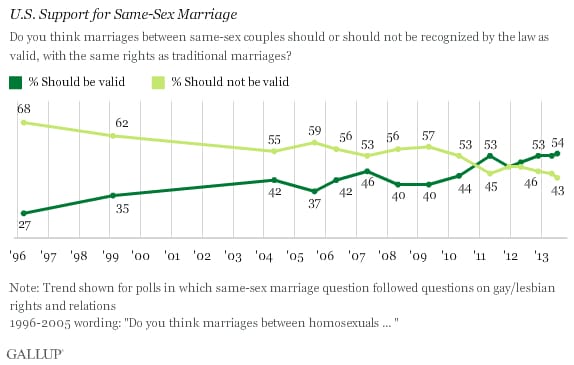
The market responds to mainstream ideas. If there is high demand for an idea, chances are we will see businesses start shifting their priorities to capitalize on this demand.
Fast forward to 2014. Not only do a majority of Americans say gay marriage should be legal, but an even larger majority say there is nothing immoral about homosexuality. In 2012, states passed voter-approved ballot initiatives to legalize same-sex marriage for the first time in U.S. history. Not only that, but same-sex marriage went 4-for-4 at the ballot box after going 0-for-32 in the previous decade.The market has responded to this as well as we have begun to see pro-gay rights marketing campaigns from several major corporations representing a variety of markets -- from Oreo to Amazon.
The free market of ideas is influencing the commercial market.
During the 2014 Conservative Political Action Conference (CPAC), U.S. Representative Michele Bachmann (R-Minn.) said the now infamous SB 1062 in Arizona, which would have protected businesses from legal challenges for denying goods and services based on strong religious convictions, failed because the gay community "have so bullied the American people."
There was certainly vocal opposition to the bill from gay rights activists, because while the LGBT community was not explicitly mentioned in the legislation, as Bachmann pointed out, it was certainly not created to protect a Muslim or Jewish deli owner who refuses to sell pork products. The timing of the bill didn't help disguise the true motives of some lawmakers, either.
Arizona Governor Jan Brewer (R) likely wasn't concerned about the vocal opposition of gay rights activists as much as she was concerned about pressure coming from local, national, and international businesses. Companies threatened to move their operation(s) out of the state or threatened to not bring their business into Arizona. The state's tourism industry was in jeopardy. The NFL could have very well moved the 2015 Super Bowl if SB 1062 was signed into law.
The gay community didn't "bully" Brewer -- the free market did.
Similarly, there was not as much pressure from gay rights groups and advocates calling for Brendan Eich's resignation as CEO of Mozilla as there was from within the Mozilla community. It came from employees who were uncomfortable working for him or companies that no longer wanted to do business with Mozilla after it was revealed that Eich gave money to an anti-gay marriage campaign in 2008.
As consumers reject these ideas more and more, the market has to respond and do what it believes is best for business. Eich was not fired as some people mistakenly say. He was pressured by the market to resign. He was not pressured by the LGBT community or gay rights groups to resign, but by forces within the industry -- an industry, by the way, that is all about the mainstream and being ahead of the curve.
This is the free market at work.
Sometimes people will say they support the free market without fully understanding what that means. There is a strong relationship between the market of ideas and the commercial market as they both have a way of influencing each other. To say they are separate is a mistake.
Photo Credit: Paul Sakuma / AP