
Pennsylvania is the latest battleground over the issue of partisan gerrymandering.
Several plaintiffs filed a lawsuit Thursday challenging congressional maps drawn by the Republican-controlled Pennsylvania General Assembly that are "so bizarrely engineered that the only fair inference is that the Republican mapmakers made them so for partisan advantage."
What is unique about this lawsuit is that the plaintiffs are not making a constitutional challenge based on race, sex, or any other class. This lawsuit comes down to one simple question: does drawing districts for purely partisan reasons violate the fundamental right to vote for everyone else?
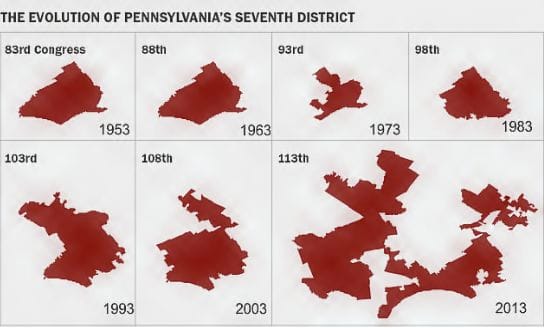
One example of how bizarre these districts are drawn is Pennsylvania's 7th district, also known as "Goofy kicking Donald Duck."
"At one point in King of Prussia, the district is so narrow that it is held together only by a Creed's Seafood & Shack," the complaint states.
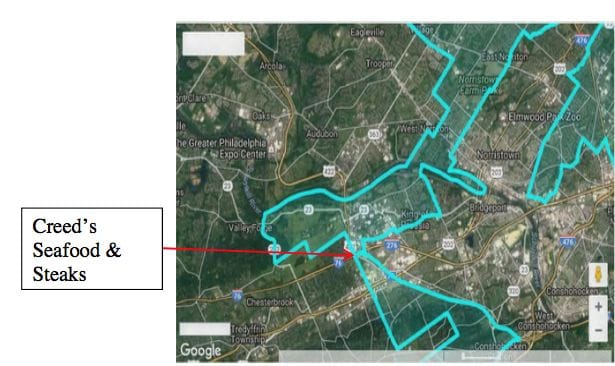
Note: All images provided are from the plaintiffs' complaint in League of Women Voters Pennsylvania, et. al. v. Commonwealth of Pennsylvania, et. al.
Plaintiffs include the evolution of the 7th district:
"As a moderate conservative my entire adult life, I've never been politically active and have had the luxury of taking our democracy for granted," said Chris Malone, who brought together 5 of the 17 plaintiffs on the lawsuit with the help of the Public Interest Law Center.
"I was shocked to learn that the boundaries of the 7th congressional district in which I live are among the most biased and absurd in the country. This lawsuit is a step in the right direction to restoring fair and honest congressional elections in Pennsylvania." - Chris Malone
Plaintiffs acknowledge that neither party has a monopoly over gerrymandering. It is as much of a problem in Democratic-controlled states like Maryland as it is in Pennsylvania.
However, they provide plenty of evidence that Republicans in Pennsylvania utilized the 2011 party strategy of "cracking and packing" to "pack" most Democratic voters into 5 districts and spread the rest across the other 13 districts.
Take a look at the 2012 election results:
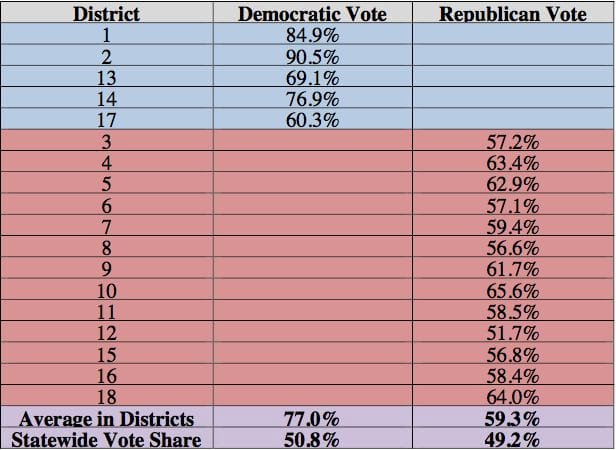
Democrats are so densely packed in a small handful of districts that they made up 90.5% of the vote in district 2. And though the statewide vote was split nearly 50-50 (with Democrats taking the majority at 50.8%), Republicans control 72% of the districts.
"Republican mapmakers used sophisticated computer modeling techniques, in Pennsylvania and elsewhere, to manipulate district boundaries with surgical precision to maximize the number of seats their party would win in future elections," the plaintiffs state.
Plaintiffs used the "efficiency gap," among other tests to show just how bad partisan gerrymandering is in Pennsylvania. The method was also used by a three-judge district court panel in Whitford v. Gill to determine that partisan gerrymandering was so extreme in Wisconsin that it violated voting rights.
That case is now before the Supreme Court.
The "efficiency gap," in the simplest of terms, counts the number of wasted votes for each party to determine if one party has an unfair advantage. Votes cast for the losing candidate are considered "wasted."
Quick example: There is a legislative race in which a Republican gets 1,000 votes and a Democrat gets 700. Republicans wasted 299 votes, since the results would not have changed if the Republican candidate received votes between 701 and 1,000. Democrats wasted 700 votes, since the results would not have changed if the party's candidate received no votes at all.
If a pattern emerges that one party consistently wastes more votes than the other, then the possibility arises that the state's electoral districts were drawn intentionally to advantage one party over the other to gain more seats.
According to plaintiffs in this case, "the efficiency gap of Pennsylvania’s congressional districts was the largest in the nation" in 2012.
"A variety of statistical modeling techniques and tests all lead to the same conclusion: the enacted plan could have resulted only from unconstitutional partisan intent, and the effect of that discrimination is significant and enduring," the plaintiffs write.
Plaintiffs hope for a repeat of the district court decision in Wisconsin. They ask the court to find that the redistricting plan in Pennsylvania is unconstitutional on the basis that it discriminates against Democratic voters because of their "political expression and affiliation."
And while the two major parties argue over issues like Voter ID, nonpartisan reformers are asking a more fundamental question: do both parties work together to suppress the vote of the individual voter?
Read the plaintiffs' full complaint: