
https://www.youtube.com/watch?v=DxHHENYh8bw
Video Credit: CNN
The response to President Donald Trump's decision to end DACA in six months unless Congress acts has been felt across the Internet.
https://twitter.com/NYGovCuomo/status/904734772546740229
https://twitter.com/JasonLeopold/status/905144084892860416
https://twitter.com/itscollmc/status/905148707393429504
It's an emotional issue, for sure. We are talking about approximately 800,000 sons and daughters of immigrants who crossed into this country illegally -- DREAMers, as they are called, who had no choice in the matter and want to continue to live in the only country they have ever known without fear of deportation.
DACA -- or Deferred Action for Childhood Arrivals -- was formally implemented under a policy memorandum sent by former DHS Secretary Janet Napolitano in 2012 (by order of President Barack Obama) to federal immigration enforcement agencies. The memo directed the agencies to "exercise their enforcement discretion on behalf of individuals who qualified for the program."
DACA (or the intention of the program, anyway) is not unpopular. A June Morning Consult and Politico poll found that 78% of respondents supported allowing DREAMers to become citizens. The poll even suggested that this included 73% of Trump voters.
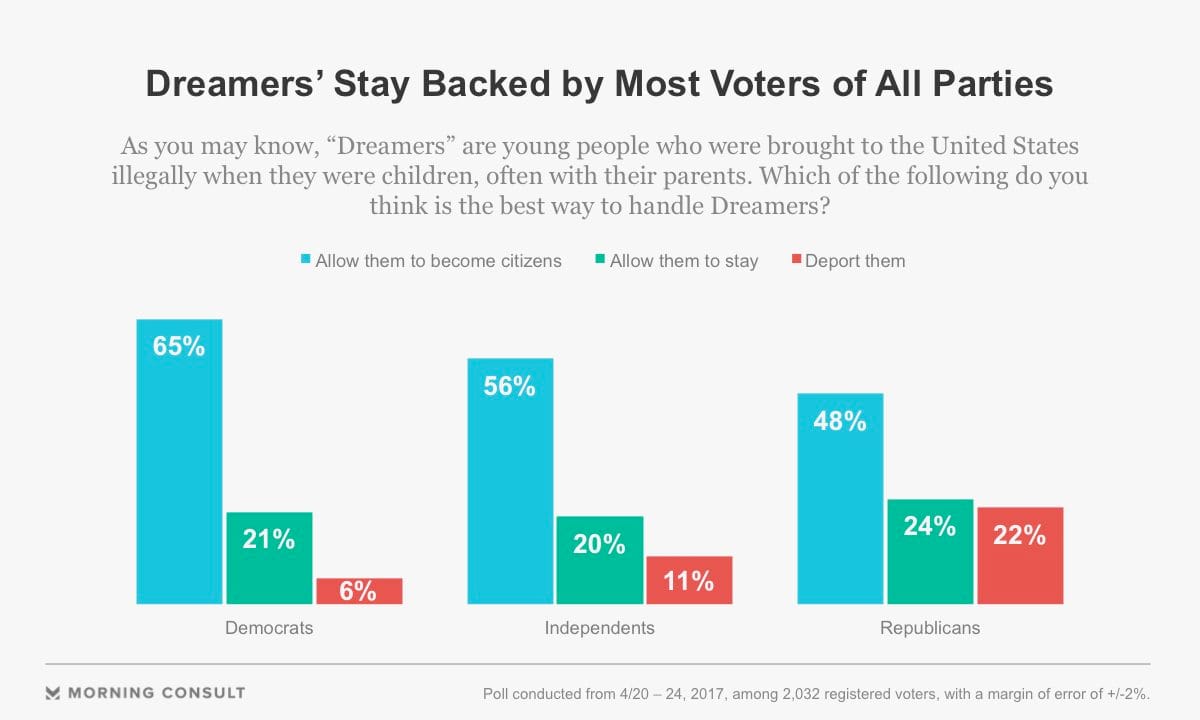
The purpose of the program has support -- to various degrees -- from leaders in both major political parties. Republican House Speaker Paul Ryan (R-Wis.) even said in a statement Tuesday:
"It is my hope that the House and Senate, with the president’s leadership, will be able to find consensus on a permanent legislative solution that includes ensuring that those who have done nothing wrong can still contribute as a valued part of this great country.” - US House Speaker Paul Ryan
But Ryan began his statement by saying that President Barack Obama abused executive authority when he enacted the policy, that it was not the president's constitutional role to create federal law -- authority that belongs solely to Congress -- and it was never going to be a long-term solution.
And this is the main argument many opponents have against the executive policy. Many people who support President Donald Trump's decision to rescind DACA do not want to see hundreds of thousands of law-abiding taxpayers deported. They are not racist nor xenophobic.
Their main beef is their belief that it was unconstitutionally enacted.
https://twitter.com/justinamash/status/905107136858005506
The issue has already gone before the federal courts. The Obama administration was sued and lost in late 2014 and 2015, respectively, when it tried to expand the program. Up until Trump's announcement, several states threatened to file more lawsuits if the president did not rescind DACA.
Eventually, DACA would have found its way to the Supreme Court, and in all probability would have been declared unconstitutional by a majority of the justices. This would have left DREAMers in a more precarious position than they are now, because DACA is not dead -- not yet.
President Donald Trump has given Congress 6 months to act on the program to make it the official law of the land or let it end. The ball is in the legislature's court now, giving Republicans and Democrats an opportunity to come together and pass significant and potentially comprehensive immigration reform.
Many might scoff at the idea. The hyper-partisan environment in Washington has stalled any substantive and comprehensive immigration bill from passing for years now.
We have lacked a nuanced debate and discussion on this issue not only on Capitol Hill, but in the two-sided, soundbite-driven media dialogue. The national conversation on immigration has long treated this topic as an emotional rejection of xenophobia versus "build the wall, deport them all."
The consequence of this is anger on both sides, because one side views the other as racist, and the other side responds to these accusations with equal vitriolic emotion. All the while, we fail to give the issue and each other the appropriate respect and courtesy to really understand the nuances of the issue and find real, lasting solutions.
Whether one supports or opposes President Trump, he has given Congress a deadline to act -- and not an unreasonable deadline of 6 months. And given the popularity of the program, it doesn't seem like either side would have much to lose if they passed a new DACA bill.
It could be the kick in the pants lawmakers need to do something about a system that a majority of Americans will agree, one way (from a security standpoint) or another (a humanitarian standpoint) is a disaster and needs comprehensive reform.
Regardless of how one feels about the DACA program, US lawmakers cannot continue to sit on their hands on this issue.
Photo Credit: a katz / shutterstock.com