 Chad Peace

California’s nonpartisan top-two primary and independent redistricting commission are widely viewed as two of the most voter-centric reforms in modern American politics. Yet new polling in the field suggests a push to roll both reforms back, and the strategy behind that effort is telling.
Two Parties, One Goal
For more than a decade IVP has warned that party leaders, given the chance, would unite to reclaim control over primary elections. The top-two nonpartisan primary, adopted by voters in 2010, moved the first stage of the public election process from a closed party contest to a single ballot open to all voters, as documented in IVN’s legal overview of primary elections.
The history of how California’s top-two nonpartisan primary reform won—despite opposition from every political party, including third parties—is almost unbelievable.
Inside the Capitol, however, neither party has ever loved the reform. Party officers lost the power to guarantee one Democrat and one Republican on every November ballot. Independent commissions also took district lines away from legislators. That loss of gatekeeping remains a sore spot.
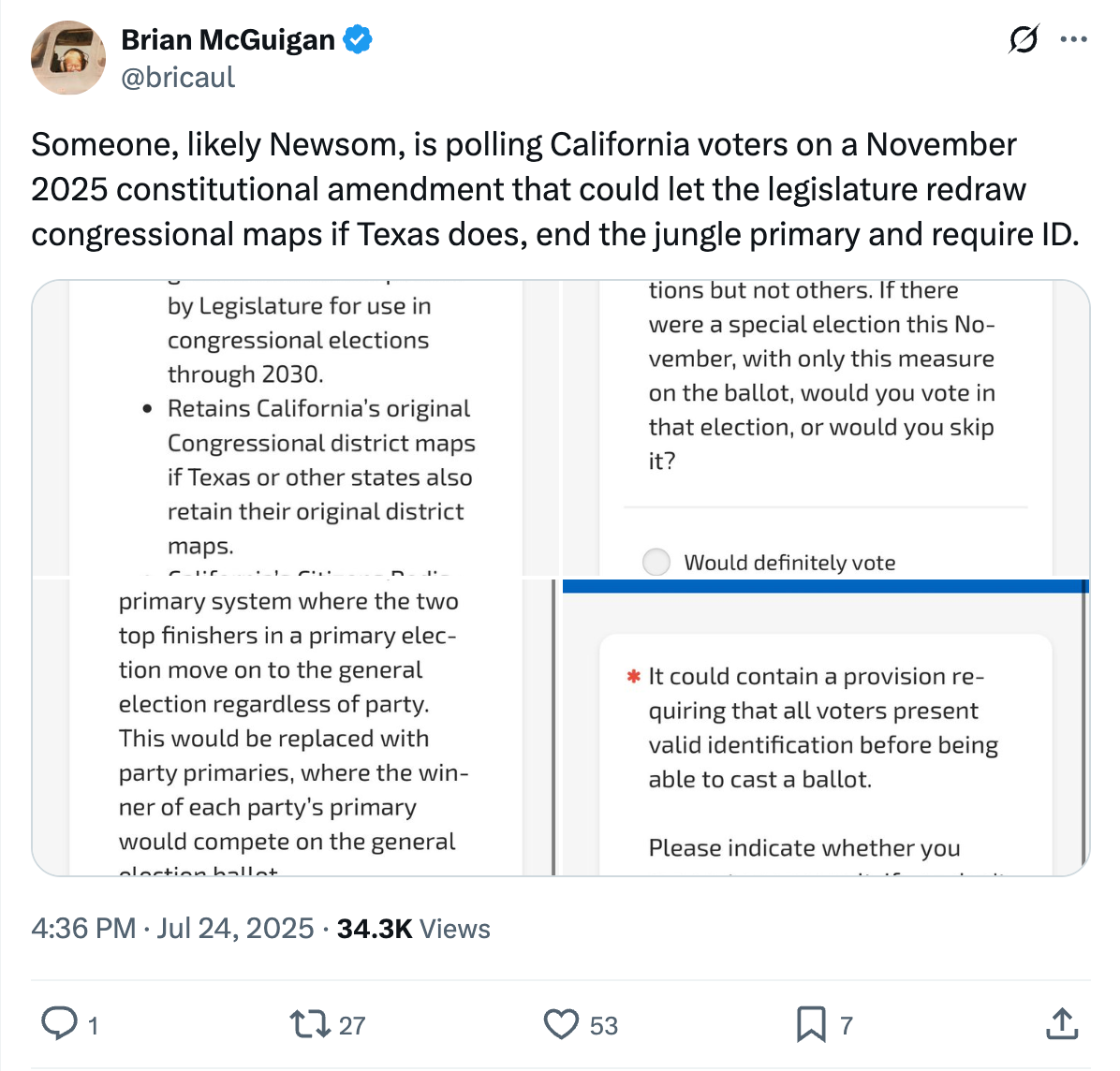
The Polling Clue
A recent survey instrument, flagged on social media, is testing whether voters would support restoring party primaries and scrapping independent redistricting if the measure also includes a statewide voter ID requirement.
The question is striking because Democratic leaders have long framed voter ID as voter suppression, while California Republicans are actively gathering signatures for a voter ID initiative of their own, covered by ABC News.
Why Link Voter ID to Nonpartisan Primary Repeal
Public opinion explains the tactic. A May 2025 Los Angeles Times / IGS poll found that 76 percent of Californians, including 68 percent of Democrats, favor some form of voter ID.
By placing voter ID in the same package with a return to party primaries and partisan redistricting, architects gain bipartisan talking points. Republicans get their ID rule, Democrats reclaim nomination control, and each party hopes its base will overlook the rest of the deal.
The Incentive Problem
Closed primaries function like proportional representation for partisans. Republicans pick their nominee, Democrats pick theirs, independents pick no one. Research from the USC Schwarzenegger Institute, “Evaluating California’s Top-Two Primary,” shows that top-two elections reduce extremism by forcing candidates to appeal beyond party bases. Pew data likewise record record-high partisan hostility and a rise in voters dissatisfied with the two-party system.
Rolling back the top-two nonpartisan primary would restore incentives for candidates to mobilize only their most loyal factions, leaving the one-in-three California voters who decline party labels without meaningful representation. That outcome runs counter to the original purpose of ranked choice experiments, independent commissions, and every reform intended to broaden participation.
History Rhymes
When California lawmakers attempted to repeal top-two by statute in 2013, public backlash stopped the bill. In 2018 party insiders floated a legal challenge instead, reported by The Atlantic. Now, polling on a combined voter ID and primary rollback suggests a third strategy, one that disguises partisan motives behind universally popular identification rules.
California’s Voter-Centric Reforms at Serious Risk
California’s nonpartisan primary and independent redistricting commission were built to reduce partisan gatekeeping and empower independent voters. If Democratic strategists now frame voter ID as the price for undoing those reforms, voters should recognize the bargain for what it is: a bipartisan bid to reclaim control over elections, at the expense of the very electorate reforms were meant to serve.
WATCH: GOVERNOR NEWSOM REDISTRICTING PRESS CONFERENCE