
The FCC voted Thursday to repeal net neutrality regulations put in place under the Obama administration. The news was largely bemoaned online, as several sites and content providers pushed US consumers to rally against the FCC's decision.
Many of these companies, along with lawmakers like US Rep. Tulsi Gabbard, launched online petitions to send to the FCC ahead of the vote.
https://twitter.com/TulsiGabbard/status/941344713772331009
Let's first be clear about one thing: Both sides on the net neutrality debate believe they are saving the internet from bad actors who want nothing more than to control your online experience to their benefit.
Who do we trust? The internet providers? The content providers? The government? Both sides of the debate promise to be neutral, and support an open internet, while pointing a finger at the other side and saying they are going to essentially hold the internet hostage.
The louder voices have hands down been the side in favor of preserving Obama-era net neutrality rules.
Opponents of the FCC's decision Thursday say ISPs, when given unchecked freedom, will stifle innovation and progress by creating a multi-tier pricing system that favors big corporations over the "little guy," will throttle internet speeds for certain content, and even censor content they don't like. Source: Wired
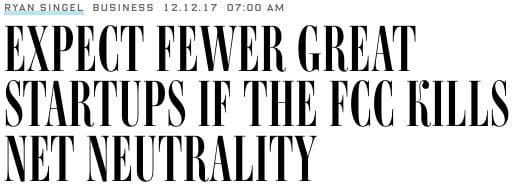
Source: NPR

Source: RollingStone.com

Those who argue for federal net neutrality rules can't understand why anyone outside ISPs would support ending these regulations, and if they do then they must not believe in a free and open internet.
But are they actually listening to the other side? And is there more to this story?
Here is what the FCC says it is doing:
"What the Declaratory Ruling Would Do:
- Restore the classification of broadband Internet access service as an “information service”—the classification affirmed by the Supreme Court in the Brand X case.
- Reinstate the private mobile service classification of mobile broadband Internet access service.
- Clarify the effects of the return to an information service classification on other regulatory frameworks, including the need for a uniform federal regulatory approach to apply to interstate information services like broadband Internet access service.
What the Report and Order Would Do:
- Adopt transparency requirements that ISPs disclose information about their practices to consumers, entrepreneurs, and the Commission.
- Restore the Federal Trade Commission’s ability to protect consumers online from any unfair, deceptive, and anticompetitive practices without burdensome regulations, achieving comparable benefits at lower cost.
- Eliminate the vague and expansive Internet Conduct Standard, under which the FCC micromanaged innovative business models, along with the bright-line rules.
What the Order Would Do:
- Find that the public interest is not served by adding to the already-voluminous record in this proceeding additional materials, including confidential materials submitted in other proceedings."
The FCC further says:
"Many of the largest ISPs (Comcast, AT&T, Verizon, Cox, Frontier, etc.) have committed in this proceeding not to block or throttle legal content. These commitments can be enforced by the FTC under Section 5, protecting consumers without imposing public-utility regulation on ISPs."
And if ISPs want to act as bad actors and conspire to throttle speeds or censor legal content?
"Section 1 of the Sherman Act bars contracts, combinations, or conspiracies in restraint of trade, making anticompetitive arrangements illegal. If ISPs reached agreements to unfairly block, throttle, or discriminate against Internet conduct or applications, these agreements would be per se illegal under the antitrust laws."
Meanwhile, ISPs and their advocates are arguing that their problems with the 2015 regulations have nothing to do with the principle of net neutrality.
Michael Powell, president and CEO of the National Cable and Telecommunications Association (NTCA), said Thursday:
"Today’s FCC action rightly restores the light-touch approach to government regulation of the internet that has fostered the development of a vibrant, open and innovative platform. For decades, America’s internet service providers have delivered an open internet – allowing consumers to enjoy the lawful internet content and applications of their choosing. Nothing in this decision alters that commitment – ISPs have stated repeatedly that they do not and will not block, throttle or unfairly discriminate in how internet traffic is delivered."
He adds, "We cannot reach for the future with regulation from the distant past. Title II and its accompanying regulatory uncertainty deters the innovation and investment needed to build the next generation of broadband and bring its benefits to all Americans. We fully support Chairman Pai and the Commission’s action today."
Proponents of the FCC's latest decision, like Powell, say net neutrality placed an unnecessary regulatory burden on ISPs, forcing them to, in effect, subsidize the real cost of delivering big-name content, like Netflix, to the customer's home.
For analogy, imagine the internet as a four lane highway. The ISPs argue that Netflix customers are taking up three lanes. This forces them to deliver services to everyone else over a single lane.
ISPs want Netflix -- and other large content providers -- to bear the burden of building new lanes. Content providers want ISPs, through their customers, to bear that burden.
Who is right? Should customers who use a lot of data have to pay for it? Should content providers that require a lot of data have to pay for it?
Or should we keep the net neutrality rules that stop ISPs from treating these high-usage customers and content providers differently than the average consumer?
Most media coverage treats this issue like it is simple, one-sided issue. You either support a free and open internet or you don't. The thing is, net neutrality is far more nuanced and complex and has a long history that escapes most headlines.
Both sides of the debate say they support an open internet. Both sides accuse each other of wanting to destroy the internet as we know it. The truth requires us to look deeper.
And for those who think this issue is over, it isn't. Lawsuits will be filed. Local and state governments, like California and Washington state, will move to enact their own net neutrality rules. Whether you support or oppose the FCC's decision, there is more to come on this issue.
Photo Credit: Steve Heap / shutterstock.com