Skip to content
Subscribe

For SCOTUS Rulings on Gay Marriage, It Isn't Always Black and White

For SCOTUS Rulings on Gay Marriage, It Isn't Always Black and White
Published:

Credit: Wikimedia Commons
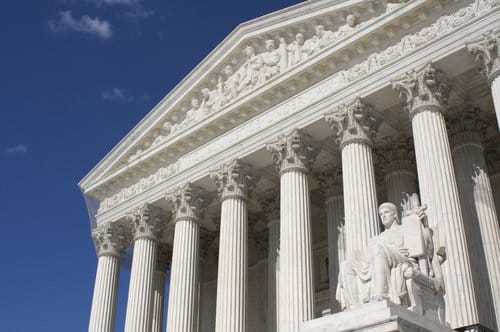
gay marriage

The United States Supreme Court is expected to rule on the Defense of Marriage Act (Windsor v. United States) and California's Proposition 8 (Hollingsworth v. Perry) in the next few days. There is a good possibility the decision on these two cases will be reserved for last.

The Washington Post offers an easy to follow graphic on the potential rulings and what the implications would be for each decision. It also provides status for marriage rights in each state. Check it out.

The Supreme Court can either uphold DOMA or they can strike it down as unconstitutional. If the justices decide the law is unconstitutional, federal benefits currently offered to heterosexual couples will be extended to homosexual couples in twelve states and the District of Columbia.

Hollingsworth v. Perry is not a black and white case. There are a number of different routes the high court can go with this case.

The Supreme Court could strike down Prop 8 and rule that a state cannot withdraw marriage rights to gay couples once those rights have already been offered. This decision would only affect California.

The justices could decide states cannot offer marriage benefits under a civil union, but withhold the label 'marriage.' This decision would have slightly broader implications as it would affect seven states.

California, Colorado, Hawaii, Nevada, Oregon, Illinois, and New Jersey currently allow same-sex couples to join in a civil union and can receive the same benefits a heterosexual married couple is eligible to receive, but the union cannot be legally labeled a marriage. If the high court rules a state cannot withhold the marriage label if they offer marriage benefits for civil unions, California is not the only state that will have to alter its laws.

More states will be affected if the Supreme Court rules Proposition 8 to be unconstitutional. If it the justices decide a state cannot deny same-sex couples the right to marry, it will impact marriage bans in 35 states. There are certainly regions in the United States where this decision would be extremely unpopular.

If the high court upholds Prop. 8 or decides it lacks standing, the only state affected is California. Obviously, if Prop. 8 is upheld, gay marriage will be banned in the state. If it is decided Prop. 8 lacks standing, same-sex marriage will continue in California and it could open the door for additional litigation challenging marriage bans nationwide.

Adhere to the IVN etiquette

By posting a comment, you agree to adhere to our etiquette rules: No partisan attacks, no personal attacks, substantiate your sources, no self-promotion.

Contact IVN

Questions about this article or our coverage? Send us a message. A free IVN member account is required.

Message sent

Thanks, we’ll review it and get back to you if needed.

Message not sent

Sorry, something went wrong. Please try again.

Sign in to send a message

Messages are tied to your IVN member account. Signing in is free and takes a few seconds.

Republish this article

Republishing guidelines

Republish IVN articles for free. Independent Voter News articles may be republished online or in print under a Creative Commons BY-NC-ND 4.0 license, on these terms:

  1. Credit the author and IVN. Keep the byline ("By Author Name, Independent Voter News") and the attribution note at the end, which links to the original.
  2. Keep the meaning. You may update time and place references and apply your house style. You may trim for length, as long as the cuts don't change the meaning or misrepresent the author. Keep the headline. Mark any additions as your own (for example "Additional reporting by ...").
  3. Translations are welcome. Translate faithfully, add "Translated from English by [your outlet]", and tell us at editor@ivn.us.
  4. Keep the links, including the link to the original article.
  5. Keep the tracking image. The HTML includes a 1-pixel image that counts readers on your page. It collects no personal information.
  6. Photos and illustrations. Images credited to IVN may be used with this article only. Images credited to others (AP, Getty, Unsplash, Wikimedia and so on) stay under their owners' terms. Secure the rights or switch "Include images" off.
  7. Don't sell it. You can't sell our articles or sell ads specifically against them. Your normal site advertising is fine.
  8. No implied endorsement. Don't suggest that IVN or the author endorses you, your candidates or your causes, or that donations to you support IVN.
  9. Keep labels. Opinion or analysis pieces keep that label.
  10. Point search engines to the original. Where your CMS allows, set the canonical URL to the original IVN article.
  11. No bulk or automated republishing, and don't submit our articles to aggregators (Apple News, Google News, MSN) as your own.
  12. Corrections and removals. Update your copy when we correct it, and remove it promptly if we ask. We'll contact you at the email you give us.
  13. Questions or print republication: editor@ivn.us.

IVN staff: fill in who you're inviting above, then create the invite.

Preparing the article

For SCOTUS Rulings on Gay Marriage, It Isn't Always Black and White

Choose a format
  • HTML
  • Email HTML
  • Markdown
  • Formatted (.docx)
  • Plain text
  • WordPress blocks
  • PDF
Choose a platform

Photos credited to others need their owners' permission.

To for

Republishing somewhere else? Questions? editor@ivn.us