
The federal government approval rating is currently lower than any other sector in the United States.
A recent survey by Gallup shows that only 28 percent of Americans have a positive overall view of the U.S. federal government, while 55 percent hold an unfavorable opinion of the federal government.
That was the lowest rating for any business or industry sector tested in Gallup's survey, which asked respondents: "For each of the following business sectors in the United States, please say whether your overall view of it is very positive, somewhat positive, neutral, somewhat negative or very negative," and then listed each sector in a randomized order.
Survey respondents had the most favorable view of the U.S. restaurant industry out of every other sector at a 59 percent positive rating after subtracting the percentage of negative responses. It was followed closely by the computer industry, with the grocery industry in third, then farming and agriculture, accounting, travel, Internet, automotive, and retail.
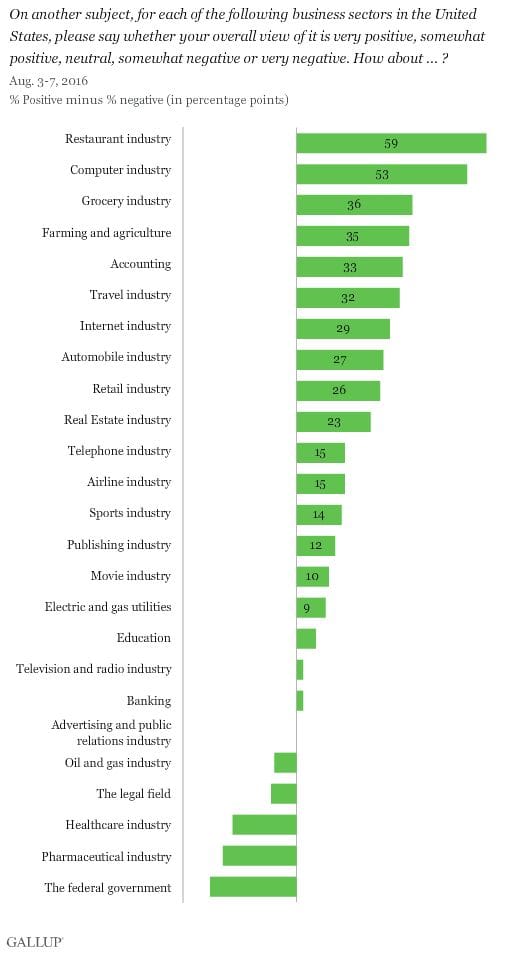
Advertising and public relations had an equal amount of positive and negative responses, and to bring up the very bottom of the list, the U.S. federal government fared worse in public opinion than the least popular industries: oil and gas, the legal field, the healthcare industry, the pharmaceutical industry, all sectors with a net negative perception among respondents.
In Gallup's analysis, the polling and public opinion company said one specific aspect of the federal government is responsible for an extraordinary amount of the negative perceptions of Washington: Congress.
"When we delve into it, we see that Americans are extraordinarily negative about one specific aspect of the federal government: their elected representatives in Congress." - Gallup
And interestingly enough, Gallup studies have found that the more Americans know about Congress, the more they dislike the nation's legislature and the role it's playing in society.
Voters clearly don't believe the legislative branch of government is functioning well at all. They believe that Congress is corrupt and does not actually represent the interests of the people.
Gallup also says that voters would be eager to completely change how Congress works altogether, writing in its analysis that, "Americans would clearly support efforts to reform or reinvent Congress and the way it works more than -- or as much as -- they might support big cuts in governmental departments and agencies."
From the mid-1970s until the late 1990s, congressional job approval hovered between a high of 40 percent and a low of 20 percent.
Congressional approval ratings enjoyed a historic swell starting in the Internet era boom and lasting through an all-time high during and after the 9-11 terrorist attacks.
That began to abate after the 2003 invasion of Iraq and the Great Recession, settling into an all-time low, often below 20 percent since 2009. This comes just as federal spending has reached astounding record highs in an era of massive appropriation bills written by special interest groups in secret and rushed to a vote without time for congressional representatives to even read them.
Yet voters who dislike Congress so much have the power to remove their representative every two years. If they expect to get a different result, they are going to have to start thinking about politics differently and voting differently as well.
The first step is discarding all the partisan claptrap and discerning the true nature of the candidates they vote on by looking at their actions, not listening to their promises.
Photo Credit: Drop of Light / shutterstock.com