Maine’s gubernatorial elections are familiar ground for independents. Just ask Angus King, two-time independent Maine governor and now independent U.S. Senator. This year’s race kept up with tradition. Independent Eliot Cutler ran once again after losing the last election by less than two percentage points to now Republican Governor Paul LePage.
While both candidates were also involved in this year’s race, this time Cutler finished a devastating 40 percentage points behind LePage. That’s a gargantuan margin if there ever was one, so you could hardly be blamed for thinking that Maine voters didn’t support Cutler.
But you’d be wrong.
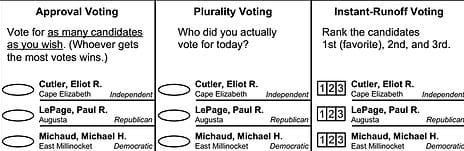
On Election Day, we had volunteers at polling places in Portland, Cape Elizabeth, South Portland, and Rockland. But we didn’t give voters the boring exit poll they were used to. Instead, we polled 689 voters using not only the regular choose-one method, but also approval voting where they could choose as many as they wanted, and instant runoff voting (a.k.a. ranked-choice voting) where they rank their choices. Each voter filled out all three ballots.
Our exit poll ballot looked like this:
So does it really matter if you change the way you express and calculate your vote?
Yes. It matters completely.
Our choose-one method is literally the least expressive you can get. Go ahead, try to think of a way to give less information while still casting a ballot … You can stop thinking now; it’s impossible. That's why this voting method’s crazy results have come to be expected. And that’s why we polled using other methods.
Because we were only able to poll from certain areas, our raw data didn’t match the election results. To correct this, we reweighted the ballots according to voters’ choose-one (plurality) ballots to that of the official election results. This is why our plurality voting numbers match the official outcome. (You can find our raw data at the end of the article.)
After we did the reweighting, here’s what we found from our poll:
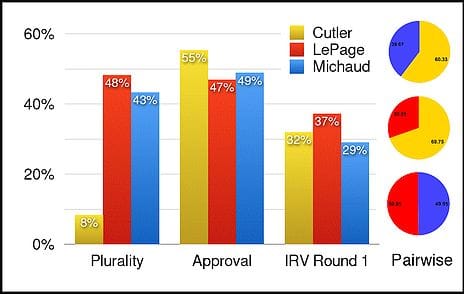
Notice anything about our choose-one method (plurality) compared to approval where voters can choose as many candidates as they want?
Cutler wins under approval! In fact, by using our ranking data we find that Cutler can beat both the Republican and the Democrat in a head-to-head election. IRV, even with its complex algorithm, managed to get this one right, too, with Cutler edging just ahead of LePage in IRV’s second round (transfers not shown for simplicity)—more on IRV here. (See footnote 1.)
Now how in the world can our choose-one voting method put a candidate at less than 10% when that same candidate is able to beat everyone in a head-to-head election?
There are two big reasons for this craziness:
1. Our choose-one method causes vote splitting. That is, because voters can only choose one candidate, the method divides support between similar candidates.
Normally, when we think of this happening, we think of a fringe candidate on the far left or far right. But Cutler was a moderate, and so he had Republican supporters taking votes from him on the right, AND he had Democratic supporters taking away votes from him on the left. Despite appealing to the most voters, this vote splitting effect destroyed Cutler’s reflected support. This type of vote splitting from the middle is called the "center squeeze effect."
2. Our choose-one method causes voters to fear wasting their vote. When a candidate appears to have little support, voters are less likely to support that candidate because voters want to have a say among the frontrunners. When this dismissed candidate is a voter's favorite, we call this "favorite betrayal."
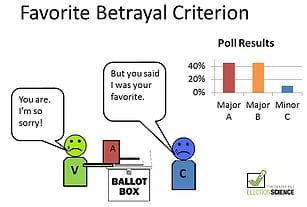
Poor Cutler was in this position. And because he looked more likely to cure cancer than win the election, it was difficult for voters to support him. Interestingly, voters were willing to support him when they thought the election was conducted under IRV.
Many voters may have thought they could vote their honest favorite under the IRV poll without realizing they could harm their later choices (unfortunately not always true). And so while we still encounter a vote splitting of first-choice rankings under our ranked ballots, we see the wasted-vote fear diminished. Without the wasted-vote fear, we get a better idea of what voters’ actual first-choice preferences were. You might think of the IRV first-round results as a traditional election had voters supported the one candidate they liked best.
We’ve said it time and again that our choose-one voting method (plurality) is the worst there is. This election is yet another example of why. We have vote splitting and people are afraid of choosing the candidate they actually want. Our voting method causes voters to literally refuse to select candidates they honestly like. Read that last sentence again. That’s absolutely crazy! How can anyone use a method where voters can’t choose their favorite candidates?
If you’re in Maine — and especially if your name happens to be Eliot Cutler — now is a good time to pay attention. We don’t take partisan sides here. Think of The Center for Election Science as the inspection engineer. Our current choose-one method fails inspection. Big time. And if you want to make it pass, you need to get rid of this awful, awful voting method. Fortunately, there’s approval voting, which addresses both the wasted vote fear and vote splitting. You can do a lot worse. You currently are.
Editor's note: This article was originally published by the Center for Election Science on November 13, 2014, and was edited for publication on IVN.
Image: WMTW

--------------------
(1) Using a bootstrap statistics analyzer, with our sample we can be 99.91% confident the approval winner is Cutler. Using the same analyzer, we can be 94.82% confident Cutler is also the IRV winner.
More detailed analysis by Warren D. Smith here.
Special thanks to our polling volunteers and analysis support!