 Shawn Griffiths

Momentum continues to build for broad systemic changes to how US citizens elect their public officials. Reforms like ranked choice voting and nonpartisan primaries are growing in popularity as voters look to solutions to make the political process fairer and voter-centric.
With 2020 near its end, political reformers are looking toward the future, and what proposals are working and what proposals need more attention. One proposal that is getting more attention from some reformers is proportional representation.
Benjamin Oestericher recently wrote for the national reform group FairVote that “studies of proportional and semi-proportional systems implemented in localities in the United States as well as other countries with more proportional systems consistently show that electoral systems without winner-take-all rules produce higher levels of both reflective and equitable representation.”
Right now, winner-takes-all defines most elections in the US -- something that sets the US apart from many other democratic methods throughout the world.
In the presidential election, for instance, a candidate doesn’t even need to get a majority of a state’s popular vote to take all of its electoral votes (in all states but Nebraska and Maine). In Congress, approximately 90% of seats are safe for one party or the other in any given election, which means a single party will always control nearly all seats.
The consequence? Right now the incentive for US policymakers is to serve the interests of their party over the interests of their constituents. Congress is plagued by partisan gridlock, efforts to push long-term solutions are marginalized, and whole communities across the country are left unrepresented.
Advocates of proportional representation argue that creating multi-seat congressional districts with proportional representation using an alternative voting method like ranked choice voting shifts the incentive structure to be more voter-focused and community-focused, because control is no longer with a single, private political organization
Here is how it works. Congress would have fewer districts, but the districts would be larger and would elect multiple representatives (the number of representatives elected should, in theory, be proportional to votes). Advocates of proportional representation argue that this eliminates gerrymandering and increases the voting power of individuals.
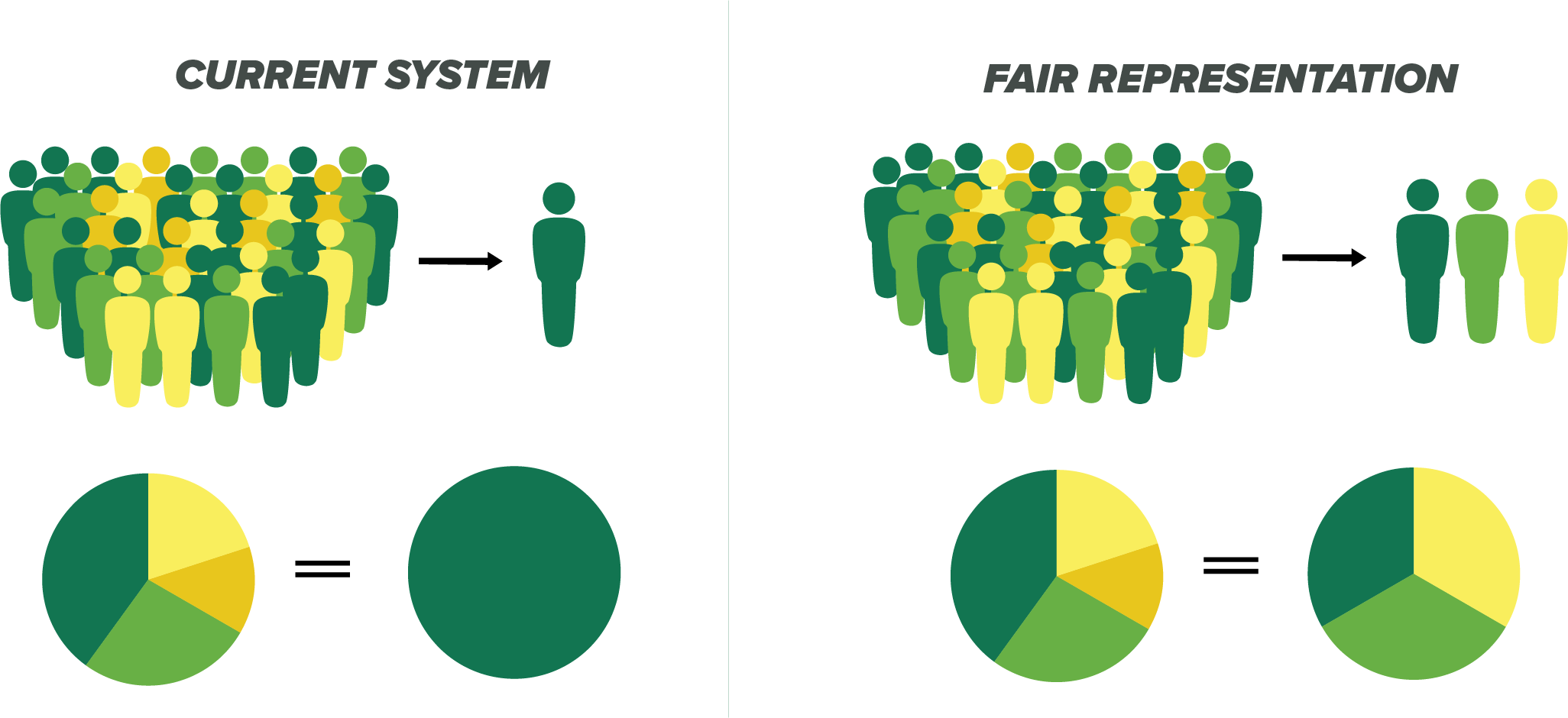
Oestericher, for instance, wrote about the benefits proportional representation could have on communities of color.
“FairVote’s simulation of House seats under the Fair Representation Act, whereby representatives would be elected in multi-member districts via ranked choice voting under a proportional system, shows that African Americans would see their number of House representatives increase by more than 25%, Hispanic Americans by more than 40%, and Asian Americans seeing a three-fold increase in representation,” he writes.
“You could travel from California across the southern United States and up through Maryland, with every part of every state having representatives who were the preferred choice of people of color.”
It also creates an incentive to compete for the most voters possible. If a party wants more seats, it has to earn them by broadening its appeal. Thus, candidates and parties would, in theory, start listening to voters outside their base and communities that feel marginalized by the current system.
Greater accountability to voters means policymakers have to actually accomplish work that meets the needs and concerns of Americans.
Under the current system, the shift of power goes back and forth between the Republican and Democratic Parties. Voters feel like their only option is to go to one party or the other in hopes they will be listened to, and are left disenchanted when policymakers put party interests first.
Voters should not have to go to the parties; The parties should have to go to them to thrive. Under a democratic process, the voters should be the ultimate authority and the purpose of elections should be to put their interests first. This is the goal of nonpartisan reform, and advocates of proportional representation assert it goes a long way to meeting this goal.