
The contested nature of the 2016 presidential race has increased interest among voters outside the Republican and Democratic parties. These voters find themselves attracted to candidates like Donald Trump and Bernie Sanders, who are running within the two-party system, but do not toe the line of the partisan establishment.
As voters become increasingly aware of an electoral system that is composed of election and campaign finance laws that favor two private political organizations, the independent movement has grown exponentially in the past few years. But it is not just in the U.S. The independent movement is on the rise in many countries where political parties have monopolized power, like Mexico.
Mexico has maintained a three-party system that has dominated the political scene for over seven decades. This establishment has ruled the country in a corrupt way, distancing themselves from the people who elected them, and ignoring their needs.
Even though Chapter IV, Article 35 of the Mexican Constitution gives the right to every citizen to vote and be voted for, independents couldn’t even run for office until recently, since candidates had to be affiliated with a party in order to be elected.
For U.S. citizens, this might sound familiar.
This changed in 2004, when Jorge Castañeda Gutman, former Minister of Foreign Affairs, started the process to register as an independent candidate for the 2006 presidential elections based on Article 35, but was denied the right to do so because only political parties had the right to register candidates for popular elections.
Castañeda sued the Mexican Government at the OAS (Inter-American Commission on Human Rights) and with that he opened the door for the independent movement.
Then in 2015, Jaime Rodriguez, better known as “El Bronco,” surprised Mexico by winning the governor's election in Nuevo Leon by a landslide, defeating the major parties with 48% of the total votes and becoming the first independent governor in the country.
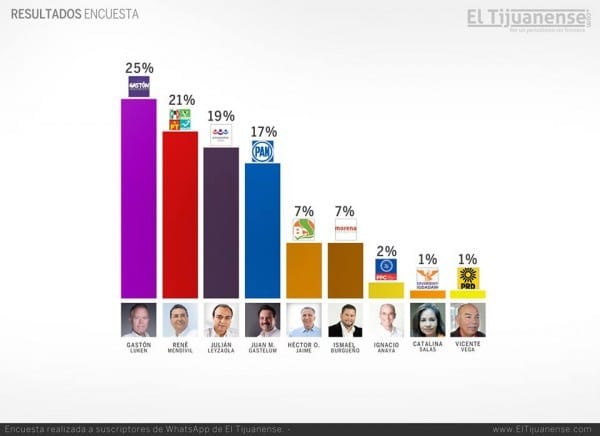
With less than a year in office, El Bronco has expressed his intentions to run in the 2018 presidential elections as an independent. A recent poll in Tijuana shows independent candidate for Mayor, Gaston Luken, in first place with 25% of the vote. Source: http://bit.ly/23SYwLt
It is not a coincidence that the independent movement is growing throughout the continent. People are tired of the establishment and are looking for a way out of the status quo. The major parties were established a long time ago when our countries had different needs, and many voters today are not feeling represented by any of their platforms.
Yet the political system gives more power to the parties than to voters themselves, so unaffiliated voters are often excluded from important stages in the election process. By comparison, we should consider how parties control elections, and the real effect this has on our idea of good government.
In the June midterm elections in Mexico, there will be a notable increase in the number of independent candidates in some of the governors’ races, especially in states like Quintana Roo, Veracruz, and Sinaloa. This is also occurring in races for mayor, particularly in border cities like Tijuana, Ciudad Juarez, and Ensenada.
These elections will have a clear impact on Mexico's presidential elections in 2018 and potentially open the path for an independent candidate and nonpartisan election reforms in Mexico that will give its independent voters more meaningful opportunity to participate.
As it stands today, Mexican election laws still make it extremely difficult for candidates and voters to participate in government without joining a political party. This is not dissimilar to the conditions right now in the U.S. presidential elections.
To follow the “independent revolution” in Mexico, you can check out independent Mexican candidates who are using Facebook to get out their message like: Gaston Luken for Tijuana, Chacho Barraza for Chihuahua and Alma Rosa Ollervides for Zacatecas.
And perhaps an independent revolution will manifest in the United States sometime soon.