
WASHINGTON, DC - The national debt increased by $1,271,158,167,126.72 for fiscal year 2018 according to the latest information published by the U.S. Treasury this month. (The U.S. federal government's fiscal– or budgetary– year begins and ends on October 1st, not at the end of the calendar year.)
Here's a graph of just how dramatically the national debt has grown since the 1970s:
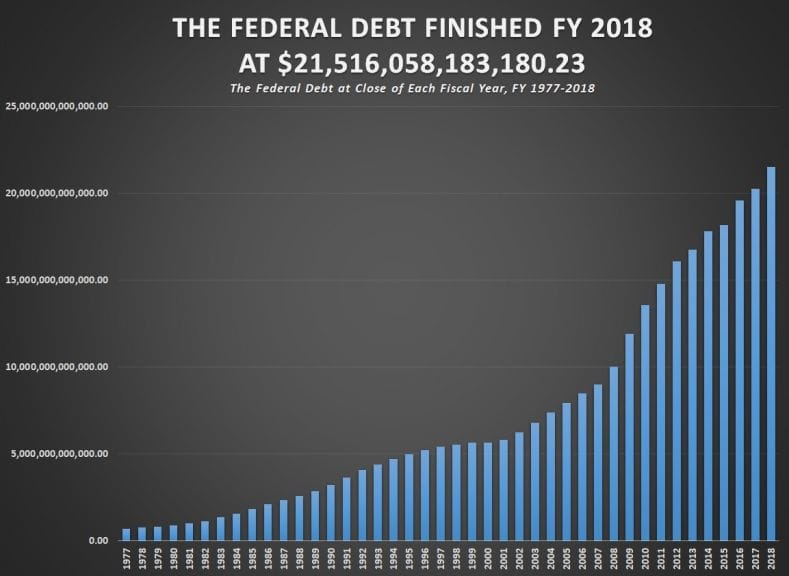
But I know that graph, and even the number 1.2 trillion are about as meaningful and important to you as they would be to a chimpanzee, your nearest relative in the Animal Kingdom.

Why People Are Usually Apathetic About National Debt Articles
The problem with discussing how massive the national debt has grown, and what a burden it places on the economy, is that your hunter gatherer brain (which made its first appearance in its present form some 200,000 years ago somewhere in or around what is modern day Ethiopia) is not at all designed for dealing with numbers so large. So multi-billion dollar pork barrel spending bills, and trillion dollar annual deficits sound really "big," but those numbers are ultimately completely meaningless to you.

It's not that you're not smart. You're very smart. But your brain is the end result of an iterative process defined by an environment in which numbers like a million never had to be reckoned with.
Much less a billion, or a trillion.
Numbers one through ten were meaningful and therefore important to your ancestors, but a million, a billion, or a trillion were numbers beyond any need of comprehension for them. Journalists might as well say the national debt has grown by a gajillion, zillion, fillion, gabillion like a six year old babbling made up -illion numbers.

An Illustration That Will Help You Wrap Your Monkey Brain Around A Number As Incomprehensible As A Trillion
So here's an illustration that will begin to give you some sense of the scale of debt that we're dealing with here:
A thousand minutes ago was yesterday or earlier today, depending on the hour you're reading this article.

It's hard to wrap our minds around what a million is, but saying it's a thousand thousands gives us some sense of it. Well at the time this article was published, a million minutes ago it was November 14, 2016. Donald Trump had just been elected president.
So pop quiz: What year was it a billion minutes ago?
No calculating it. Gut feeling. What do you reckon?
Remember a million minutes ago, it was 2016 and Donald Trump had just been elected president of the United States...

A billion minutes ago, it was the year 116 AD, the Bible didn't even exist yet, Roman Emperor Trajan had just completed his invasion of Parthia, and the Han Dynasty in China was dealing with a turbulent financial crisis (I guess history does repeat itself).

A trillion minutes ago, it was the year 1,900,569 BC, which is a silly way to say it, because we're now so far before human history, or even the advent of anatomically modern humans, that we're on the geological time scale, and scientists would say it was 1.9 ma ago (meaning mega annum, a million years). Cows had not even evolved yet, and Smilodon (saber tooth tiger) had just evolved .6 ma ago.

That's how much more a million is than a thousand, how much bigger a billion is than a million, and how unfathomably more vast a trillion is than a billion. Now convert that sense of scale from minutes to dollars. The United States government is burning through a trillion dollars each year on top of what it spends from tax revenues that set record volumes every year. All that money is borrowed, and Washington politicians are promising that you, your kids, and your grand kids will pay it all back.
That's why politicians kiss babies.
Because they know that's who's paying for all their bright ideas.
Photo Credit: Jennie Book / shutterstock.com