
Update 5/9/18: Issue 1 -- Ohio redistricting reform -- passed with three-fourths voter support, 74.9% voting "Yes."
Update 5/8/18, 8:57 PM ET: Election results in Ohio point to overwhelming victory for Issue 1, with no active opposition opposing the measure.
Ohio voters will go to the polls Tuesday for the state's primary elections. On top of voting for their preferred nominees for local, state, and federal elected offices, they will also have a chance to pass major redistricting reform.
It is likely the measure -- Issue 1 -- will pass as it has broad support across the two-party aisle and outside the Republican and Democratic Parties.
"This year is the big year generally for democracy reform, because we have never seen a map as active as 2018," says Josh Silver, director of Represent.us, a nonpartisan anti-corruption organization that has actively supported the measure. "We've got 5 states, including Ohio, that are likely moving forward with redistricting reform."
What Issue One Does
Issue 1, as it appears on the ballot, would amend the Ohio constitution to change how electoral district lines are drawn.
Under the proposed measure, the legislature would still draw the maps, but it would require three-fifths approval from lawmakers, including at least half the members of the two largest political parties.
However, there is a catch. If the legislature cannot agree on new maps, the matter will go before a redistricting commission made up of 7 people
- The governor;
- The auditor of state;
- The secretary of state;
- One person each appointed by the majority and minority party leaders in the State House (2 total); and
- One appointed by the party leaders in the State Senate (2 total).
At least 2 members of the minority party have to agree to any proposed redistricting changes.
But wait, there's more!
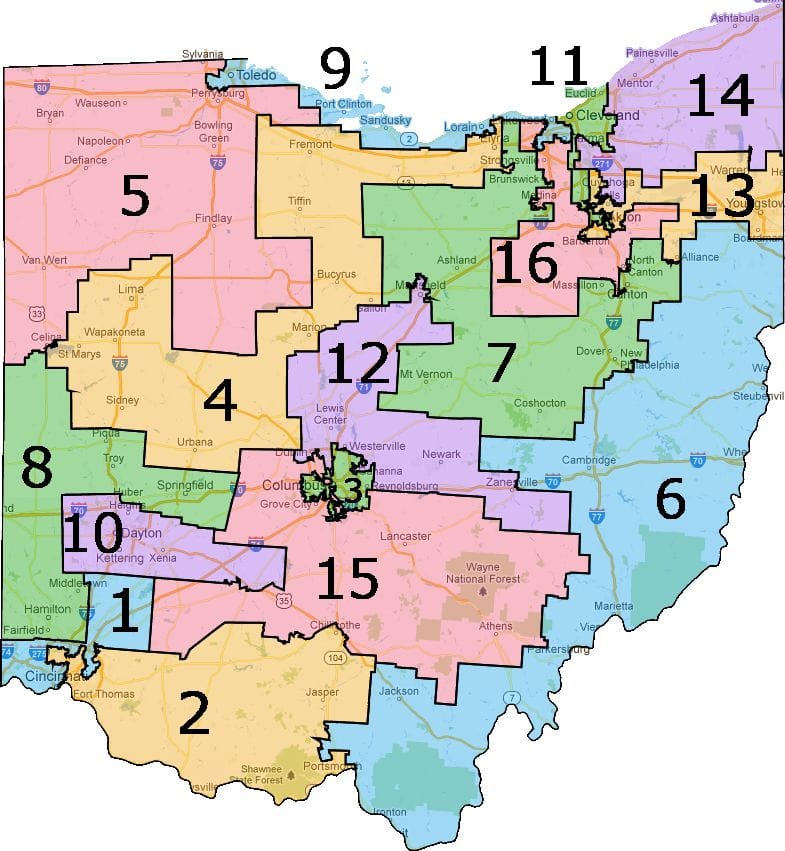
If the redistricting commission cannot agree on proposed changes, the matter goes back to the legislature, where again it must pass by a three-fifths majority. This time, however, it only needs at least one-third support from each major party to enact redistricting changes for 10 years.
Passing with a simple majority will put the redistricting change in effect for 4 years. Some new rules also kick in:
- Reasons for redrawing the district lines must be justified in writing;
- Counties must be kept whole as much as possible;
- And maps cannot be drawn with the explicit intent of favoring one party over another.
And there's one more thing! (Ok, not just one, but bear with me.)
The public can submit proposed redistricting plans, which require at least two public hearings. There are also a bunch of rules that limit how districts can be split up and require districts to be compact.
A Compromise to End Gerrymandering?
Issue 1 is certainly a little (maybe read a lot) more complicated than most reformers would probably prefer, but it has broad support across the political spectrum.
The measure has support from Gov. Kasich. It has Republican support. It has Democratic support. It also has support from nonpartisan groups and independent activists.
"It's the best kind of compromise gerrymandering reform model we have seen," says Josh Silver. "That is, it's got teeth, and while it's not perfect, it will certainly result in more competitive races around Ohio."
Represent.us is part of a nonpartisan coalition called the Fair Districts = Fair Elections Coalition, which collected more than 200,000 signatures in support of redistricting reform in Ohio. Other "member" organizations include Common Cause Ohio, The League of Women Voters of Ohio, and and many more.
Silver says the measure is also cause for optimism for the other 4 states that will take up partisan gerrymandering at the ballot box in 2018: Colorado, Michigan, Missouri, and Utah.
It also comes at a time when the US Supreme Court is taking up partisan gerrymandering cases out of Wisconsin and Maryland. Pennsylvania was also forced to redraw its congressional map after the court found it unconstitutional on the grounds of political discrimination.
"I think a big part of why gerrymandering is getting more popular is because it used to be viewed as a competition issue, which it is," says Silver. "But people are increasingly understanding that it is also directly related to the nauseating extremism that defines politics in 2018."
He added that public education is revealing the fact that when general elections are not competitive, extreme primary voters end up running the agenda. The only way to take control out of the hands of the extreme minority is to figure out how to make general elections competitive.