
Good news folks: by the end of the week, everybody you know will be an expert on the DC Circuit Court of Appeals. And people who have never been quite sure what appellate judges do are about to develop long and deeply held convictions about the distribution of judicial caseloads and the proper staffing of circuit courts. Everybody's completely non-political opinions on these matters will correspond with their party's immediate political interests, but this will be coincidental. We are all only interested in the facts.
And boy will we have the facts. Even as I write, nearly every media outlet in the country is preparing its talking points for tomorrow’s announcement that President Obama is submitting three nominations to the Senate at once to fill vacancies in the Court that have been open, respectively, since February of this year, since 2011, and since 2005 (when John Roberts was named to the Supreme Court). This will quickly become the major political news of the summer.`
The three nominees appear to be well qualified and unobjectionable. None are liberal firebrands, though they are all the sorts of judges that Democratic presidents nominate for things. Any one of them would probably have sailed through a normal nomination process. One of them—Judge Robert L. Wilkins—was confirmed by the Senate on a voice vote in 2010. Another—attorney Patricia Ann Millett—worked in the Solicitor General’s office under the first George Bush.
Normally, a single circuit court nomination—even to the DC Circuit—fails to make the media’s threshold for 24-hour coverage. But three of anything is a lot bigger than one, and three nominees for a powerful court—one that has traditionally leaned to the right—is going to be a genuinely big deal indeed. Expect the coverage on this to be somewhere between a Supreme Court nomination and a double Kardashian Wedding.
And battle lines have already been drawn. The GOP will probably not oppose the individual nominees on ideological grounds; rather, they will argue that the vacancies don't need to be filled because the DC Circuit circuit already has too many judges. This has been the Republican message for the past two weeks, as reports have circulated that the President intends to fill these positions. “I certainly hope,” said Senator Mike Lee (R-UT) in a clear preemptive strike, that “neither the White House nor my Democratic colleagues will . . . decide to play politics and seek—without any legitimate justification—to pack the D.C. Circuit Court with unneeded judges simply in order to advance a partisan agenda.”
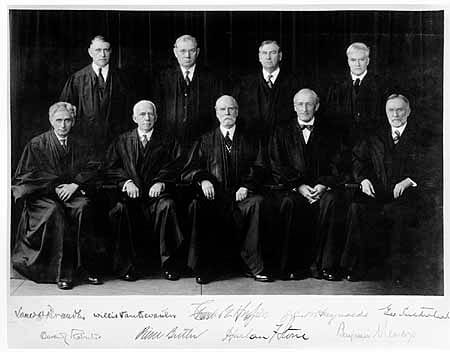
Some of Lee’s colleagues have been quick to point out that the term “pack the court”—commonly used to describe Franklin Roosevelt’s attempt to add seats to the Supreme Court in order to overcome votes against the New Deal—does not actually apply to nominations to fill vacancies in seats that already exist. What we are really talking about is not “packing the court” by the President, but a proposal for "unpacking the court” by Republicans in the Senate. Like Roosevelt, Senate Republicans want to alter the number of seats on a court in a way that (intentionally or otherwise) secures an immediate political advantage for the Republican Party.
There can be no doubt, however, that Lee is correct on one point: Obama and the Democrats are definitely "playing politics." But Lee and the Republicans are not apolitical auditors who have just discovered, after years of filling it with their own nominees, that, golly gee, the DC Circuit Court has more seats than it needs. They are playing politics too. Everybody is playing politics. They are politicians; it's what they do.
And that’s how it is supposed to be. As much as we might like to think that judicial appointments should be politics-free, they are not, and they never have been. Our Constitution sets up a fairly straightforward system in which those who win elections get to appoint judges. There were other ways to do it, but the Framers--many of whom actually saw "politics" as a noble pursuit--chose to make judicial appointments dependent on electoral success.
Elections, in other words, have consequences--which, it turns out, is kind of what democracy means to begin with.