Skip to content
Subscribe

With Rand Paul's Support, Kentucky Could Be Next for Medical Marijuana Legalization

With Rand Paul's Support, Kentucky Could Be Next for Medical Marijuana Legalization
Published:

Medical marijuana legalization is making its way through the Commonwealth of Kentucky's legislature with House Bill 166, which enjoys the support of both Republicans and Democrats in the Kentucky legislature, and would allow patients with certain conditions to consume the plant or products made from it.

HB 166 is also backed by Kentucky's Secretary of State Alison Grimes, one of the main officials behind the bill. According to Jaime Montalvo with Kentuckians for Medicinal Marijuana, health conditions that would qualify for medical marijuana treatment in Kentucky range from cancer to PTSD among many others.

While the bill enjoys bipartisan support in Frankfort and a strong endorsement from the Louisville Metro Council (which voted 20-4 to endorse legalizing medical marijuana in Kentucky), it stalled last week in the House Judiciary Committee which may take it up again later in the 2018 session, which ends mid-April.

In a statement Friday, U.S. Senator Rand Paul weighed in to endorse the bill to legalize medical marijuana in his home state:

"I believe decisions on how to regulate cannabis should be left to state governments. I support passage of HB 166. I believe that patients suffering from medical illness should have the right to try cannabis."

A Republican with a course-charting independent streak, Rand Paul challenges his party to remain true to the Constitution and the American spirit of individualism when it comes to civil liberties, while defying the president and congressional leadership to remain the most stalwart defender of the GOP's professed fiscal conservatism.

The Bluegrass State would be the 31st to legalize marijuana for medicinal or recreational purposes. Still it lags behind overall support for marijuana legalization for any purpose, which is presently at an all time high in America.

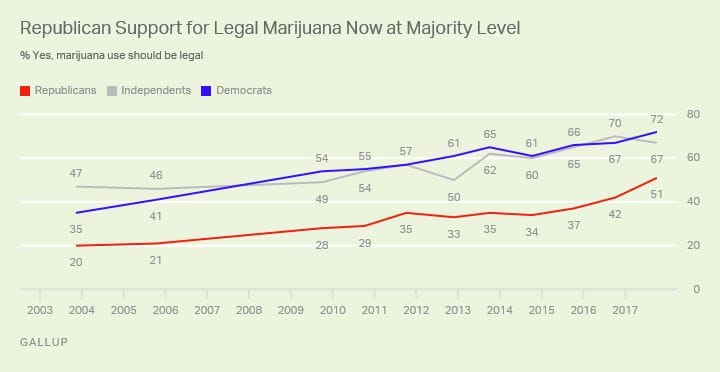
Two out of three independent voters support marijuana legalization, and the percentage of non-partisan voter support for legalizing marijuana has tracked closely with the relatively higher percentage of supporters among Democrats over the years since 2004, a year in which independents were far ahead of Democrats as well as Republicans in supporting marijuana legalization.

Although today a majority of voters in both parties and among the non-affiliated are in favor, with a majority of Republican voters– at 51 percent (up nine percent over 2016)– supporting marijuana legalization for the first time last year. (Source: Gallup)
Adhere to the IVN etiquette

By posting a comment, you agree to adhere to our etiquette rules: No partisan attacks, no personal attacks, substantiate your sources, no self-promotion.

Contact IVN

Questions about this article or our coverage? Send us a message. A free IVN member account is required.

Message sent

Thanks, we’ll review it and get back to you if needed.

Message not sent

Sorry, something went wrong. Please try again.

Sign in to send a message

Messages are tied to your IVN member account. Signing in is free and takes a few seconds.

Republish this article

Republishing guidelines

Republish IVN articles for free. Independent Voter News articles may be republished online or in print under a Creative Commons BY-NC-ND 4.0 license, on these terms:

  1. Credit the author and IVN. Keep the byline ("By Author Name, Independent Voter News") and the attribution note at the end, which links to the original.
  2. Keep the meaning. You may update time and place references and apply your house style. You may trim for length, as long as the cuts don't change the meaning or misrepresent the author. Keep the headline. Mark any additions as your own (for example "Additional reporting by ...").
  3. Translations are welcome. Translate faithfully, add "Translated from English by [your outlet]", and tell us at editor@ivn.us.
  4. Keep the links, including the link to the original article.
  5. Keep the tracking image. The HTML includes a 1-pixel image that counts readers on your page. It collects no personal information.
  6. Photos and illustrations. Images credited to IVN may be used with this article only. Images credited to others (AP, Getty, Unsplash, Wikimedia and so on) stay under their owners' terms. Secure the rights or switch "Include images" off.
  7. Don't sell it. You can't sell our articles or sell ads specifically against them. Your normal site advertising is fine.
  8. No implied endorsement. Don't suggest that IVN or the author endorses you, your candidates or your causes, or that donations to you support IVN.
  9. Keep labels. Opinion or analysis pieces keep that label.
  10. Point search engines to the original. Where your CMS allows, set the canonical URL to the original IVN article.
  11. No bulk or automated republishing, and don't submit our articles to aggregators (Apple News, Google News, MSN) as your own.
  12. Corrections and removals. Update your copy when we correct it, and remove it promptly if we ask. We'll contact you at the email you give us.
  13. Questions or print republication: editor@ivn.us.

IVN staff: fill in who you're inviting above, then create the invite.

Preparing the article

With Rand Paul's Support, Kentucky Could Be Next for Medical Marijuana Legalization

Choose a format
  • HTML
  • Email HTML
  • Markdown
  • Formatted (.docx)
  • Plain text
  • WordPress blocks
  • PDF
Choose a platform

Photos credited to others need their owners' permission.

To for

Republishing somewhere else? Questions? editor@ivn.us