Skip to content
Subscribe

How Does Ranked Choice Voting Work?

How Does Ranked Choice Voting Work?
Published:

"Ranked choice voting" is gaining momentum in cities and states across the country. The attention it has gotten in places like Maine -- which will be the first state to use it for statewide elections -- has raised its profile as a popular alternative voting method than what is currently used in most jurisdictions in the US.

This attention also has many unfamiliar with the election reform asking: How does ranked choice voting work?

How RCV Works

https://www.youtube.com/watch?v=DQYRZsbxGgE

Video Credit: The Chamberlain Project Foundation, "More Voice"

"RCV is straightforward for voters: rank candidates in order of choice. Voters can rank as many candidates as they want, without fear that ranking others will hurt the chances of their favorite candidate," says FairVote, a leading advocate for alternative voting methods like ranked choice voting.

"Every vote counts for its first choice. If a candidate has more than half of the vote based on first-choices, that candidate wins. If no candidate has more than half of those votes, then the candidate with the fewest first choices is eliminated. The voters who selected the defeated candidate as a first choice will then have their votes added to the totals of their next choice. This process continues until a candidate has more than half of the active votes or only two candidates remain."

It's easy. Just rank your choices. Then a system of automatic runoffs (if needed) takes care of the rest. Proponents say it cuts down on vote splitting concerns, and ensures the winner of an election has majority support. It also eliminates the need for additional runoff elections, saving taxpayers additional time and money.
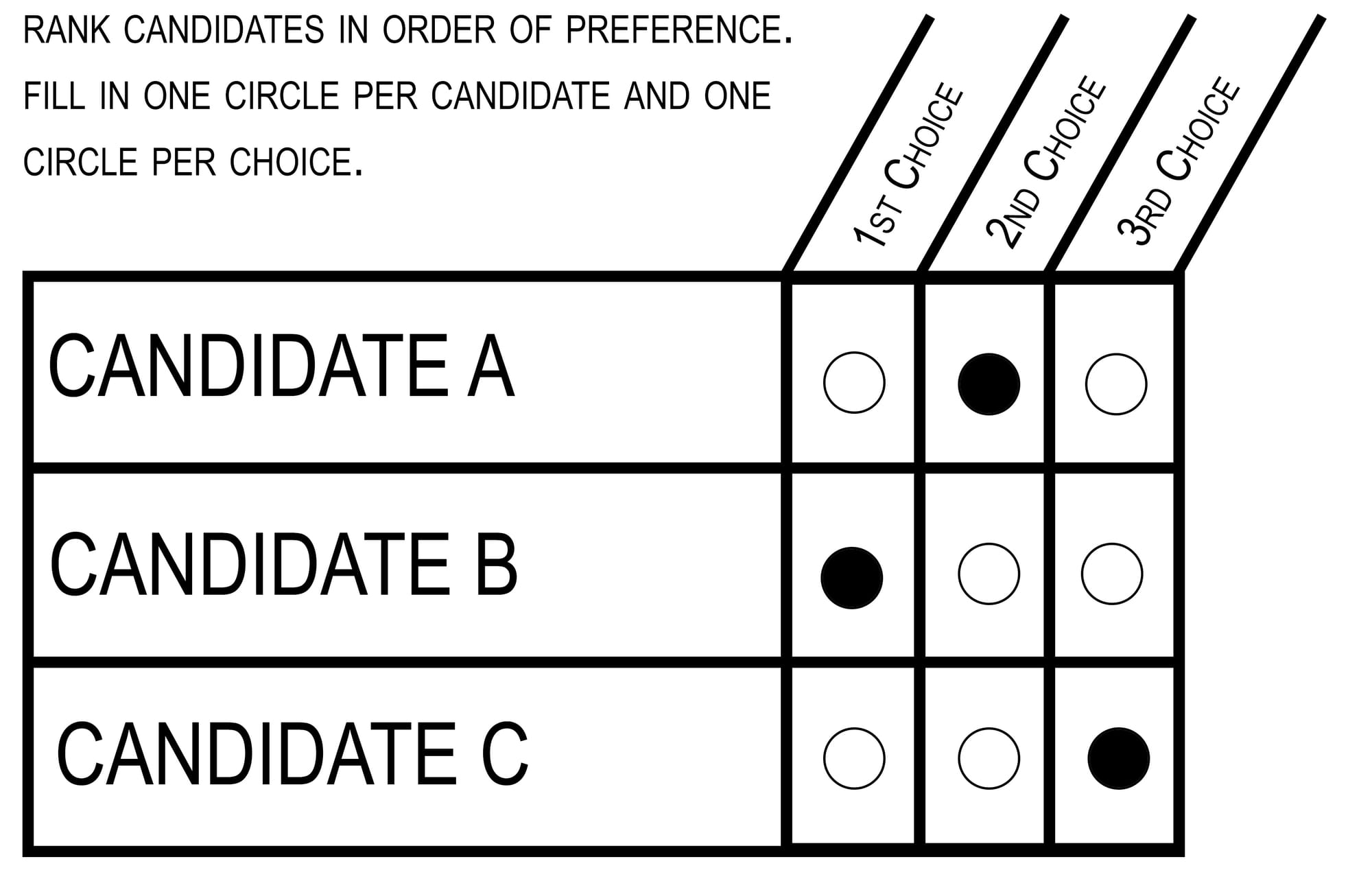
In 2018, for the first time in history, ranked choice voting will be used in statewide and congressional races in Maine, where Gov. Paul LePage won election in 2010 with 37.6 percent of the vote.

This means nearly two-thirds of voters voted for someone else in that election. LePage also won re-election in 2014 with less-than-majority support.

Most jurisdictions use the same choose-one voting method Maine used for these elections and others prior to 2018, which can often result in the winner being picked by a minority of voters.

Yet the popularity of ranked choice voting is spreading.

Where RCV Is Used

Ranked choice voting is used in mostly local municipalities like San Francisco, Oakland, Minneapolis, Cambridge, and 8 more, according to FairVote.

RCV is also used for overseas and military voting in states like Alabama, Arkansas, Illinois, Louisiana, Mississippi, and South Carolina. And it is used by various political parties, companies, and organizations for internal elections.

In 2016, Maine became the first state in the US to approve ranked choice voting's use in statewide and congressional races. After several battles in the legislature and in court, ranked choice voting will be used in the June 12 primary elections.

Get More Information

You can get more information about ranked choice voting, its uses, and why proponents say it is necessary reform by visiting FairVote's in-depth breakdown and analysis here.

Adhere to the IVN etiquette

By posting a comment, you agree to adhere to our etiquette rules: No partisan attacks, no personal attacks, substantiate your sources, no self-promotion.

Contact IVN

Questions about this article or our coverage? Send us a message. A free IVN member account is required.

Message sent

Thanks, we’ll review it and get back to you if needed.

Message not sent

Sorry, something went wrong. Please try again.

Sign in to send a message

Messages are tied to your IVN member account. Signing in is free and takes a few seconds.

Republish this article

Republishing guidelines

Republish IVN articles for free. Independent Voter News articles may be republished online or in print under a Creative Commons BY-NC-ND 4.0 license, on these terms:

  1. Credit the author and IVN. Keep the byline ("By Author Name, Independent Voter News") and the attribution note at the end, which links to the original.
  2. Keep the meaning. You may update time and place references and apply your house style. You may trim for length, as long as the cuts don't change the meaning or misrepresent the author. Keep the headline. Mark any additions as your own (for example "Additional reporting by ...").
  3. Translations are welcome. Translate faithfully, add "Translated from English by [your outlet]", and tell us at editor@ivn.us.
  4. Keep the links, including the link to the original article.
  5. Keep the tracking image. The HTML includes a 1-pixel image that counts readers on your page. It collects no personal information.
  6. Photos and illustrations. Images credited to IVN may be used with this article only. Images credited to others (AP, Getty, Unsplash, Wikimedia and so on) stay under their owners' terms. Secure the rights or switch "Include images" off.
  7. Don't sell it. You can't sell our articles or sell ads specifically against them. Your normal site advertising is fine.
  8. No implied endorsement. Don't suggest that IVN or the author endorses you, your candidates or your causes, or that donations to you support IVN.
  9. Keep labels. Opinion or analysis pieces keep that label.
  10. Point search engines to the original. Where your CMS allows, set the canonical URL to the original IVN article.
  11. No bulk or automated republishing, and don't submit our articles to aggregators (Apple News, Google News, MSN) as your own.
  12. Corrections and removals. Update your copy when we correct it, and remove it promptly if we ask. We'll contact you at the email you give us.
  13. Questions or print republication: editor@ivn.us.

IVN staff: fill in who you're inviting above, then create the invite.

Preparing the article

How Does Ranked Choice Voting Work?

Choose a format
  • HTML
  • Email HTML
  • Markdown
  • Formatted (.docx)
  • Plain text
  • WordPress blocks
  • PDF
Choose a platform

Photos credited to others need their owners' permission.

To for

Republishing somewhere else? Questions? editor@ivn.us