
I. The State of Self-Driving Car Technology and The Possibilities
In the 1990 film, Total Recall (starring Arnold Schwarzenegger and Sharon Stone), the protagonist played by the now former governor of California hails a self-driving car with a humanoid, robotic attendant sitting where a human driver would.
What makes the surreal scene eerily prophetic is how Schwarzenegger asks the AI cab driver questions like one might ask Alexa, Siri, or Google's voice assistant, and the "Johnny Cab" sasses him and cracks jokes just like Siri might do.
Well, as real history unfolded, it turns out search giant Google (now owned by parent company Alphabet Inc.) and hardware/software empire Apple Inc. have both developed fully autonomous vehicles that are capable of watching the road with more senses than a human driver has, making better judgments, and reacting faster.
Electric carmaker Tesla is also at the vanguard of the driverless car revolution, and the ride-sharing app company Uber is very interested in a fleet of self-driving cabs to save itself and its customers some money. You can bet long haul freight companies are watching closely as the technology gets ready for the market.
Experts predict a sharp decline in the number of automobile accidents as self-driving cars become the norm on America's roads. This is a welcome development, because in 2016, the most recent year for which the statistics are available from the National Highway Traffic Safety Administration (NHTSA), over 37,000 people died in automobile accidents in the United States.
To put it in perspective, approximately the same number of people who died in the 9/11 terrorist attacks have died every single month for decades in the United States from automobile accidents alone. If AI driven cars can prevent most of these collisions, in just two years this technology could save more lives than America lost in the Vietnam War.
II. State and Federal Policy for Autonomous Motor Vehicles (2018)
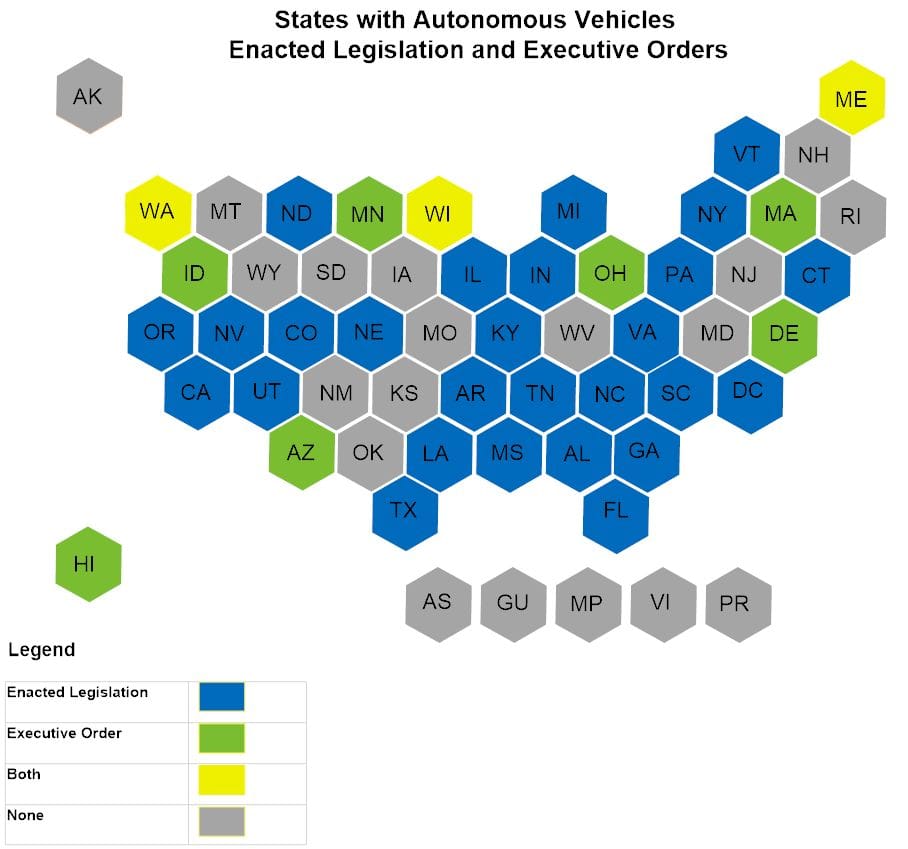
The National Conference of State Legislatures has an autonomous vehicles legislative database for keeping up with current state policies for driverless cars around the country.
According to the NCSL, Nevada was the first state to legalize self-driving cars on public roads back in 2011, when the technology was already fit enough for a state to take this bold legislative step, and that was nearly a decade of technological progress ago. California and Florida legalized autonomous vehicles on public roads in 2012.
Since then, 19 other states, including Alabama, Arkansas, Colorado, Connecticut, Georgia, Illinois, Indiana, Louisiana, Michigan, New York, North Carolina, North Dakota, Pennsylvania, South Carolina, Tennessee, Texas, Utah, Virginia, and Vermont– and Washington D.C. –have passed legislation to legalize or begin the process of legalizing the operation of autonomous vehicles on public roadways.
Over that time, governors in Arizona, Delaware, Hawaii, Idaho, Maine, Massachusetts, Minnesota, Ohio, Washington, and Wisconsin have issued executive orders to do the same.
The federal government caught up with the states last year, with H.R. 3388, the SELF DRIVE Act of 2017, which legalizes self-driving cars nationwide at the federal level, and requires states to adopt standards "regarding the design, construction, or performance of highly automated vehicles or automated driving systems" that are compliant with federal standards.
III. Privacy and Self-Driving Cars
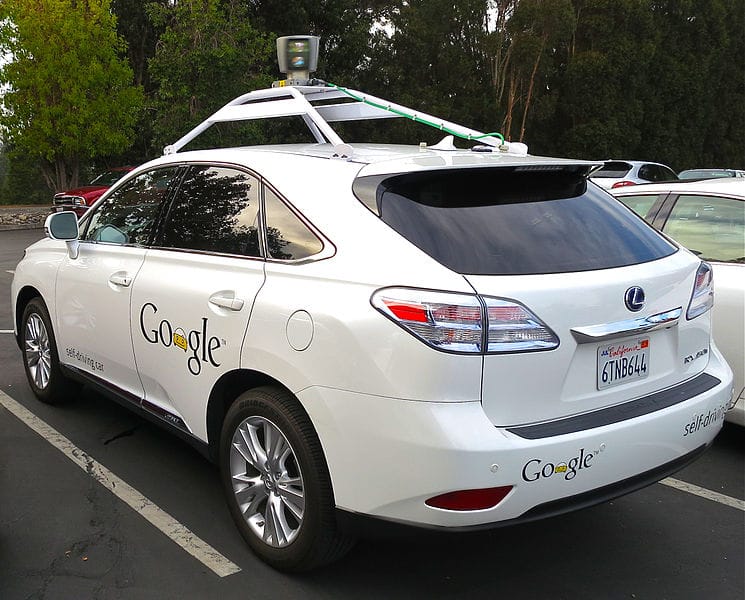
Along with the merciful benefits of saving thousands of lives every year, there will be a cost to society as individuals increasingly give up more of their data to the tech giants leading the AI revolution.
An article in the Atlantic titled, "How Self-Driving Cars Will Threaten Privacy," warned in March 2016 that, "Automated vehicles will learn everything about you—and influence your behavior in ways you might not even realize."
So as it turns out, the relentless barrage of advertisements in our flourishing digital society may be coming to an autonomous vehicle near you. Think "Sponsored Destinations."
Perhaps more ominous than companies trying to figure out how to advertise to you even more from your use of an automated car, is the potential threat from hackers and even government actors illegally collecting your private data (like where you live, where you go, and where you spend most of your time based on GPS data from your car) without your consent.
Many of the recommendations out there for federal regulation of privacy concerns related to self-driving vehicles (like in this short Tufts University paper on the subject) focus on setting federal standards for security protocols used by autonomous car companies. We can be sure to trust that the engineers responsible for these projects as well as the market incentives for corporate oversight will produce robust security solutions, but we can also be sure that hackers will relentlessly find a way.
In order for the federal government to have any credibility when it comes to protecting Americans' privacy (or even living up to the guarantees in its own charter document, the U.S. Constitution), it will first have to show that it is capable of regulating and restraining itself, and doing its own part to respect its citizens' digital privacy.
Once secret, the NSA mass surveillance programs disclosed by whistle blower Edward Snowden in 2013 continue to spy on Americans' Internet and phone use, now openly and with explicit permission from Congress. When self-driving cars inevitably reshape our entire physical and digital infrastructure, will the National Security Agency still be spying on Americans?
And now that federal police agencies like the FBI have been politicized and weaponized for partisan slugging matches between political groups, will we be able to withstand the relentless surveillance of an increasingly partisan police state or will glittering prizes and endless compromises shatter the illusion of integrity?