
Ever heard of a primary election? That's where voters nominate candidates for the general election, right?
Well in San Diego County, that's just not so.
Did you know San Diego County elections contain a little known loophole called the "50%+1 rule" whereby a candidate who receives a majority of the vote in a low-turnout primary wins the election, outright. So, voters who show up in the November general election? Well, they're late to the party. The election was decided months before by the voters who participated in June.
If this sounds familiar it should, last election, voters in the City of San Diego removed this loophole by passing the Independent Voter Project authored Measure K. The measure passed by a wide margin, and now, all city elections must be decided when the most voters participate ... the November general election.
But the old loophole still applies to San Diego County elections.
So what's this got to do with voting rights?
SUPREME COURT RULING
First, as the Supreme Court held about 20 years ago, calling an election that can be decided before the general election a "primary" doesn't make it so. Granted, this case was decided on federal grounds, but the rationale remains the same.
How could San Diego County hold a "primary" election in June, tell its voters that it's a primary election, and then declare a winner long before the "general" election occurs? At the very least, the County of San Diego should do some voter education.
While the 50%+1 rule may seem rational on its surface, its disparate effect on insulating the establishment from competition is well known to political insiders. A quick glance of voter turnout statistics for a non-presidential gubernatorial primary had turnout at just 27%, with asian voter turnout near 10% and latino turnout not much higher. In other words, primary election outcomes are more severe for minority voters who turnout in MUCH higher proportions during the general election.
Just consider this from the Public Policy Institute of California, "Whites make up only 43% of California’s adult population but 61% of the state’s likely voters. In contrast, Latinos comprise 34% of the adult population but just 18% of likely voters. Asian Americans make up 15% of the population and 12% of likely voters, while 6% of both the population and likely voters are African American."
DISTRICT ATTORNEY RACE
So what is the effect of the "50%+1" loophole in a two woman race for San Diego County's next District Attorney? Because there are only two candidates it is guaranteed that one will get a majority and general election voters will be left out of the voting process altogether.
What makes this even more interesting is that one of the candidates is an African American woman, Geneviéve Jones-Wright. Think her candidacy might be negatively impacted by an election process that stops the election before African Americans really start paying attention?
FEDERAL VOTING RIGHTS CLAIM
The federal Voting Rights Act prohibits state and local governments from conducting elections in any way that has a "disparate impact" on a protected class of voters.
Someone bringing a Voting Rights Act claim at the federal level has to show an election procedure was designed with the intent to diminish the impact of a protected class.
But this is California. We like to push the envelope.
In 2001, the California Voting Rights Act eliminated the need to prove intent. Impact alone is enough to prove the violation.
From Section 14041:
(d) Proof of an intent on the part of the voters or elected officials to discriminate against a protected class is not required.
The District Attorney is a powerful position. They are in charge of enforcing both criminal AND civil law. It is unlikely that the unelected incumbent, Summer Stephan, would enforce the civil rights act in this case. But maybe the minority candidate that wants her job would see the self-interest ... at the very least.
Update: To clarify the point being made about the disparate impact primary elections have vs. general elections on minority communities look at the video and table below. The Primary turnout, particularly for African Americans, latinos, and asian voters is significantly less than the turnout for November General elections relative to white voters.
While voter turnout among the general electorate usually increases about 80 - 100% for the November general election compared to the June primary, the difference in turnout among minorities is particularly telling with respect to the disparate impact the 50%+1 rule has on minorities.
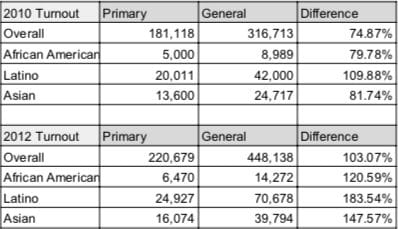
This was a key point that was made in the successful campaign to get rid of the 50%+1 loophole in the City: