
The severe collapse in the economy did not result from the typical business-cycle, overheated and bubble-bursting downturn. The contraction of business activity, unprecedented in both depth and velocity inflicted during U.S. history, was brought on by government decree imposing economic marital law, forbidding normal consumer activity, and shuttering business operations.
Labeled the “Great Suppression” by some, the rationale for shutting down the economy was to “flatten the curve,” ration scarce medical supplies, and extend the novel coronavirus impact to allow a more measured and orderly response. Whether the intensity of shutdown was entirely necessary or could have been less severely imposed, or fallout from the pandemic would have been even worse if not shutting down, is open for debate, but the effects on the economy are unmistakable.
Business bankruptcies and joblessness, other deaths and morbidity, trillions added to U.S. Treasury debt, and tightening grip by the government happened with unparalleled proportion. According to monitors of economic action, the U.S. Bureau of Economic Analysis reports Gross Domestic Product fell by an annualized rate of 32.9 percent in the second quarter of 2020.
In San Diego, when the region would normally add jobs in March, April and May, the region lost 230,000 — 15.2 percent of the 1.5 million labor force working at the time. By June and July, 68,500 jobs were added back, under other circumstances, an extraordinary number of job gains for just two months.
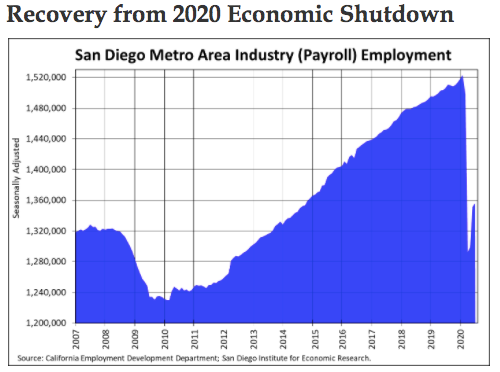
Several sectors of San Diego’s economy were impacted far worse than others. Generally, consumer service sectors absorbed the greatest losses. Several categories of retail businesses, other than grocery stores, lost significant proportions of their jobs, including clothing stores losing two-thirds of their workers. Leisure and hospitality sectors — an important segment of San Diego’s economy — absorbed the greatest number of job losses. Entertainment and recreation lost 62 percent of their jobs at a time they would normally be gearing up for the critical summer tourism season. Accommodations similarly lost 60 percent of their workforce, instead of normally adding jobs. Restaurants and drinking places also lost a third of their workers. While each of these sectors report some job gains in the past two months, they are still far from recovery and forever lost out on the critical summer season.
Traditional business cycle theory does not explain the downturn from malinvestments needing to be mended. Neither is the recovery to be produced under ordinary investment or redeveloping circumstances. Business operations do not need to be reoriented so much as need to be unleashed for normal operations.
As deep and devastating as the recession has been, the overall effects could be relatively short-lived so long as the government withdraws the iron fist over business operations. The longer the shutdown persists, however, the greater and enduring effects will leave greater obstacles to be overcome and more tenuous for businesses to recover and resume pre-pandemic levels of operation.
The recovery will not be quite V-shaped as GDP growth will not as easily reverse the rapid decline. For one thing, many marginal businesses and their jobs have been permanently destroyed. It will take considerable effort for many businesses to reassemble in a post-pandemic environment. Another impediment comes from supplementing weekly unemployment insurance with checks larger than earned while working, making it difficult for many businesses to lure workers back.
The unemployment rate will likely stay in double-digits until the end of the year. It may not be until the first quarter of 2021 that real GDP matches the level of the fourth quarter 2019, technically ending the recovery phase. This is the first-ever recovery from a pervasive government-imposed pandemic shutdown making resumption for normal business operations tenuous at best.