Skip to content
Subscribe

Supreme Court Rules in PA Gerrymandering Case

Supreme Court Rules in PA Gerrymandering Case
Published:

https://www.youtube.com/watch?v=WRqyYokJ97c

Video Source: CBS News

The Supreme Court turned down a request by Republican state lawmakers Monday to prevent Pennsylvania’s new congressional map from being used.

The decision further upholds the Pennsylvania Supreme Court's ruling in January that the former congressional map was unconstitutional and constituted a partisan gerrymander. The court also ordered the state legislature to redraw the map by February 9 -- which it managed to do in the eleventh hour.

Now, Pennsylvania will have a new congressional map for the general election, which will have major implications on elections in the state.

Americans... And Maps: A Geography Lesson

The State Supreme Court says the political majority in the Pennsylvania Legislature packed opponents into as few districts as possible, then spread others across districts as thinly as possible to prevent them from overtaking the majority there.

The strategy is often referred to as "packing and cracking," and can produce some oddly shaped districts.

Take the 18th Congressional District, where Democrat Conor Lamb recently won a special election for a seat he will no longer represent. The old district kind of looks like a lower case "r," doesn't it?
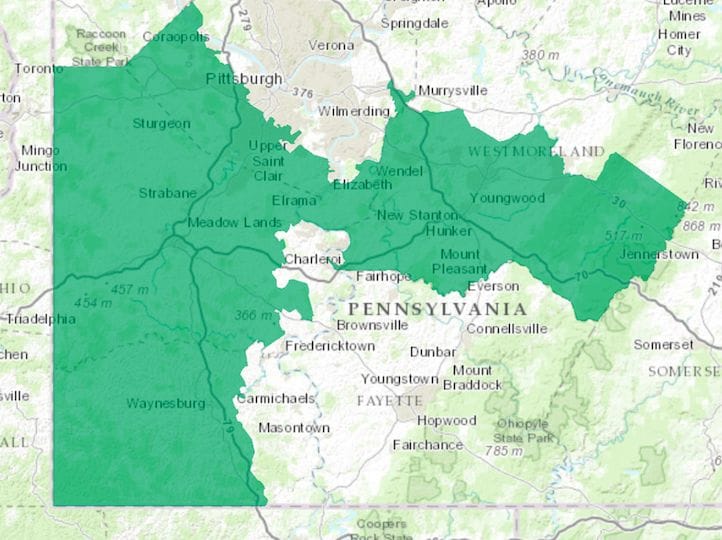
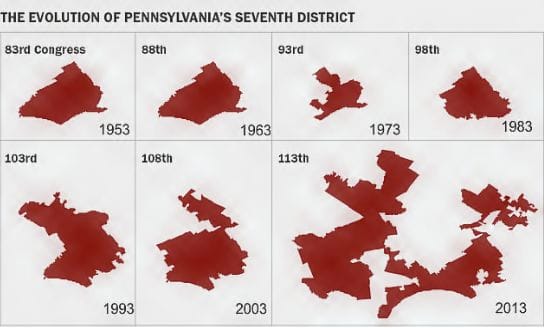
That is not even the weirdest one. Check out the old 7th Congressional District, which was colloquially known as "Goofy Kicking Donald Duck," and was held together in one area by -- I kid you not -- a seafood restaurant. Here is how it evolved since the 1950s:
Of course, this isn’t the only case of partisan gerrymandering nor is it solely a Republican problem. Partisan gerrymandering is a two-party scheme.

On March 28, the Supreme Court will hear oral argument in a case against Maryland's congressional map, which was drawn by the Democratic majority in the legislature. In this case, U.S. District Court Judge James K. Bredar said partisan gerrymandering was "a cancer on our democracy."

We are still waiting on a Supreme Court decision in Gill v. Whitford, the first case in which a federal court ruled electoral maps unconstitutional not on the grounds of racial or socioeconomic discrimination -- but political discrimination. The decision could have a major impact on gerrymandering nationwide and future cases.

As for Pennsylvania, time will tell how the new maps will work out. It is clear though that voters want an end to the partisan games.

Adhere to the IVN etiquette

By posting a comment, you agree to adhere to our etiquette rules: No partisan attacks, no personal attacks, substantiate your sources, no self-promotion.

Contact IVN

Questions about this article or our coverage? Send us a message. A free IVN member account is required.

Message sent

Thanks, we’ll review it and get back to you if needed.

Message not sent

Sorry, something went wrong. Please try again.

Sign in to send a message

Messages are tied to your IVN member account. Signing in is free and takes a few seconds.

Republish this article

Republishing guidelines

Republish IVN articles for free. Independent Voter News articles may be republished online or in print under a Creative Commons BY-NC-ND 4.0 license, on these terms:

  1. Credit the author and IVN. Keep the byline ("By Author Name, Independent Voter News") and the attribution note at the end, which links to the original.
  2. Keep the meaning. You may update time and place references and apply your house style. You may trim for length, as long as the cuts don't change the meaning or misrepresent the author. Keep the headline. Mark any additions as your own (for example "Additional reporting by ...").
  3. Translations are welcome. Translate faithfully, add "Translated from English by [your outlet]", and tell us at editor@ivn.us.
  4. Keep the links, including the link to the original article.
  5. Keep the tracking image. The HTML includes a 1-pixel image that counts readers on your page. It collects no personal information.
  6. Photos and illustrations. Images credited to IVN may be used with this article only. Images credited to others (AP, Getty, Unsplash, Wikimedia and so on) stay under their owners' terms. Secure the rights or switch "Include images" off.
  7. Don't sell it. You can't sell our articles or sell ads specifically against them. Your normal site advertising is fine.
  8. No implied endorsement. Don't suggest that IVN or the author endorses you, your candidates or your causes, or that donations to you support IVN.
  9. Keep labels. Opinion or analysis pieces keep that label.
  10. Point search engines to the original. Where your CMS allows, set the canonical URL to the original IVN article.
  11. No bulk or automated republishing, and don't submit our articles to aggregators (Apple News, Google News, MSN) as your own.
  12. Corrections and removals. Update your copy when we correct it, and remove it promptly if we ask. We'll contact you at the email you give us.
  13. Questions or print republication: editor@ivn.us.
Preparing the article

Supreme Court Rules in PA Gerrymandering Case

Choose a format
  • HTML
  • Email HTML
  • Markdown
  • Formatted (.docx)
  • Plain text
  • WordPress blocks
  • PDF
Choose a platform

Photos credited to others need their owners' permission.

Republishing somewhere else? Questions? editor@ivn.us