
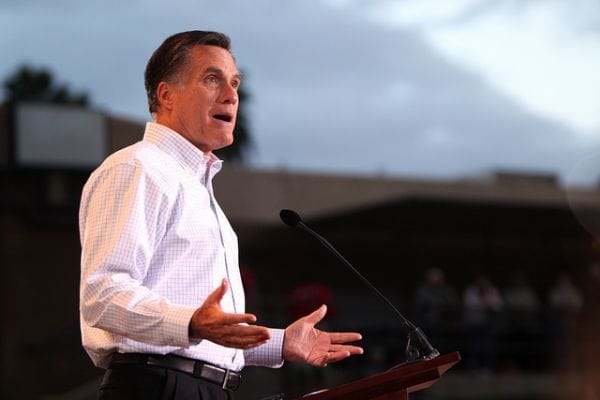
Photo: Gage Skidmore
"The Conservative Case Against Mitt Romney" may seem like an odd title. Isn't making a conservative case against Mitt Romney the equivalent of squaring the circle?
The foremost liability against Romney is his untrustworthiness. As the Bible says in 1 Timothy 6:10, "For the love of money is a root of all kinds of evil." It is out of this singular trait that flow many of the reasons conservatives should not support the former Massachusetts governor. Each of these liabilities can be broken into simple conservative principles: restraint in foreign policy, personal responsibility, privatization of loss, and the preservation of life.
Proposing that Romney may have a Nixonian "secret economic plan," Bloomberg columnist Josh Barro suggests that Romney doesn't really believe his own rhetoric because "His ideological positions are entirely flexible and his capacity for pandering enormous." Therefore, "to increase his chances of getting elected, he will have to implement policies" conducive to achieving that and it's unlikely "he'll actually invade somewhere (a war doesn't seem like the kind of project Romney would enjoy overseeing)."
Romney's guiding interest is indeed his own self-preservation, but part of that self-preservation includes placating the most hawkish elements of his party. Columnist Pat Buchanan recently wrote, "Usually, not always, the peace party wins." If Romney wanted to implement policies to cater to the American public -- and in the foreign policy debate he was careful not to out-hawk Obama -- Bush administration advisors from Eric Edelman to Mitchell Reiss and Dan Senor would not be a part of his foreign policy team.
Romney may be disinclined to launch an Iraq-style war, because he wouldn't enjoy overseeing it, but there is little evidence that he thinks wars like those in Iraq were a mistake. However, without any guiding principles he is also apt to be manipulated by his advisors, and even if he was not drawn to Iraq-style wars, he willingly surrounded himself with the type of Republicans who supported that policy. Suggesting that Romney can't possibly believe his own rhetoric and that he's only posing as a hawk's hawk turns a propensity to lie into a virtue.
One of the more contentious issues during the Obama term has been the Affordable Care Act (ACA), colloquially known as "ObamaCare." Jonathan Gruber, a professor at MIT who worked on both the Massachusetts health care law and the ACA admitted to MSNBC's Lawrence O'Donnell:
"It's the same basic structure applied nationally. John McDonough, one of the other advisors, who work in both Massachusetts and advised the White House said 'it's the Massachusetts with three more zeroes.' And that's basically a good description of what the federal bill did."
At the first debate against President Obama, Romney mentioned the differences between the plan enacted in Massachusetts versus the plan that became the ACA, but they tended to be cosmetic: "We had Democrats and Republicans come together." "We didn't cut from Medicare," because "we don't have Medicare, but we didn't cut Medicare by $716 billion."
This liability was not enough to derail Romney's path to the nomination, but a Romney presidency also spells the likely solidification of the ACA. While he previously supported complete repeal, during the general election Romney has said he would "replace ObamaCare with my own plan" and reminded viewers that "Even in Massachusetts . . . our plan there deals with pre-existing conditions." Romney did not mention whether he sought repeal of the individual mandate in the ACA, the lynchpin Chief Justice John Roberts upheld, but Romney's Massachusetts plan included the same controversial measure of which the governor said at the time that he was "very pleased."
Votes for the Troubled Asset Relief Program (TARP) were a bridge too far for several veteran Republican lawmakers. Bob Bennett of Utah, Richard Lugar of Indiana, and Lisa Murkowski of Alaska all earned and lost primary challenges in part because they each voted for this unpopular legislation. Although not holding office at the time, Romney voice support for TARP saying it was the "right thing to do."
On other bailouts, Detroit's auto industry, Romney was on the same side as the bank bailouts, but he was coyer. While advocating public funds for Detroit, the perception that Romney would "let Detroit go bankrupt" grew out of a 2008 New York Times op-ed of the same title. There he wrote:
"Detroit needs a turnaround, not a check. . . . A managed bankruptcy may be the only path to the fundamental restructuring the industry needs. . . . The federal government should provide guarantees for post-bankruptcy financing and assure car buyers that their warranties are not at risk."In a managed bankruptcy, the federal government would propel newly competitive and viable automakers, rather than seal their fate with a bailout check."
Perhaps expecting the title the Times gave the op-ed would be enough to condemn Romney as heartlessly letting his hometown of Detroit fail, President Obama used this line of attack on Romney, but this was not Romney's plan. Romney's plan was to allow managerial restructuring during bankruptcy before receiving funds from the federal government.
In fact, the managed bankruptcy Romney advocated was very much what the Obama administration eventually implemented in 2009. By mid-year, General Motors emerged from Chapter 11 bankruptcy protection after nearly $50 billion in aid. By 2012, Romney was taking credit for the idea that saved Detroit:
"My own view, by the way, was that the auto companies needed to go through bankruptcy before government help. And frankly, that's finally what the president did. He finally took them through bankruptcy. That was the right course I argued for from the very beginning."
Romney won the argument against Obama regarding the Detroit bailout, but by doing so, he admitted that he explicated the same viewpoint on taxpayer funds to private corporations that made Bennett, Lugar, and Murkowski unacceptable and which the Democratic president implemented.
Last, but not least, is life. Since Roe v. Wade became the national abortion policy in 1973, the GOP has been the home of disaffected southerners, Catholic Democrats, and others who vote on the single issue of outlawing abortion. Believing that the key to overturning Roe v. Wade is nominating enough conservative or strict constructionist justices has made the GOP a reliable home for these voters.
Romney's history on the issue of life, however, is eventful and well-known. In his 2002 gubernatorial race, Romney explicitly stated: "I will preserve and protect a woman's right to choose" and vowed to maintain the provision allowing a court order from "a judge or a justice to get that permission" for children younger than eighteen years old to receive an abortion.
Of course, Romney reversed himself in 2004 and it is on this issue that many conservatives may consider voting for Romney. While he did not appoint anyone to the Massachusetts Supreme Court during his term, Romney did appoint many lower-level judges. One such appointment was Matthew J. Nestor to the state district court in 2005, after Romney's conversion to the pro-life cause.
One might counter that Romney had no option except to appoint pro-choice Democrats to the bench with a legislature that was 87% Democratic. However, this is no mark in favor of Romney's principles, honesty, or courage. That he will nominate only those to the highest court that are assured of confirmation means that the only way to appoint the strict constructionist justices pro-life conservatives hope will overturn Roe v. Wade can be with a compliant Romney and a filibuster-proof 60-member Republican caucus in the US Senate in which each member is committed to the pro-life cause. This makes any Romney US Supreme Court nominee more David Souter than Antonin Scalia.
In the end, the conservative case against Mitt Romney comes down to untrustworthiness. It is possible Romney may spurn his more hawkish advisors, and not invade a sovereign country. Maybe he will get a Republican-majority Senate and sign a complete repeal of the ACA. Maybe he will not insert himself into bankruptcy proceedings of private corporations. Maybe he will replace Ruth Bader Ginsburg and Stephen Breyer with another Samuel Alito and Clarence Thomas.
Unfortunately, all of this is predicated on hoping that events and Romney's sense of self-preservation lead him to adopt more conservative policies and not on a record that suggests he will usually do the opposite.