
New York City Housing Authority (NYCHA) is in crisis. It needs $17 billion to update public housing that has fallen into disrepair.
New York City is home of the US's largest public housing population, with 650,000 residents. Federal funding for NYCHA, and low-income housing across the country, has sharply declined in the past two decades.
To make up funding needs, NYCHA has turned to leasing government housing to private developers. Many NYCHA residents are worried that their beloved communities will be destroyed by privatization, and that private developers will ultimately push low-income residents out of their own communities, leaving them among the growing homeless.
Determined to be heard and raise awareness, NYCHA residents and supporters took to the streets in Harlem to protest poor living conditions, and new plans to privatize low-income housing in NYC.
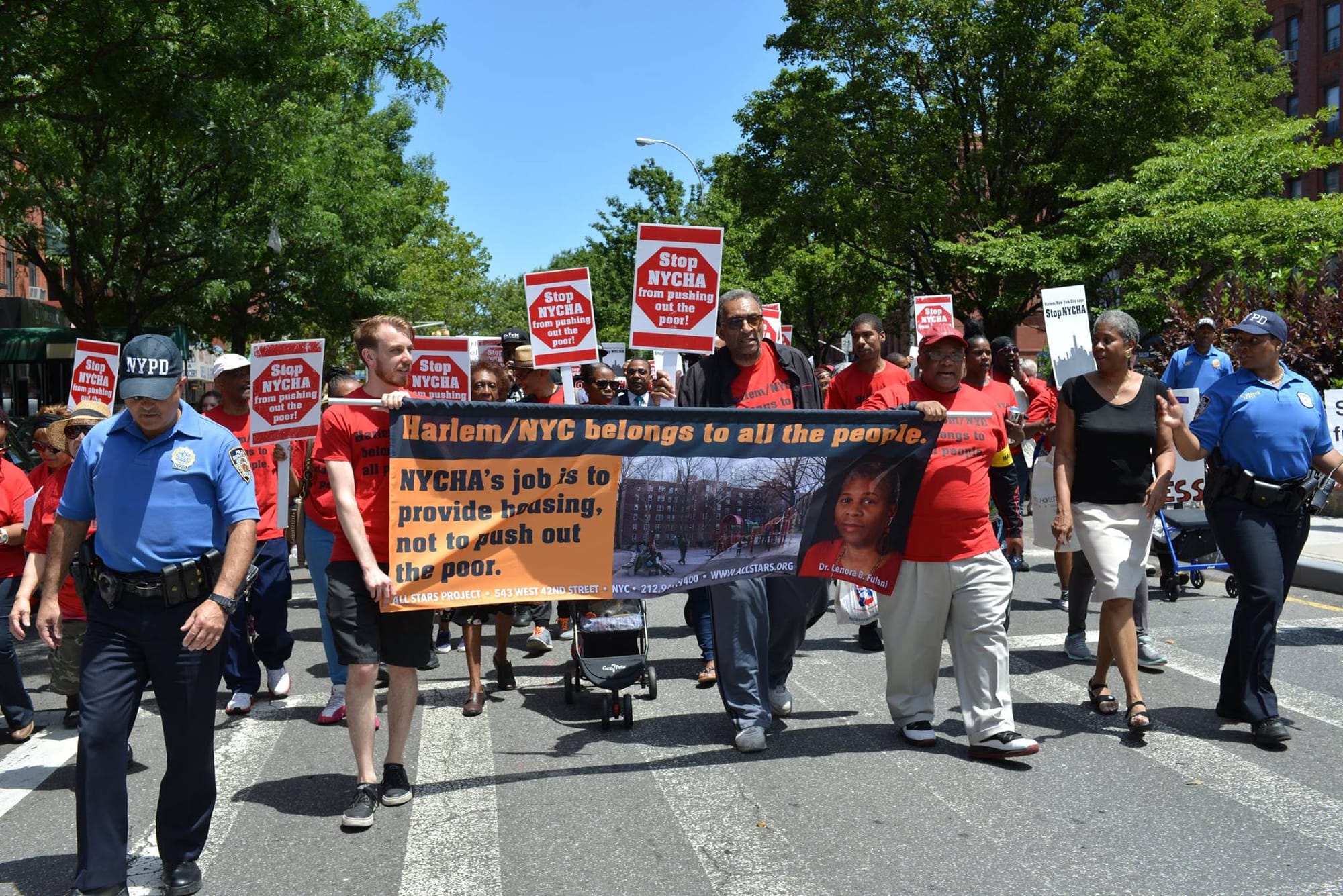
NYCHA resident and tenant leader, Brenda Temple, was part of the march.
"We are scared, frustrated, and confused," she said.
NYCHA has meetings with the residents to prepare them for changes but, Temple says, they have little notice, aren't given enough time to voice their concerns, and when they do they aren't given clear answers. She also notes that residents do not have access to bipartisan lawyers who can explain the changes, and defend their rights.
"It is not transparent. They are making decisions without input from the community," Temple said.
She and her community at Far Rockaway in Queens have been told at meetings that privatization will include low-income opportunities, but will also make new space for tenants with incomes of $50,000 and up.
"Where will they put them?" she asked. "We are already full." "NYCHA is home to 1 in 14 New Yorkers. Our residents are employed as teachers, police officers, nurses – people who provide services that are essential to the City. NYCHA “alumni” include Howard Schultz, the founder of Starbucks, Goldman Sachs Chair and CEO Lloyd Blankfein, Whoopi Goldberg, NASA aerospace engineer Aprille Ericsson, journalist Errol Louis, and Dr. Mary Bassett, New York City Health Commissioner. Since 1998, when New York Governor George Pataki terminated operating subsidies to NYCHA, we’ve seen a steady decline in federal and State funding for both operations and capital projects. This disinvestment has resulted in the deterioration of our buildings, which now need $17 billion in major repairs. Our 10-year strategic plan, NextGeneration NYCHA, released in May 2015, is protecting and preserving this priceless public resource for today’s residents and the next generation of New Yorkers." -
Temple says she welcomes private management, and the repairs they are making. Her neighborhood has asbestos plaster indoors, and other dangerous issues that need to be fixed. "But," she said, "not to the extent of eviction and displacement."
Asked about barriers to transitioning out of low-income housing, she simply said, "There is no where to go."
Temple stressed the value of community in NYCHA developments. People know each other, she said, they help each other with problems, and they need each other. She does not want to see families, or the community, torn apart.
Asked what she wanted to gain from the march, Temple said, "We need a seat at the table. We need to let know what a disaster it will be if they evict low-income residents."
"We will continue to march, rally, and even boycott, if worse comes to worse. We deserve an affordable place to live without fear of eviction," Temple said.
The march in Harlem was organized by Dr. Lenora Fulani, the founder of the Committee for Independent Community Action (CICA).
Fulani is an accomplished independent politician: the first black woman to gain ballot access as a presidential candidate in all 50 states, a Dr. of psychology, and a researcher in the field of social environment and learning. Fulani is also a founder of several political and community organizations, including the nationally-acclaimed All Stars Project, CICA, and the Committee for a United Independent Party.
Fulani has been an independent since the 1970s.
"It was clear that the two-party system was dysfunctional, and did not come through for voters...politicians courted the black community, but didn't represent. We needed to build something outside the two-party system that wasn't institutionalized to the point of distancing itself from ordinary citizens," Fulani said in an interview for IVN.
Fulani said it became apparent that low-income residents were being displaced about 10 years ago.
"[Public housing officials] weren't filling empty houses, and they were making moves on NYCHA resident," she said.
By 'making moves' Fulani explained that people were being evicted, and punitive rules were being enacted to keep people out of NYCHA properties. She organized the march to raise awareness.
"People don't recognize that an increase in homelessness is a direct result of dismantling NYCHA," Fulani explained. She says she sees families involved in her All Stars Project kicked out of public housing every other week.
Fulani questions why the political class hasn't responded to cuts in public housing.
"In poor communities people support Democrats, but won't open their mouths. They won't talk about it," she said. "The political class made a deal with developers, and backed away from community needs."
Fulani does not believe the government cannot come up with the $17 billion to manage public housing.
"They don't have the desire or commitment," she said. "They are anti-poor."
She added, “When people say 'there is no money,' what does that mean? 'There is no money for the poor’ would be a more honest statement.”