
(Photo: ABC News)
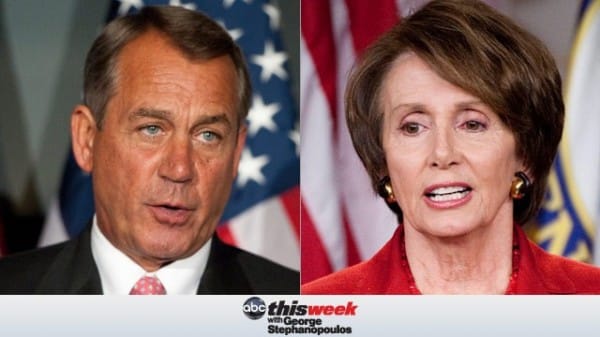
While there is no mathematical formula for calculating partisanship, both party-line voting and ideology were considered in finding the ten most partisan members of Congress.
In determining a Republican's partisanship, his score from the American Conservative Union (ACU) and the percentage of the time that he voted with his party, according to OpenCongress.org, were factored. For example, an ACU annual score of 95% or higher and voting with the party at least 96% of the time made him a partisan Republican.
For Democrats, the rankings of "Heroes" and "Zeroes" from the Americans for Democratic Action (ADA) were used along with the percentage of the time that a Democrat voted with the party according to OpenCongress.org. For example, a Democrat ranked as a "Hero" and who voted with the party 95% of the time or more was categorized as a partisan Democrat.
The most recent year with data available from both the ACU and ADA is 2009. Therefore, no one elected during the Republican wave of 2010 is figured in this total.
Naturally, this formula is highly unscientific and subjective. Using the ACU and ADA as barometers for the respective parties risks boiling down partisanship to a handful of votes each organization considers important. However, combining philosophical criteria with party voting hopefully captures not only the ideological rigidity prevalent in Washington, but also shows how closely congressmen adhere to the issues each organization identifies as important.
Perhaps a coincidence or a consequence of the nature of and relationship between the two bodies, but all of the ten most partisan members of Congress are in the House of Representatives; none are in the Senate.
Republicans
John Boehner (Ohio)
As the House Minority Leader in 2008, Boehner led the GOP in its defeat of the Troubled Asset Relief Program (TARP) on its first vote only to reverse course and lead the party to pass the $700 billion bill. The Speaker of the House is the only current Republican who voted with the party 100% of the time.
Eric Cantor (Virginia)
One of the self-styled "Young Guns" of the GOP, Cantor is the House Republican Majority Leader and the second highest-ranked Republican after Speaker Boehner. One of the many Republicans who voted for President Bush's $170 billion stimulus in 2008, and for TARP, but against President Obama's stimulus, Cantor is a vocal advocate for Israel as well as an ardent opponent of Wall Street reform and regulation.
Kevin McCarthy (California)
Although only in Congress since 2007, McCarthy is already the House Majority Whip, the third-ranking Republican in the House. Despite recent demands in the National Journal that Democrats work with Republicans, McCarthy votes with his own party 97% of the time.
John Kline (Minnesota)
Little known outside of Minnesota's second congressional district, Kline has voted with the GOP 97% of the time. Along with many other Republicans, Kline has refused to consider any tax increases and in an editorial for the St. Paul Pioneer Press, the only bipartisan effort mentioned was Kline's support for a bill to restore pay to soldiers on leave.
Todd Akin (Missouri)
While Akin became infamous for his "legitimate rape" comments, he has been routinely named one of the more ardently conservative members of the House of Representatives. While he voted against some of the Bush administration's big domestic initiatives such as Medicare Part D and No Child Left Behind, the rest of his voting record and controversial comments continue to make him a divisive figure.
Democrats
Nancy Pelosi (California)
Although Pelosi does not register as one of ADA's "Heroes," she makes this list as a co-architect of the controversial Affordable Care Act (ACA), which did not receive a single Republican vote.
Lois Capps (California)
A member of the "New Democrat Coalition," which advertises itself as moderate, the National Journal describes Capps as a "solid liberal" and during her tenure, she has voted for some of the more controversial Democratic initiatives such as the ACA.
Rosa DeLauro (Connecticut)
Representing New Haven since 1991, DeLauro has compiled one of the more liberal voting records in Congress. A strong supporter of the ACA, she strongly opposed the Stupak-Pitts Amendment, which would have placed limits on taxpayer-funded abortions in relation to the ACA.
Chris Van Hollen (Maryland)
The fifth-ranking Democrat in the US House, Van Hollen gained attention earlier this year when questioning Jeb Bush. Grilling a public official who had no influence on federal policy during the time in question, Van Hollen said to the former Florida governor, "I've searched the record, and as far as I can tell, during that eight-year period you did not challenge the Bush administration's handling of the economy, criticize the excessive spending or the rising deficits."
Richard Neal (Massachusetts)
Representing Massachusetts since 1989, Neal is a member of the House Ways and Means Committee. Influential in deciding how federal revenue is spent, Neal is a candidate to someday become chairman of the committee. Although he voted with his party 95% of the time during the most recent congress, he has voted with his party as much as 99% in the past.