
In the study of migration patterns, scholars often times point to different “push” and “pull” factors that have influenced migration trends over time.
Historically, the free market structure of the United States’ economy, combined with its stable democracy has been a very strong “pull” factor that has enticed millions of families (including my own) to immigrate here from various corners of the earth.
Conversely, dysfunctional governments that have proven unable to serve their people have historically been very strong “push” factors.
“Brain drain” occurs when a country loses a significant amount of highly talented individuals due to a combination of push and pull factors.
As was previously stated, this phenomenon is formally limited to migration patterns. However, the shifting political landscape of the United States may warrant an expansion of the way we apply these terms.
It is no secret that divisiveness, tribalism, and hypocrisy pervade our political system today. While some of this is to be expected in an election year, the fact that it has endured well into 2018 is truly an aberration from previous norms.
This departure from the norm has had many impacts on society, and most of them have been unpleasant. One of the side effects stemming from the intransigence of our two parties is a brain drain, but of different sorts.
No, the brightest minds in America are not fleeing the country at an alarming rate, but they are fleeing their parties at one.
The reason why our nation’s brightest minds are fleeing the two major political parties is akin to why our ancestors left their indigenous countries. That is, the environment created by our current political system has shown that it is unable to appropriately respond to the will of the people, and this has incentivized large segments of our population to seek a political alternative.
This is not speculation, and has actually been backed by a bevy of recent data. For example, Pew Research Center reports that 39% of Americans identify as Independent, which is up from 30% in 2004. But the most useful information regarding this trend can be found when digging a little deeper into the political tend of individuals under 40.
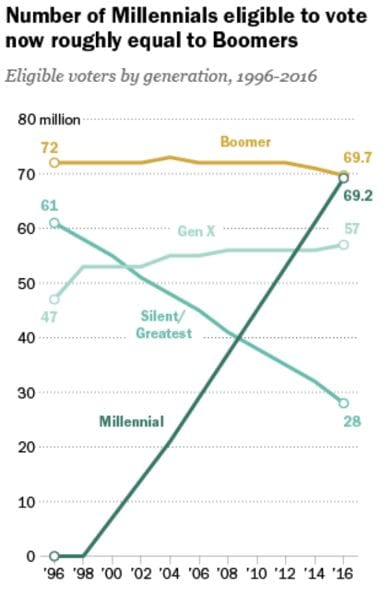
To begin, let’s take a look at the graph above, detailing the changing dynamics of eligible voters in the United States.
As you can see, Millennials are on track to become the largest voting bloc in our country by the 2018 midterm elections. This information becomes even more compelling when you couple it with a recent study from the University of Chicago.
In the 2017 study, it was reported that 71% of individuals between 18-29 believed that a third party option was needed for our country. Additionally, a Harvard poll found that 67% of millennials are more fearful than hopeful for the future of our country.
This is important, because fear is the greatest cause of unrest in any society; and if our two-party system continues in its obdurate ways, then they run the significant risk of seeing their influence wane dramatically.
It is important to remember, however, that this does not mean anything unless these individuals actually go out and vote. That is why the record number of young voters in the recent Virginia election should alarm both parties, especially Republicans.
As this data shows, younger generations are involving themselves in politics at a younger age and have been surprisingly effective despite their youth. The overwhelming social media campaign led by high school students in the wake of the Parkland massacre exemplifies this, and it also indicates a seismic shift in our political landscape.
To any casual observer, it is blatantly clear that our two-party system is plagued by political gridlock, and the prominence of social media and the echo chambers created by it have only exacerbated these conditions.
This meteoric rise in partisanship has created a great deal of political pressure, so to speak. Political pressure is the same as any other kind of pressure in that it constantly seeks an escape valve.
What this data shows us is that the escape valve in this sense is a formidable independent party.
More and more, we are seeing independents announce their candidacy for state office. This is happening across the country in states like Colorado, Missouri, and Maryland. At this rate, it is only a matter of time before this trend spills over to the federal level.