Skip to content
Subscribe

Two in Three Americans Now Support Legalizing Marijuana

Two in Three Americans Now Support Legalizing Marijuana
Published:

Look at the person to your left. Now look at the person to your right. Odds are, at least one of them supports legalizing marijuana, and there's a good chance you probably do too.

According to the latest Gallup poll, 66% of Americans now support legalizing marijuana. That's a new record high in an upward trend of support for marijuana legalization since Gallup began putting the question to survey takers a half century ago.
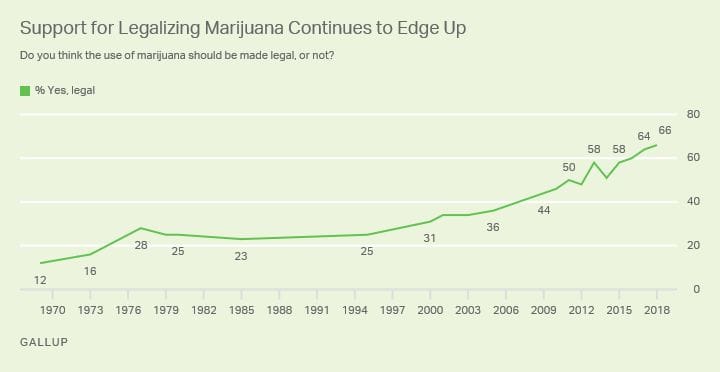
As you can see from the graph, ending marijuana prohibition was not a popular idea when Gallup first began asking the question in 1969, with only 12% of respondents agreeing the psychoactive plant and its products should be made legal.

It took twenty years for that figure to double, and nearly another twenty for it to double again, with a sudden uptick in support over the last few years as several states defy federal prohibition and legalize the cultivation, sale, possession, and consumption of cannabis for recreational and or medical purposes.

If you'll notice, throughout the years, Gallup has asked the question, "Do you think the use of marijuana should be made legal, or not?" which marijuana industry insiders and advocates would say biases the survey results against a positive response for two reasons:

1) It asks if marijuana should be made legal rather than asking should the federal government stop imprisoning people for possessing marijuana, and 2) The question phrases the marijuana question in terms of use, rather than consumption.

"Users" as in "drug users" has a generally negative connotation, whereas "consumers" has a positive connotation. Even as scientific, objective, and unbiased as the pollsters may think they are, or even genuinely may attempt to be, it is impossible not to build tacit bias right into a survey.

And still the survey results for this question have trended upward over the decades, reaching a new high this week just as the federal government of Canada becomes the second government in history to legalize marijuana nationwide since prohibition swept over global drug policy in the 20th century.

In North Dakota and Michigan, two states bordering Canada, voters will decide whether to legalize marijuana for recreational consumers this November, and the ballot proposals enjoy enough support to win in the latest polls in both North Dakota and Michigan.

Adhere to the IVN etiquette

By posting a comment, you agree to adhere to our etiquette rules: No partisan attacks, no personal attacks, substantiate your sources, no self-promotion.

Contact IVN

Questions about this article or our coverage? Send us a message. A free IVN member account is required.

Message sent

Thanks, we’ll review it and get back to you if needed.

Message not sent

Sorry, something went wrong. Please try again.

Sign in to send a message

Messages are tied to your IVN member account. Signing in is free and takes a few seconds.

Republish this article

Republishing guidelines

Republish IVN articles for free. Independent Voter News articles may be republished online or in print under a Creative Commons BY-NC-ND 4.0 license, on these terms:

  1. Credit the author and IVN. Keep the byline ("By Author Name, Independent Voter News") and the attribution note at the end, which links to the original.
  2. Keep the meaning. You may update time and place references and apply your house style. You may trim for length, as long as the cuts don't change the meaning or misrepresent the author. Keep the headline. Mark any additions as your own (for example "Additional reporting by ...").
  3. Translations are welcome. Translate faithfully, add "Translated from English by [your outlet]", and tell us at editor@ivn.us.
  4. Keep the links, including the link to the original article.
  5. Keep the tracking image. The HTML includes a 1-pixel image that counts readers on your page. It collects no personal information.
  6. Photos and illustrations. Images credited to IVN may be used with this article only. Images credited to others (AP, Getty, Unsplash, Wikimedia and so on) stay under their owners' terms. Secure the rights or switch "Include images" off.
  7. Don't sell it. You can't sell our articles or sell ads specifically against them. Your normal site advertising is fine.
  8. No implied endorsement. Don't suggest that IVN or the author endorses you, your candidates or your causes, or that donations to you support IVN.
  9. Keep labels. Opinion or analysis pieces keep that label.
  10. Point search engines to the original. Where your CMS allows, set the canonical URL to the original IVN article.
  11. No bulk or automated republishing, and don't submit our articles to aggregators (Apple News, Google News, MSN) as your own.
  12. Corrections and removals. Update your copy when we correct it, and remove it promptly if we ask. We'll contact you at the email you give us.
  13. Questions or print republication: editor@ivn.us.

IVN staff: fill in who you're inviting above, then create the invite.

Preparing the article

Two in Three Americans Now Support Legalizing Marijuana

Choose a format
  • HTML
  • Email HTML
  • Markdown
  • Formatted (.docx)
  • Plain text
  • WordPress blocks
  • PDF
Choose a platform

Photos credited to others need their owners' permission.

To for

Republishing somewhere else? Questions? editor@ivn.us