 Cara Brown McCormick

Could Voter ID Be the Issue Republicans Use to Gain Ground in Deep Blue California?
SACRAMENTO, CALIF. - Republican lawmakers, political groups, and donors are going to attempt to qualify a constitutional amendment for California’s November 2026 ballot that would require voters to present government-issued identification and verify their citizenship before casting a ballot.
The proposal, backed by Assemblymembers Carl DeMaio and Bill Essayli, US Rep. Ken Calvert, and the Lincoln Club of Orange County, is being advanced through a signature-gathering campaign, not the legislature. Reform California, the advocacy group chaired by DeMaio, is leading the effort.
DeMaio posted the following video in March:
If the group collects nearly 874,000 valid signatures, the initiative will ask voters whether California should follow the lead of 36 other U.S. states that already require some form of ID to vote.
Broad Public Support, But Fierce Institutional Opposition
There is unmistakable division between the Republican and Democratic Parties over the issue of voter ID. Republican leaders and officials say it strengthens election security, while Democratic leaders and officials say it leads to voter suppression.
Meanwhile, public opinion polls show Americans are not so divided on the subject. A Gallup poll from October 2024 found that 84% of respondents believed that all voters should be required to show identification in order to vote, including 67% of Democrats.
Reforms like voter ID and automatic voter registration are portrayed as strictly Republican and Democratic issues, respectively, in the media. However, polling shows support for a wide breadth of reforms across the political spectrum.
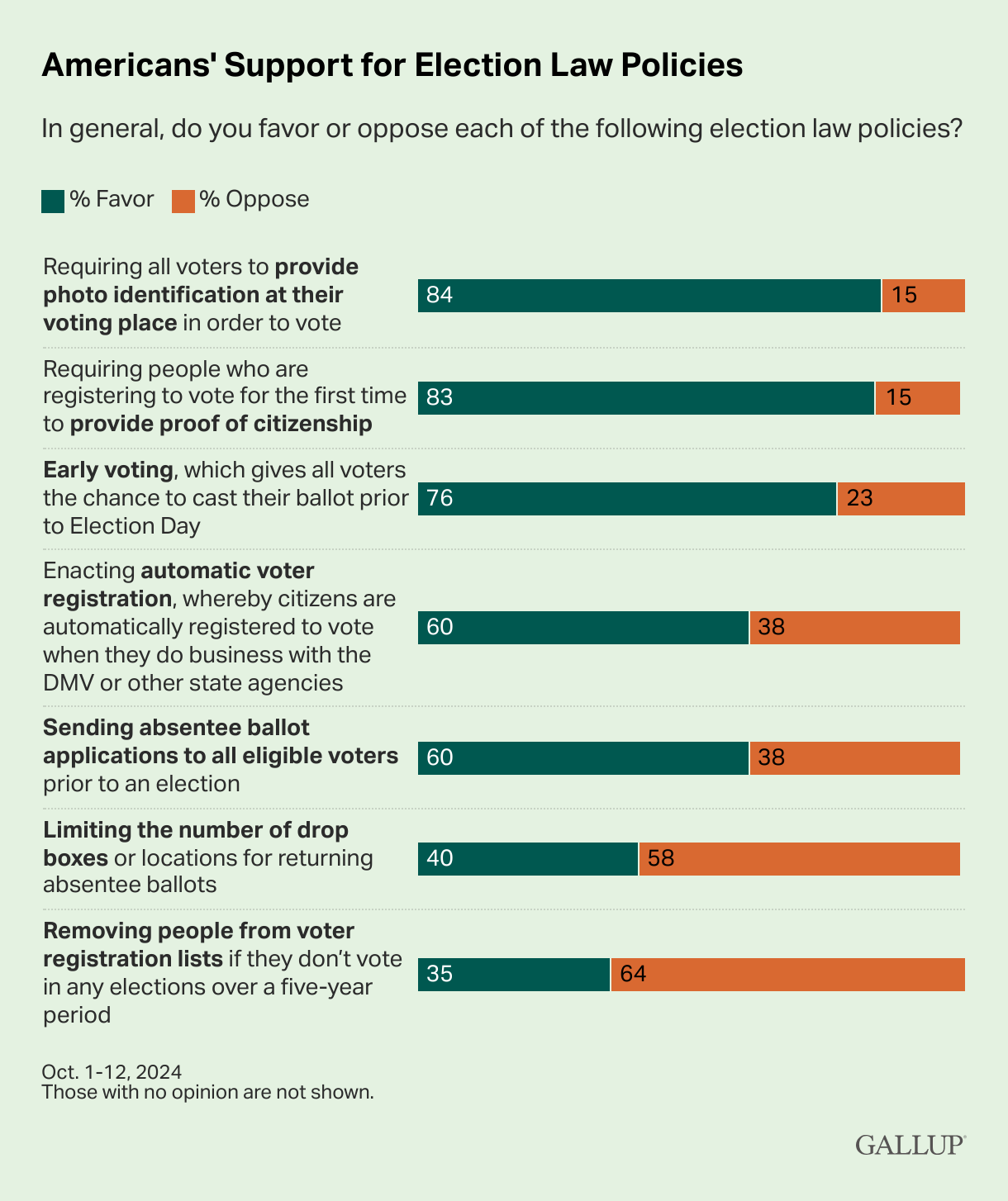
“This is not a partisan issue. This is a common-sense election integrity reform that resonates with Californians regardless of party,” said Julie Luckey, Director of Californians for Voter ID.
Yet, despite its broad appeal, the measure faces staunch resistance from powerful Democratic officials and aligned advocacy organizations. Attorney General Rob Bonta and Secretary of State Shirley Weber have sharply criticized voter ID efforts, stating that they address a nonexistent problem and risk disenfranchising voters.
Dora Rose of the League of Women Voters of California called voter ID laws a stark effort to disenfranchise voters and cause chaos. The ACLU of Southern California and other civil rights organizations argue such rules disproportionately harm low-income voters, seniors, and people of color.
A Potential Opening for Republicans?
The voter ID campaign in California faces long odds. Organizers must gather well over a million raw signatures to ensure enough are valid. Still, the issue’s polling strength raises a provocative question:
Have Republicans found an issue that appeals to a large majority of voters but not to the Democratic political establishment or its traditional interest group allies?
Assemblymember DeMaio believes so.
“This is not about voter suppression. This is about restoring public trust in elections,” he said, noting the initiative would preserve vote-by-mail and allow voters to use various forms of ID, including Real ID, passports, or Social Security numbers already on file.
Other Republicans, including Calvert and Essayli, echo that message. “There’s a cancer growing in our democracy where too many people have lost confidence in our elections,” Essayli said. “Enacting a voter ID law should be seen as the best bipartisan solution to this problem.”
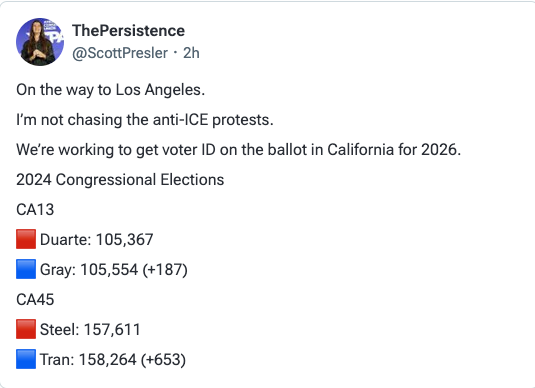
Whether the effort succeeds in reaching the ballot remains to be seen, but its popularity with voters suggests the political stakes may extend beyond a single measure. In a state where Republican candidates often struggle statewide, voter ID could represent a rare point of alignment between GOP messaging and broad-based voter sentiment.
“Even Far Lefties Want Voter ID”
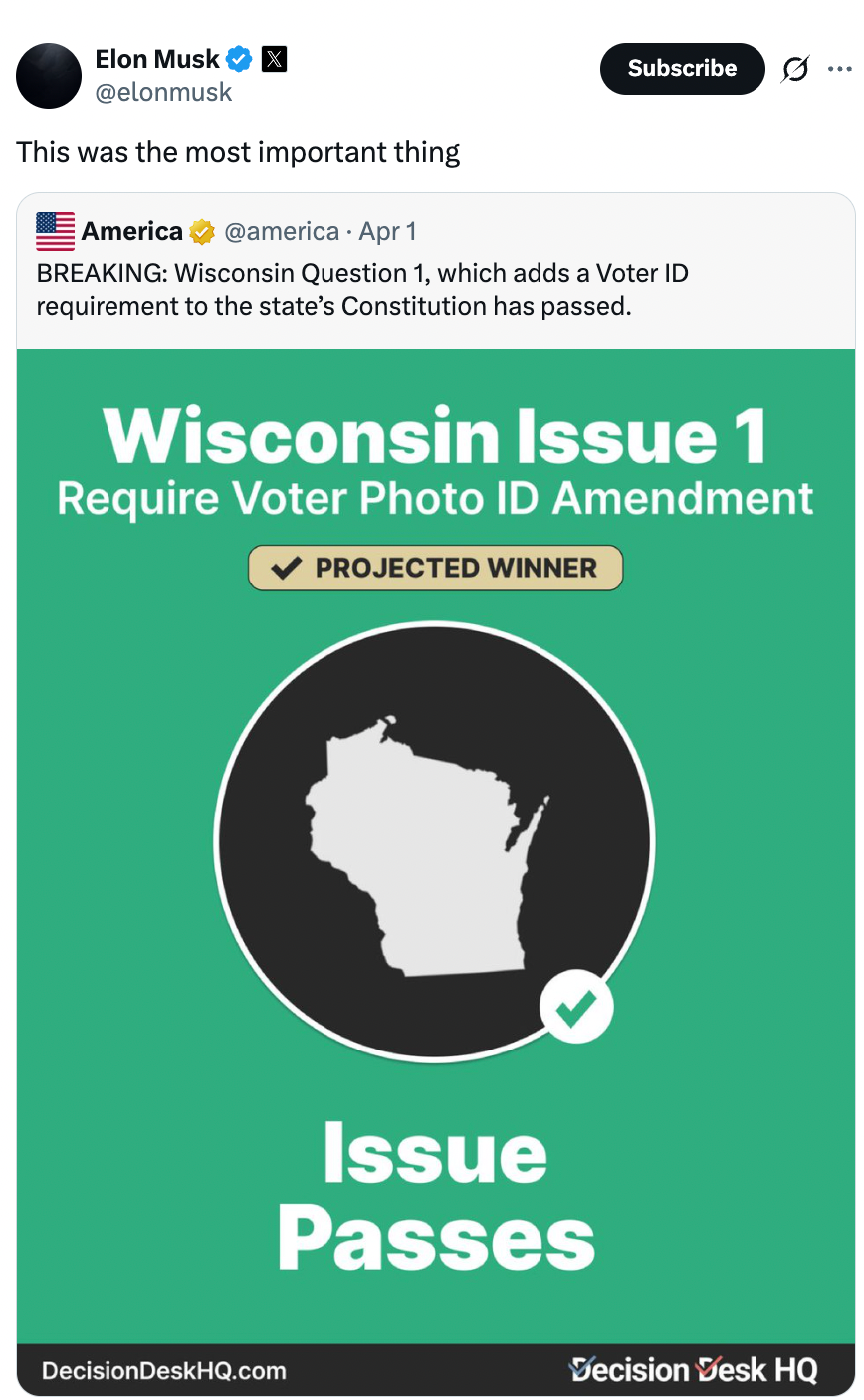
Voters approved enshrining a voter ID requirement in the Wisconsin Constitution through a constitutional amendment approved by voters in April 2025.
Even though they lost a key judicial race, Republicans celebrated the consolation prize in Wisconsin, predicting that the big win for a strong voter ID law in the critical swing state could have reverberations as far away as California.
“Even far lefties want voter ID,” declared Ric Grenell on X (formally Twitter) in a post that has since been removed. Grenell is President Donald Trump’s envoy for special missions. He is weighing a run for California governor in 2026. “Next up…California!”
“This was the most important thing,” Musk posted on X in response to a post that the voter ID measure had prevailed by a wide margin.
A Local Test Case in Huntington Beach
In March 2024, 53.4% of Huntington Beach voters approved a city charter amendment, Measure A, which allows officials to require identification at polling places for city races starting in 2026.
In September 2024, California Governor Gavin Newsom (D) signed a bill into law that bars local governments from enacting laws requiring residents to show a valid form of identification to vote.
The state has challenged the Huntington Beach law in court, arguing the policy is preempted by state election law. An Orange County judge sided with the city in April 2025, ruling in favor of the city and rejecting the state’s claim.
On May 30, Attorney General Bonta and Secretary Weber filed a formal appeal. In a press release, Bonta’s office argued that the law unlawfully departs from California’s election framework and could disenfranchise voters by requiring additional ID to vote.
“State law supersedes local law when it comes to constitutional matters like the right to vote,” Bonta said. Weber added, “Municipalities should not be allowed to defy state laws in the name of solving nonexistent problems.”
The lawsuit states that Huntington Beach presented no evidence to support the claim that voter fraud is a significant issue in its local elections, and that regulating voter eligibility is a matter of statewide concern. The case is now before the California Fourth District Court of Appeal, which could determine whether cities like Huntington Beach have the authority to impose voter ID rules independently.
Political Implications
The issue could also influence local and state races. Huntington Beach Councilmember Gracey Van Der Mark, who served as mayor in 2023, has launched a campaign for the open 72nd Assembly District seat in 2026. The seat is being vacated by Assemblymember Diane Dixon of Newport Beach, who is running for the Orange County Board of Supervisors. Van Der Mark is a backer of the city’s voter ID law.
What Happens Next
By August, supporters of the voter ID constitutional amendment hope to bring the Voter ID measure to the secretary of state’s office. Once the attorney general signs off on a title and summary for the ballot measure, organizers will have 180 days to collect roughly 874,000 signatures from California voters to place the measure on the November 2026 ballot.
Even if it does not qualify, the public debate it triggers could shape legislative races and test whether voter ID is the kind of cross-partisan issue Republicans can use to reconnect with independent and moderate voters in a deep blue state.
According to the National Conference of State Legislatures, thirty-six states have laws requesting or requiring voters to show some form of identification at the polls. The remaining 14 states and Washington, D.C., use other methods to verify the identity of voters.
Study Says Fear Expressed by Both Sides of Voter ID Debate is Overstated
While Republicans frame voter ID as essential for election security, and Democrats argue it will suppress turnout, recent academic research suggests neither concern is borne out by the data.
A 2021 study by researchers at Harvard Business School found that voter ID laws have no measurable effect on voter turnout or registration, regardless of race, gender, age, or political affiliation. The study also found no evidence that these laws reduce actual or perceived voter fraud.
Although some eligible voters may lack ID, the research concluded that targeted outreach and mobilization efforts often offset any potential barriers, particularly for nonwhite voters. In fact, campaigns were more likely to contact and engage those voters in ID-law states, resulting in no net decline in participation.
The authors concluded that voter ID laws are largely symbolic, with little practical impact on election outcomes or fraud prevention.
In their words, “the fears expressed by both sides of the voter ID debate may be overstated."