
Benjamin Disraeli, one of Britain’s greatest prime minsters, once referred to his climb to the top of parliamentary power in England as the “long greasy pole.”
What Mr. Disraeli achieved then, Maureen Dowd has achieved today -- not in politics, but in journalism as a columnist for The New York Times.
Before you conclude that’s a weird pairing, Disraeli and Dowd, read on:
Since Ms. Dowd became an op-ed columnist for The Times in 1995, she consistently has been the bane of presidents – as in Clinton, Bush 43, Obama, and now, Trump.
In this particular art form, holding accountable presidents and other political leaders, Ms. Dowd is unrivaled.
But the reason you’re reading this is because Ms. Down and I exchanged emails Sunday.
I wrote asking if she would speak about her new book, “The Year of Voting Dangerously: The Derangement of American Politics,” at a dinner event of the Fenway Park Writers Series I chair for the Boston Red Sox.
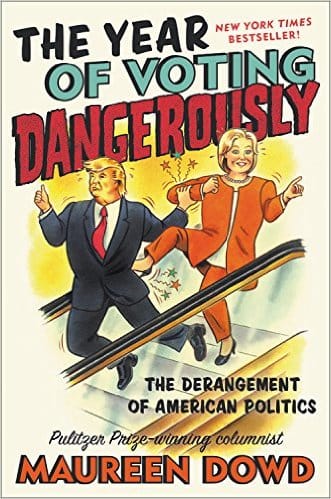
I think that will happen, because whenever I’ve written Ms. Dowd (you may called it “emailing” if you like), she writes back. That’s not the norm for her profession; especially, not for those at the top of the “greasy pole.”
Which brings me to a grievance about journalists other than Maureen Dowd:
The state of newspapers today is a worrisome state. Newspaper are struggling mightily to stay in business. The roll call of those that haven’t made it is long and depressing, and many are those who believe the days of print journalism are over.
I disagree, and I know the evidence, have read the stories, seen the studies, looked at the decline of circulation, but for newspapers to have a future, the disconnection between readers and journalists must be addressed – and that’s not happening.
Too many journalists are out of touch with their readers, believing that politicians, preachers, priest, rabbis, and imams, need to stay connected but not editors, columnists, writers, or reporters – unless you’re Maureen Dowd.
Ms. Dowd was taught while growing up in a traditional Catholic family, to say, “Thank you.” But that hugely important grace appears foreign to journalists today.
Call them, they won’t return your call. Write a letter, they won’t answer. Email them, they won’t respond, tweet them, they will ignore you.
It is mindless that this goes on in a profession whose very future is in question. It is all the more exasperating when we live in an age of technology, one that provides the greatest means of communication that have ever existed!
If journalists say they get too many phone calls, too many letters, too many emails, too many tweets, I allow that may be true, but the means of responding, no matter the volume, exist.
When you fail to respond, people will feel slighted, ignored, and annoyed. Not a good thing when you should be doing your best to hold on to your audience.
Several times a year Wikipedia appeals for support. On two occasions I have responded by making a contribution, which is proper because I use it every day. Both times, within 30 minutes, an email letter was sent back from Wikipedia’s president, thanking me for my gift.
If Wikipedia, used worldwide by hundreds of millions of people, has found the means to stay in touch with its constituents, to convey a note of thank you, tell me why journalists cannot do the same?
In the case of Wikipedia’s response, did I know it was a rote letter? Yes. Did I care? No. I was acknowledged. I had no other expectation. I wanted a response. I got it. Good for Wikipedia.
Ultimately, all life is personal, including journalism. Editors, columnists and reporters may not see it that way, but they’re wrong – and if they don’t figure that out and start finding ways to connect to their constituents, i.e., their readers, they, like too many other newspapers and journalists, will be out of business and out of a profession.
If I’m Brian McGrory, editor of the Boston Globe, or Dean Baquet, editor of The New York Times, or Marty Baron, editor of the Washington Post, or the editor of any American newspaper, my journalists will know the rules – return phone calls, answer letters, respond to emails, engage on Twitter.
And, so we’re clear, I want Mr. McGrory, Mr. Baquet, and Mr. Baron, and their counterparts, to follow the rules they lay down for others.
In other words, like Maureen Dowd, remember your parents’ emphasis on the grace of saying, “Thank you.”
It still matters – to a whole lot of people in the USA.
The only thing at stake, the future of a profession Thomas Jefferson said mattered more than government.
Photo Credit: Microgen / shutterstock.com