Skip to content
Sign up free
News

5 Facts About the History of the U.S. Debt Ceiling

5 Facts About the History of the U.S. Debt Ceiling

By Anthony Astolfi

2-minute read

A statutorily imposed debt ceiling has been in effect since 1917 when the US Congress passed the Second Liberty Bond Act. Before 1917 there was no debt ceiling in force, but there were parliamentary procedural limitations on the level of possible debt that could be held by government. Prior to 1917, the United States had no debt ceiling. Congress either authorized specific loans or allowed Treasury to issue certain debt instruments and individual debt issues for specific purposes.

Sometimes Congress gave Treasury discretion over what type of debt instrument would be issued. In 1917, during World War I, the debt ceiling law was passed, which allowed the executive branch to issue bonds and take on other debt without Congressional approval, as long as the total debt fell under the statutory debt ceiling. The United States first instituted a statutory debt limit with the

Second Liberty Bond Act of 1917. This legislation set limits on the aggregate amount of debt that could be accumulated through individual categories of debt (such as bonds and bills).

Prior to the Budget and Impoundment Control Act of 1974, the debt ceiling played an important role since Congress had few opportunities to hold hearings and debates on the budget. James Surowiecki argued that the debt ceiling lost its usefulness after these reforms to the budget process.In 1979, noting the potential problems of hitting a default, Dick Gephardt imposed the "Gephardt Rule," a parliamentary rule that deemed the debt ceiling raised when a budget was passed. This resolved the contradiction in voting for appropriations but not voting to fund them. The rule stood until it was repealed by Congress in 1995.

The 1995 request for a debt ceiling increase led to debate in Congress on reduction of the size of the federal government, which lead to the non-passage of the federal budget, and the United States federal government shutdown of 1995–96. The ceiling was eventually increased and the shutdown resolved.

In 2011, Republicans in Congress used the debt ceiling as leverage for deficit reduction because of the lack of Congressional normal order for fiscal year budget votes on the chamber floors and subsequent conference reconciliations between the House and the Senate for final budgets.

The credit downgrade and debt ceiling debacle contributed to the Dow Jones Industrial Average falling 2,000 points in late July and August.

Related: The History of the U.S. Debt Ceiling Following the increase in the debt ceiling to $16.394 trillion in 2011, the United States again reached the debt ceiling on December 31, 2012 and the Treasury began taking extraordinary measures. The fiscal cliff was resolved with the passage of the American Taxpayer Relief Act of 2012 (ATRA), but no action was taken on the debt ceiling.

The No Budget, No Pay Act of 2013 suspended the debt ceiling from February 4, 2013 until May 19, 2013. On May 19, the debt ceiling was formally raised to approximately $16.699 trillion to accommodate the borrowing done during the suspension period.
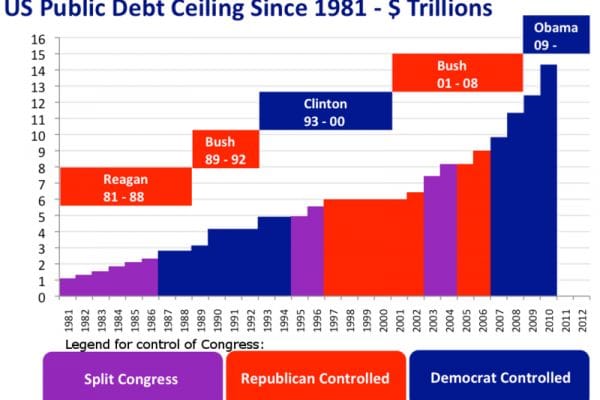
US Public Debt Ceiling 1981-2010
Tags: News

Adhere to the IVN etiquette

By posting a comment, you agree to adhere to our etiquette rules: No partisan attacks, no personal attacks, substantiate your sources, no self-promotion.

Get IVN’s Free Weekly Newsletter:Get IVN’s Free Newsletter

Get IVN’s Free Weekly Newsletter:Get IVN’s Free Newsletter

Nonpartisan Issues. Diverse Perspectives.

Check your inbox and click the link to confirm.

Republish this article

Republishing guidelines

Republish IVN articles for free. Independent Voter News articles may be republished online or in print under a Creative Commons BY-NC-ND 4.0 license, on these terms:

  1. Credit the author and IVN. Keep the byline ("By Author Name, Independent Voter News") and the attribution note at the end, which links to the original.
  2. Keep the meaning. You may update time and place references and apply your house style. You may trim for length, as long as the cuts don't change the meaning or misrepresent the author. Keep the headline. Mark any additions as your own (for example "Additional reporting by ...").
  3. Translations are welcome. Translate faithfully, add "Translated from English by [your outlet]", and tell us at editor@ivn.us.
  4. Keep the links, including the link to the original article.
  5. Keep the tracking image. The HTML includes a 1-pixel image that counts readers on your page. It collects no personal information.
  6. Photos and illustrations. Images credited to IVN may be used with this article only. Images credited to others (AP, Getty, Unsplash, Wikimedia and so on) stay under their owners' terms. Secure the rights or switch "Include images" off.
  7. Don't sell it. You can't sell our articles or sell ads specifically against them. Your normal site advertising is fine.
  8. No implied endorsement. Don't suggest that IVN or the author endorses you, your candidates or your causes, or that donations to you support IVN.
  9. Keep labels. Opinion or analysis pieces keep that label.
  10. Point search engines to the original. Set the canonical URL of your copy to the original IVN article (the HTML we give you includes the tag).
  11. No bulk or automated republishing, and don't submit our articles to aggregators (Apple News, Google News, MSN) as your own.
  12. Corrections and removals. Update your copy when we correct it, and remove it promptly if we ask. We'll contact you at the email you give us.
  13. Questions or print republication: editor@ivn.us.

IVN staff: fill in who you're inviting above, then create the invite.

Preparing the article

5 Facts About the History of the U.S. Debt Ceiling

Choose a format
  • HTML
  • Email HTML
  • Markdown
  • Formatted (.docx)
  • Plain text
  • WordPress blocks
  • PDF
Choose a platform

Photos credited to others need their owners' permission.

To for

Republishing somewhere else? Questions? editor@ivn.us