Skip to content
Sign up free
News

80 Years after Reefer Madness, Grandpa Still Doesn't Want You Smoking Weed

80 Years after Reefer Madness, Grandpa Still Doesn't Want You Smoking Weed

By Jane Susskind

2-minute read

It is now commonly accepted that a majority of Americans support the legalization of marijuana, with states like Colorado and Washington taking the first steps in making recreational marijuana socially (and legally) acceptable.

What is less clear is why such a dramatic shift has taken place in our society. An overwhelming 68 percent of Millennials favor legalizing marijuana use, according to a recent Pew study, and almost every other age group has recorded an increase in support as well.

There is one exception to the trend, however: the Silent Generation (aged 70-87). The Washington Post’s Philip Bump speculates that the reason for this is the difference in drug propaganda from earlier years versus now.

"When I was a kid during the 1980s, drugs were terrifying, depicted everywhere as hopelessly addictive and imminently deadly. One of my colleagues told a story about being terrified by encountering some pot."

Part of the terror came from ads like this, and the "This Is Your Brain on Drugs" campaign of the 1980s. But anti-marijuana propaganda is not a recent phenomena. Anti-marijuana ads date back to the first commissioner of the U.S. Treasury Department's Federal Bureau of Narcotics, Harry J. Anslinger, in the 1930s.

Ads like the one below depicted marijuana as the root of all evil, and were widely circulated in the mass media, linking violent crimes to the drug with little to no substantiation.
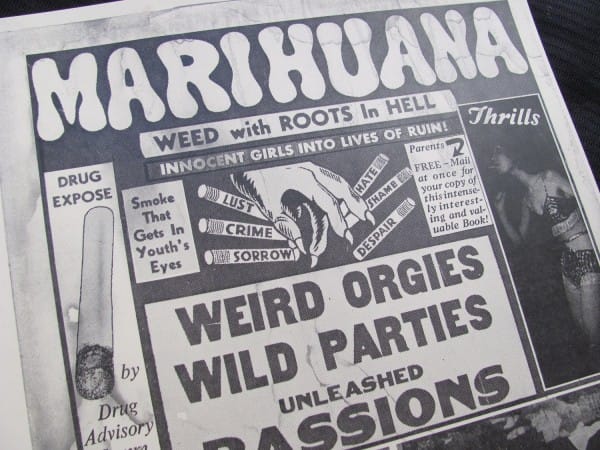
anti drug propaganda

The fear instilled in earlier generations is reflected in Pew’s findings on why people oppose legalization, with the most common concern being drug safety. It also explains why the most staunch opposition to legalization comes from the Silent Generation.

Pew also reports that among the public, 30 percent say they support legalizing marijuana use and have always felt that way, while 21 percent have changed their minds. Those who oppose legalization, however, remain more rigid in their views, with just 7 percent having changed their minds from supporting to opposing legalization.

Based on these findings, do you think drug propaganda is the cause of stubborn opposition to marijuana legalization?

Tags: News

Adhere to the IVN etiquette

By posting a comment, you agree to adhere to our etiquette rules: No partisan attacks, no personal attacks, substantiate your sources, no self-promotion.

Get IVN’s Free Weekly Newsletter:Get IVN’s Free Newsletter

Get IVN’s Free Weekly Newsletter:Get IVN’s Free Newsletter

Nonpartisan Issues. Diverse Perspectives.

Check your inbox and click the link to confirm.

Republish this article

Republishing guidelines

Republish IVN articles for free. Independent Voter News articles may be republished online or in print under a Creative Commons BY-NC-ND 4.0 license, on these terms:

  1. Credit the author and IVN. Keep the byline ("By Author Name, Independent Voter News") and the attribution note at the end, which links to the original.
  2. Keep the meaning. You may update time and place references and apply your house style. You may trim for length, as long as the cuts don't change the meaning or misrepresent the author. Keep the headline. Mark any additions as your own (for example "Additional reporting by ...").
  3. Translations are welcome. Translate faithfully, add "Translated from English by [your outlet]", and tell us at editor@ivn.us.
  4. Keep the links, including the link to the original article.
  5. Keep the tracking image. The HTML includes a 1-pixel image that counts readers on your page. It collects no personal information.
  6. Photos and illustrations. Images credited to IVN may be used with this article only. Images credited to others (AP, Getty, Unsplash, Wikimedia and so on) stay under their owners' terms. Secure the rights or switch "Include images" off.
  7. Don't sell it. You can't sell our articles or sell ads specifically against them. Your normal site advertising is fine.
  8. No implied endorsement. Don't suggest that IVN or the author endorses you, your candidates or your causes, or that donations to you support IVN.
  9. Keep labels. Opinion or analysis pieces keep that label.
  10. Point search engines to the original. Set the canonical URL of your copy to the original IVN article (the HTML we give you includes the tag).
  11. No bulk or automated republishing, and don't submit our articles to aggregators (Apple News, Google News, MSN) as your own.
  12. Corrections and removals. Update your copy when we correct it, and remove it promptly if we ask. We'll contact you at the email you give us.
  13. Questions or print republication: editor@ivn.us.

IVN staff: fill in who you're inviting above, then create the invite.

Preparing the article

80 Years after Reefer Madness, Grandpa Still Doesn't Want You Smoking Weed

Choose a format
  • HTML
  • Email HTML
  • Markdown
  • Formatted (.docx)
  • Plain text
  • WordPress blocks
  • PDF
Choose a platform

Photos credited to others need their owners' permission.

To for

Republishing somewhere else? Questions? editor@ivn.us