
Last year, Twitter hit a benchmark in its quest to the top of the social ladder, boasting over 200 million active users on the social network. What remains less clear, however, is where these users are located and to what extent, if any, does Twitter dictate the discourse of the mainstream media.
While some correlations between geography and usage may seem obvious, like access to electricity, the Internet, or wireless connection, some unlikely indicators of Twitter activity are explored in a recent study led by GDELT Data co-creator Kalev Leetaru. Published on the peer-reviewed online journal First Monday, Leetaru and his team of researchers seek out to map the human connections made possible by Twitter, using information gathered over the course of a month, October 23-November 30, 2012.
In an attempt to compare activity on Twitter to a location's coverage in the mainstream media, Leetaru monitored 3,369,388 news articles through Google News RSS, mentioning 164,594 locations, which are mapped in Figure 1:."
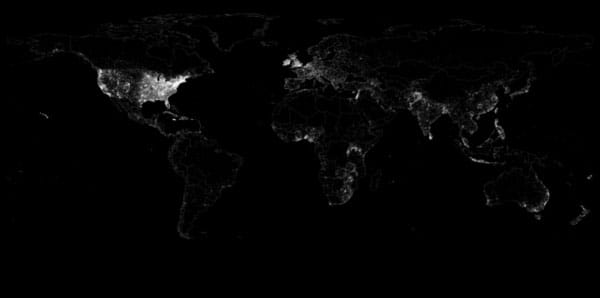
Figure 1: "All locations mentioned in articles found in the English–language Google News RSS stream 23 October 2012 to 30 November 2012. To see a higher resolution version of this figure, click here

This was then compared to all georeferenced tweets, with the results mapped in Figure 2:."
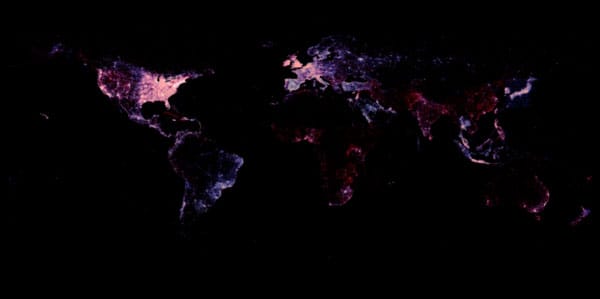
Figure 2: "Comparison of georeferenced Twitter Decahose (blue) and English Google News (red) geographic coverage 23 October 2012 to 30 November 2012. To see a higher resolution version of this figure, click here

Georeferenced tweets are shown in blue, news mentions are shown in red, meaning that areas that are predominately blue have higher Twitter representation and areas predominantly red have more news coverage in the mainstream media.
Some key findings:
- While Twitter activity in Latin America is high, the mainstream media appears to include significantly less coverage of this area.
- In contrast, the mainstream media's coverage of African countries is much higher in relation to the number of tweets being sent in the country.
- Iran and China were represented more strongly in the media than on Twitter, which can be attributed to their bans on Twitter.
Conclusion: "Overall, mainstream media appears to have more even coverage, with less clustering around major cities."
Keep in mind that tracking activity on Twitter is a complex process and information gathered from results paint an incomplete picture of the geography of Twitter.
"Given that two–thirds of the native geography of Twitter is driven by just one percent of all users, this suggests that studies relying purely on these tweets will have a skewed view of the Twitterverse, especially over short periods of time," the summary warns.
Despite the impossibility of defining the geography of Twitter, this research sheds some lucidity onto relationship between human connections and social media around the globe.
The paper provides an in-depth analysis on the different types of ways to map a tweet, using either GPS location based data or contextual references within the language of the Tweet, which can be found in the original paper.