
Photo: Genevieve Santiago
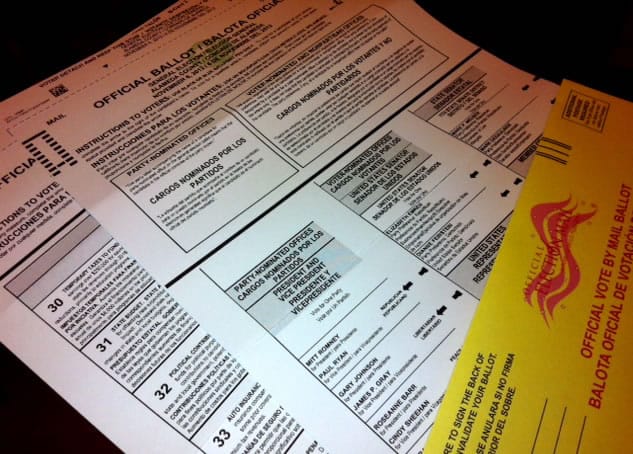
Since the mid 1990s, the number of California absentee voters has steadily risen. In 2008, nearly forty-two percent of ballots were cast by mail for the general election and, in 2010, that number rose to forty-eight percent. On October 19, Political Data Inc released absentee data on Senate and Assembly races in California. Currently, absentee ballot returns are low.
Senate District 13
In 2010, California voters approved the Top Two Primaries Act, which has resulted in same-party races this year. In Senate District 13, Democrats Jerry Hill and Sally Lieber compete for a seat where sixty-two percent of registered voters submit absentee ballots. On average, just under seven percent of absentee ballots have been mailed back within the 40 California Senate districts.
In District 13, eight percent of absentee ballots have been received. Forty-nine percent of the voters here are registered as Democrats, twenty-one percent identify as Republican, and twenty-six percent "decline to state." District 13's slightly higher-than-average return rate may be linked to the fact that seventy-five percent of the voting population identified as a Democrat or independent.
Senate District 15
Moving south, in Senate District 15, Democrats Joe Coto and Jim Beall are running for office where forty-five percent of voters are registered Democrat, twenty-three percent are registered Republican, and just under twenty-nine percent "decline to state." Here, seventy percent of voters are registered to vote by mail. This is the highest amount of absentee voters among the forty senate districts, yet only four percent of ballots have been returned thus far. What the data does not account for is the thirty-two percent of registered voters who do not identify with the two largest parties. There is no doubt that independent voters are among those who vote by mail in District 15, but their lack of representation could decrease their impact on the election.
In the CA State Assembly, same-party candidates are contending in eighteen districts for a seat. Fourteen Republicans compete for seven assembly seats, and twenty-two Democrats vie for eleven positions.
Assembly District 23
In Assembly District 23, Republican candidates Jim Patterson and Bob Whalen are facing off, and forty-five percent of registered voters submit their ballot by mail. With just under half of the voting population being absentee voters, District 23 has only received eighty-five ballots out of 108,008. Here, forty-five percent are registered Republican and thirty-four percent are registered Democrat. It is plausible to suggest that the district's low returns can be correlated to the two Republican candidates. Between the registered Democrats, the "decline to state," and voters identifying with "other" parties, just under fifty-five percent of voters do not directly identify with Republicans, yet their only choice lies within that party.
Assembly District 18
In Assembly District 18, Democrats Rob Bonta and Abel Guillen compete for the seat. In the district, fifty-two percent are absentee voters, and out of 227,478 registered voters, sixty-three percent are registered Democrat. Because this is a majority Democrat district, one may assume that the majority of voters could easily find satisfaction with their options of representation.
So far, only five percent of ballots have been returned. In District 18, more voters "decline to state" than there are registered Republicans. Together, they make up 29.4% of voters. Here, the absentee tracking data may reveal that same-party races have not made candidate choices any clearer, even within a majority-party district. If anything, voters can no longer rely on party identification to give them a quick overview of a candidate. Now, voters will need to research candidates in order to differentiate them from their same party opponent.
Senate races in Districts 13 and 15 and Assembly Districts 23 and 18 are races among twenty-four that IVN has noted should be “of interest to independent voters.” Overall, absentee returns seem relatively low at this time. According to the US Election Assistance Commission, in 2008 California ranked fifth among states with the "highest absentee voting rates."
The absentee tracking data did not include the percentage of independent voters, or those registered to parties other than the two largest. These groups are included among the totals for those registered in the district, but they are not represented as a component in the partisan breakdown of voters. During the June primary, 3.65 million Californians were independent. Even though they have not been recognized in absentee data, they are growing in number, and bound to influence races next Tuesday.