Skip to content
Sign up free
News

ACLU Reports on U.S. Resistance to Solitary Confinement Reform

ACLU Reports on U.S. Resistance to Solitary Confinement Reform

By Terri Harel

2-minute read

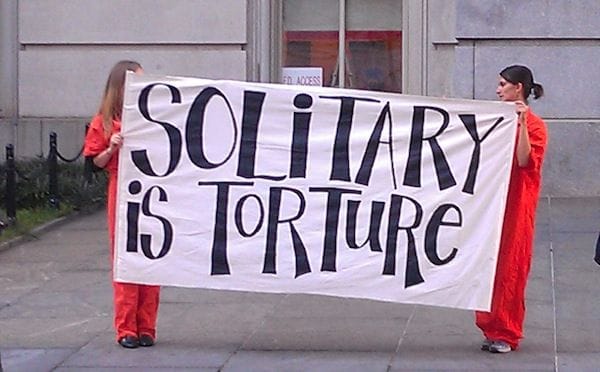
Photo: Francisco Quinones // solitarywatch.com // A demonstration against the use of solitary confinement in prisons.
Last week the United Nations held a meeting on prisoners’ rights in Buenos Aires. The conference, called the Inter-Governmental Expert Meeting (IGEM), resulted in an important updated Draft Report of the Standard Minimum Rules for the Treatment of Prisoners (SMRs), an agreement which had not been updated since its promulgation in 1955.

The U.S. continues to treat the SMRs as a “valuable set of general rules by which to manage correctional systems and facilities” rather than a strict set of guidelines based on recent advances in “correctional science and best practices.” According to a report by a representative of the ACLU, the U.S. delegation noted in their opening remarks the need to update the SMRs and distinctly welcomed non-governmental organizations to offer their advice in the process.

Despite this more welcoming, open attitude by the U.S. government, many human rights activists, in particular the ACLU, have been vocal about their disappointment in the United States’ response to the review process. While the U.S. appears to have made some promising, constructive progress in their approach to corrections and prisoner treatment, specifically in the field of health care, they have stopped short of budging on important modifications to their long-term solitary confinement policy.

Solitary confinement has damaging psychological effects on prisoners, which can manifest in self-inflicted physical harm, and is considered by some to be cruel and unusual punishment. According to the ACLU report from Buenos Aires:

“The U.S. continues to defend the use of long-term solitary confinement. Several governments and NGOs  endorsed a 15- or 30-day limit on solitary confinement, as well as an absolute ban on solitary for vulnerable groups like juveniles, pregnant women, and persons with mental illness. The U.S. delegation rejected all of these proposals.“

The ACLU does add, however, that the U.S. delegation was not the only government to resist adjustments to solitary confinement policy.

The ACLU offered an official response to the U.S. position, making it clear that addressing solitary confinement in the SMRs is essential to ensure the U.S. remains consistent with international human rights standards. Two recommendations were made by the ACLU with regards to solitary confinement policy: 1. Solitary confinement only be used in cases deemed absolutely necessary to “prevent death, bodily injury, or a major breach of prison security.” 2. Solitary confinement should not exceed 30 days, and if so, it is deemed inconsistent with international standards, i.e. the updated SMRs.

Tags: News

Adhere to the IVN etiquette

By posting a comment, you agree to adhere to our etiquette rules: No partisan attacks, no personal attacks, substantiate your sources, no self-promotion.

Get IVN’s Free Weekly Newsletter:Get IVN’s Free Newsletter

Get IVN’s Free Weekly Newsletter:Get IVN’s Free Newsletter

Nonpartisan Issues. Diverse Perspectives.

Check your inbox and click the link to confirm.

Republish this article

Republishing guidelines

Republish IVN articles for free. Independent Voter News articles may be republished online or in print under a Creative Commons BY-NC-ND 4.0 license, on these terms:

  1. Credit the author and IVN. Keep the byline ("By Author Name, Independent Voter News") and the attribution note at the end, which links to the original.
  2. Keep the meaning. You may update time and place references and apply your house style. You may trim for length, as long as the cuts don't change the meaning or misrepresent the author. Keep the headline. Mark any additions as your own (for example "Additional reporting by ...").
  3. Translations are welcome. Translate faithfully, add "Translated from English by [your outlet]", and tell us at editor@ivn.us.
  4. Keep the links, including the link to the original article.
  5. Keep the tracking image. The HTML includes a 1-pixel image that counts readers on your page. It collects no personal information.
  6. Photos and illustrations. Images credited to IVN may be used with this article only. Images credited to others (AP, Getty, Unsplash, Wikimedia and so on) stay under their owners' terms. Secure the rights or switch "Include images" off.
  7. Don't sell it. You can't sell our articles or sell ads specifically against them. Your normal site advertising is fine.
  8. No implied endorsement. Don't suggest that IVN or the author endorses you, your candidates or your causes, or that donations to you support IVN.
  9. Keep labels. Opinion or analysis pieces keep that label.
  10. Point search engines to the original. Set the canonical URL of your copy to the original IVN article (the HTML we give you includes the tag).
  11. No bulk or automated republishing, and don't submit our articles to aggregators (Apple News, Google News, MSN) as your own.
  12. Corrections and removals. Update your copy when we correct it, and remove it promptly if we ask. We'll contact you at the email you give us.
  13. Questions or print republication: editor@ivn.us.

IVN staff: fill in who you're inviting above, then create the invite.

Preparing the article

ACLU Reports on U.S. Resistance to Solitary Confinement Reform

Choose a format
  • HTML
  • Email HTML
  • Markdown
  • Formatted (.docx)
  • Plain text
  • WordPress blocks
  • PDF
Choose a platform

Photos credited to others need their owners' permission.

To for

Republishing somewhere else? Questions? editor@ivn.us