
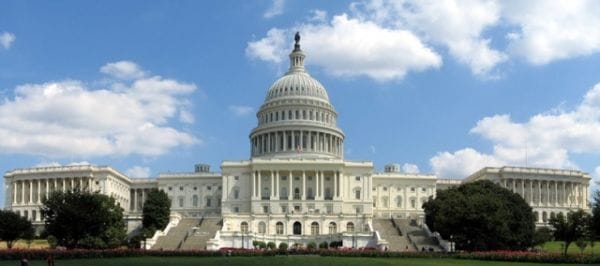
In the final voting session before the election break, Congress saw its fair share of partisanship and finger pointing. In the voting record, three of the four votes fell strictly down party lines for San Diego representation. The fourth vote, a six month stopgap, was approved by all San Diegan representatives. San Diego residents have three Republicans and two Democrats representing them. Are local representatives protecting San Diego interests?
A Six Month Stopgap (HJ Res 117)
Passing with a large majority, both the House and the Senate passed a measure to fund the government for the first six months of Fiscal Year 2013 at an annual rate of $1.047 trillion. This number may seem large, which it is, as it is more than the 2012 spending levels. This stopgap measure is necessary because Congress has failed to enact any of the twelve regular appropriations bills for the Fiscal Year that began on October 1.
What does this bill mean for the American people? Federal workers will not see a pay raise anytime soon because wages will be frozen for a third consecutive year. However, there is a major increase in funds to process claims for disabled veterans. Furthermore, Congress has also increased funds for initiatives to fight wildfires, modernize the U.S. nuclear arsenal, and provide further security for federal computer systems.
All five San Diego representatives voted yes for the passage of this bill.
Government Spy Powers (HR 5949)
The House sent the Senate a bill to renew the Foreign Intelligence Surveillance Act (FISA) through 2017. Here is how this bill affects Americans:
The law authorizes the National Security Agency (NSA) to conduct surveillance without specific warrants of phone calls, emails, and other contacts between foreigners that pass through telecommunication switching points in the US. The key to this part of the bill is the word foreigners. The bill does not authorize surveillance of two US citizens communicating. However, the language of the bill does open up to the possibility that communication between citizens and foreigners could be monitored.
The bill also authorizes a secret FISA court to issue blanket warrants for spying on communications between US and foreign locations and continues the requirement that strictly domestic spying on Americans be authorized by the FISA court on a case-by-case basis. On a positive note, any surveillance conducted without a specific warrant that inadvertently picks up communications by an American must be expunged or disregarded. The secret FISA court is made up of current federal judges.
FISA was enacted in 1978 to govern the domestic collection of foreign intelligence with a goal of protecting Americans’ civil liberties. San Diego’s three Republican Representatives, Brian Bilbray, Duncan Hunter, and Darrell Issa, voted to approve this bill while Democrats, Susan Davis and Bob Filner, voted no on it.
Budget Control (HR 6365)
HR 6365 is a Republican initiative directing President Obama to send Congress specific spending cuts to replace the $110 billion in blind, across-the-board cuts in military, foreign-affairs, and domestic spending scheduled for January 2013 under the 2011 Budget Control Act.
The bipartisan deal struck in 2011 that averted a government default required $110 billion in across-the-board cuts as part of the $2.7 trillion in deficit reductions laid out in the bill over ten years. Half of the $110 billion is to come from the Pentagon budget. Majority Leader Eric Cantor believes if the cuts go forward they will fundamentally weaken our current and long-term security, including reductions in shipbuilding, aircraft, and missiles; shrinking our current armed forces to levels not seen since the 1930’s.
The vote on the bill was a strict party-line vote with San Diego representatives. Republicans voted for the measure, which passed in the House 223-196. Democrats voted no.
Democratic Alternative to Budget Control
As many would guess, this vote went the complete opposite way of the original Budget Control Bill. This Democratic alternative was the only bill defeated during the week. Democrats purposed the $110 billion in blind cuts come from a combination of tax increases on the wealthy and targeted spending cuts.
The bill would have enacted the so-called “Buffett Rule” which sets a minimum tax rate of thirty percent on households with at least $1 million in income from salaries and/or investments. Furthermore, the bill sought to extend the Bush tax cuts for income under $250,000 while allowing them to expire for income over $250,000.
Democrats Susan Davis and Bob Filner supported this measure.