Skip to content
Sign up free
News

Bay Delta Conservation Plan Draws Environmental Ire

Bay Delta Conservation Plan Draws Environmental Ire

By Cheyenne Cary

2-minute read

image courtesy SacramentoRiverDelta.net
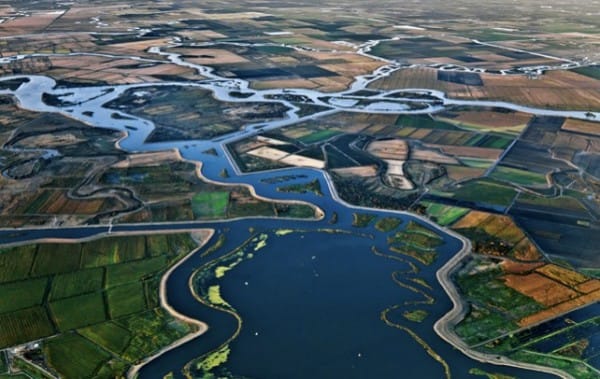
In a push to provide more water for agribusiness and residents of southern California, Governor Jerry Brown has proposed a pair of 40 mile tunnels to move water from the Sacramento River Delta to the town of Tracy, a project with a price tag anywhere from $24 to $50 billion in construction, conservation and operational costs. The tunnels are the centerpiece of the Bay Delta Conservation Plan, a program designed to balance the water needs of communities and ecosystems around the Bay with those of southern California. Considering that local pumping of the Delta has already been restricted in recent years due to impact on fisheries, how will such an increase in water demand impact the Delta, local economies both north and south and, overall, the State of California budget?

Environmental impact: Whence the fishes?

The current Delta tunnel plan is essentially a revision to the original “peripheral canal” that Brown proposed in his first term as governor, and that voters defeated in 1982. Growing urban water consumption and years of droughts have given the proposal a new lease on life, but it remains dogged by the same environmental concerns as before.

Perhaps most obvious is the impact of the tunnels, or “conveyance system,” on fish and wildlife; excessively draining the watershed poses an existential risk for recreational and commercial fisheries of Chinook and steelhead salmon as well as a threat to their related food chain. Throughout the conveyance system planning process, the California Department of Fish and Game, National Marine Fisheries Service and US Fish and Wildlife Service have warned that fisheries could be irreparably harmed by the new development, and have argued that the methodologies used by the Bay Delta Conservation Plan understate the tunnel’s fish footprint.

Nonetheless, the Brown administration maintains that the BDCP will not only spare the salmon from extinction, it will in fact “improve the status of a wide variety of listed species and species of concern under the Endangered Species Act.” To be fair, the plan for the conveyance system budgets $10 billion toward habitat restoration, so that claim might have some merit. However, the fact that the plan includes a 50-year exemption from the very same Endangered Species Act throws the BDCP’s credibility into question.

State agencies are currently working on an Environmental Impact Report for the BDCP in compliance with the California Environmental Quality Act and the National Environmental Protection Act. Results have not yet been released, but up until now almost every account holds that the conveyance system will have a net negative impact on the Delta ecosystem. So then, will the economic benefits of the Bay Delta Conservation Plan outweigh the environmental costs?

Tags: News

Adhere to the IVN etiquette

By posting a comment, you agree to adhere to our etiquette rules: No partisan attacks, no personal attacks, substantiate your sources, no self-promotion.

Get IVN’s Free Weekly Newsletter:Get IVN’s Free Newsletter

Get IVN’s Free Weekly Newsletter:Get IVN’s Free Newsletter

Nonpartisan Issues. Diverse Perspectives.

Check your inbox and click the link to confirm.

Republish this article

Republishing guidelines

Republish IVN articles for free. Independent Voter News articles may be republished online or in print under a Creative Commons BY-NC-ND 4.0 license, on these terms:

  1. Credit the author and IVN. Keep the byline ("By Author Name, Independent Voter News") and the attribution note at the end, which links to the original.
  2. Keep the meaning. You may update time and place references and apply your house style. You may trim for length, as long as the cuts don't change the meaning or misrepresent the author. Keep the headline. Mark any additions as your own (for example "Additional reporting by ...").
  3. Translations are welcome. Translate faithfully, add "Translated from English by [your outlet]", and tell us at editor@ivn.us.
  4. Keep the links, including the link to the original article.
  5. Keep the tracking image. The HTML includes a 1-pixel image that counts readers on your page. It collects no personal information.
  6. Photos and illustrations. Images credited to IVN may be used with this article only. Images credited to others (AP, Getty, Unsplash, Wikimedia and so on) stay under their owners' terms. Secure the rights or switch "Include images" off.
  7. Don't sell it. You can't sell our articles or sell ads specifically against them. Your normal site advertising is fine.
  8. No implied endorsement. Don't suggest that IVN or the author endorses you, your candidates or your causes, or that donations to you support IVN.
  9. Keep labels. Opinion or analysis pieces keep that label.
  10. Point search engines to the original. Set the canonical URL of your copy to the original IVN article (the HTML we give you includes the tag).
  11. No bulk or automated republishing, and don't submit our articles to aggregators (Apple News, Google News, MSN) as your own.
  12. Corrections and removals. Update your copy when we correct it, and remove it promptly if we ask. We'll contact you at the email you give us.
  13. Questions or print republication: editor@ivn.us.

IVN staff: fill in who you're inviting above, then create the invite.

Preparing the article

Bay Delta Conservation Plan Draws Environmental Ire

Choose a format
  • HTML
  • Email HTML
  • Markdown
  • Formatted (.docx)
  • Plain text
  • WordPress blocks
  • PDF
Choose a platform

Photos credited to others need their owners' permission.

To for

Republishing somewhere else? Questions? editor@ivn.us