
Chevron refinery emits pollutants in Los Angeles. Credit: DeviantArt
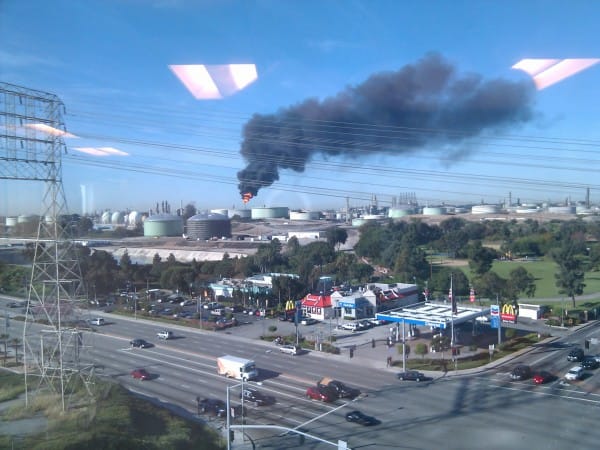
In an effort to reduce emissions and running contrary to national trends, California cap and trade testing has begun, with full implementation coming soon.
Proposed as a market-based solution to reduce greenhouse gas emissions, the cap and trade system has been falling in and out of political favor for years. At the Governor's Global Climate Summit in 2008, then President-elect Obama promised that he would help create “a federal cap and trade system” that would “establish strong annual targets that set us on a course to reduce emissions.” However, after Republicans gained seats in the House and Senate in 2010, federal cap and trade has been mostly shelved.
Yet while cap and trade at the federal level sits at a stalemate, the nation’s first comprehensive carbon tax system is getting ready to take flight in California. AB 32, passed by California legislature in 2006, aims to reduce greenhouse gases emissions by 17% over 10 years by using cap and trade economics. The process is now moving through its final testing phase before full implementation in November, and its success or failure will be a strong reading on the feasibility of similar programs nationwide.
The basics of cap and trade are easy enough to follow; a central government authority (in AB 32’s case, the California Air Resources Board) will set a “cap,” a maximum amount of greenhouse gas emissions, for major emitters within the state. The authority will then sell emissions permits, or “allowances,” to companies that emit large amounts of GHGs, effectively placing a tax on each unit of pollutant emitted.
Gradually the cap will move lower, reducing the number of allowances available and forcing companies to draw down their emissions through technological improvements or investing in “offsets,” projects that help mitigate pollution such as forestry or destruction of ozone-depleting substances. Companies that perform well will end up with surplus allowances that they will be able to “trade” with companies looking to buy more allowances. In California, AB 32’s cap and trade will primarily cover power plants, oil refineries and factories producing cement and glass, setting a cap at about 90% of average emissions within each industry.
Somehow AB 32, also known as the Global Warming Solutions Act, has slipped beneath the political radar of many Californians as a relatively obscure piece of legislation. Nevertheless, the bill created a huge stir amongst the regulated industries and political conservatives, who have tried to recast AB 32 as a threat to economic recovery and job creation due to increased costs of doing business.
In California’s 2010 election, oil and gas companies poured over $10 million into a ballot proposition to overturn AB 32, called the California Jobs Initiative by supporters. The proposition was defeated with a 61% “No” vote, but debate and discussion continue as to the economic impact of a statewide carbon tax.
The nonpartisan Legislative Analyst’s Office published a report in 2010 that said AB 32’s impact on jobs would be “modest in comparison to the overall size of the state’s economy,” and Governor Jerry Brown has even included $1 billion of revenue from AB 32 into his 2013 budget towards the General Fund.
As California cap and trade testing ends and full implementations begins, important questions about distribution of costs and appropriation of revenues come to the surface. This will be explored in subsequent articles.