Skip to content
Sign up free
News

California Cities Face Massive Budget Cuts, Default, Bankruptcy

California Cities Face Massive Budget Cuts, Default, Bankruptcy

By Bob Morris

2-minute read

stockton_bankruptcy

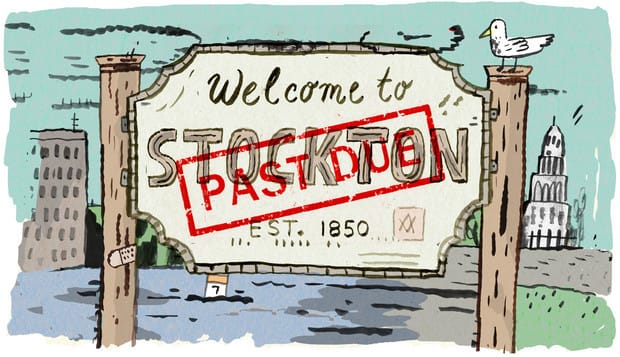
Many California municipalities are facing crushing bond and pension debt, while eviscerating budgets in attempts to stay solvent. Among the worst hit is the city of Stockton, whose city council recently voted to default on bond payments. It's a move widely seen as a precursor to filing for bankruptcy.

The city is now trying to negotiate terms with bond holders in hopes that bankruptcy can be avoided. Their city manager says there are no other alternatives. Stockton's budget has already been drastically reduced, salaries cut, and taxes raised. Doing more of the same is no longer an option. Their problems are an exaggerated version of what most California municipalities face. Pension obligations for retirees are expensive and rising. Debt brought on by financing during the real estate boom remains while the economy has yet to sufficiently recover. When real estate collapsed, so did revenue.

Real estate prices zoomed up in Stockton as workers in the Bay Area increasingly looked for housing they could afford. But when the bubble burst, there was no cushion, nothing to bounce off. Stockton is not near much of anything, agriculture is the primary industry, and there aren’t many jobs.  Home prices have dropped by two-thirds. Violent crime has soared. Last year, Forbes ranked Stockton as the "#1 Most Miserable City” in the U.S.

Other cities have faced similar troubles. Vallejo emerged out of bankruptcy last year, but things are still dire. The police and fire departments are hugely reduced in size. Prostitution and drug use is now prevalent while neighborhood associations are doing what the police used to do. As cities continue to hollow out, neighborhood watch groups may become increasingly paramilitary in other cities and municipalities.

And Stockton and Vallejo are hardly alone. Bakersfield, Merced, Lincoln, Hercules and Half Moon Bay have also considered bankruptcy. Santa Ana is disbanding its 128 year old fire department and will contract fire and rescue out to the Orange County Fire Authority. They say it will save them $10 million a year. They currently have a shortfall of $30 million. El Segundo, Costa Mesa, and Monterey Park are considering similar moves.

Perhaps regionalizing resources is a strategy for cities to reduce debt, as it would cut training costs and provide economies of scale. But will the level of service be the same? This may help going forward but doesn’t reduce existing bond and pension debt. The only way that existing debt can be reduced is by renegotiating with debtors or breaking contracts due to a bankruptcy filing, some which many California cities may be doing soon.

Tags: News

Adhere to the IVN etiquette

By posting a comment, you agree to adhere to our etiquette rules: No partisan attacks, no personal attacks, substantiate your sources, no self-promotion.

Get IVN’s Free Weekly Newsletter:Get IVN’s Free Newsletter

Get IVN’s Free Weekly Newsletter:Get IVN’s Free Newsletter

Nonpartisan Issues. Diverse Perspectives.

Check your inbox and click the link to confirm.

Republish this article

Republishing guidelines

Republish IVN articles for free. Independent Voter News articles may be republished online or in print under a Creative Commons BY-NC-ND 4.0 license, on these terms:

  1. Credit the author and IVN. Keep the byline ("By Author Name, Independent Voter News") and the attribution note at the end, which links to the original.
  2. Keep the meaning. You may update time and place references and apply your house style. You may trim for length, as long as the cuts don't change the meaning or misrepresent the author. Keep the headline. Mark any additions as your own (for example "Additional reporting by ...").
  3. Translations are welcome. Translate faithfully, add "Translated from English by [your outlet]", and tell us at editor@ivn.us.
  4. Keep the links, including the link to the original article.
  5. Keep the tracking image. The HTML includes a 1-pixel image that counts readers on your page. It collects no personal information.
  6. Photos and illustrations. Images credited to IVN may be used with this article only. Images credited to others (AP, Getty, Unsplash, Wikimedia and so on) stay under their owners' terms. Secure the rights or switch "Include images" off.
  7. Don't sell it. You can't sell our articles or sell ads specifically against them. Your normal site advertising is fine.
  8. No implied endorsement. Don't suggest that IVN or the author endorses you, your candidates or your causes, or that donations to you support IVN.
  9. Keep labels. Opinion or analysis pieces keep that label.
  10. Point search engines to the original. Set the canonical URL of your copy to the original IVN article (the HTML we give you includes the tag).
  11. No bulk or automated republishing, and don't submit our articles to aggregators (Apple News, Google News, MSN) as your own.
  12. Corrections and removals. Update your copy when we correct it, and remove it promptly if we ask. We'll contact you at the email you give us.
  13. Questions or print republication: editor@ivn.us.

IVN staff: fill in who you're inviting above, then create the invite.

Preparing the article

California Cities Face Massive Budget Cuts, Default, Bankruptcy

Choose a format
  • HTML
  • Email HTML
  • Markdown
  • Formatted (.docx)
  • Plain text
  • WordPress blocks
  • PDF
Choose a platform

Photos credited to others need their owners' permission.

To for

Republishing somewhere else? Questions? editor@ivn.us