
Credit: commons.wikimedia.org
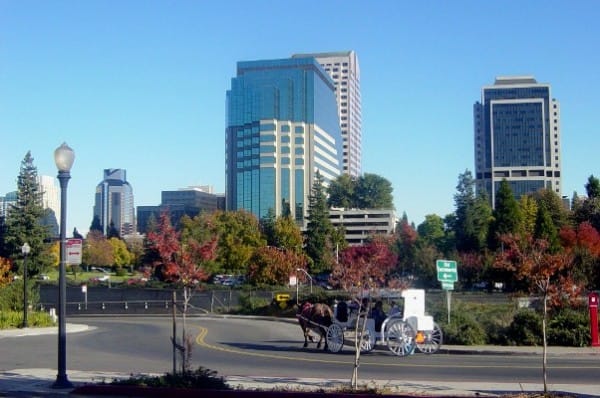
Shock waves reverberated through Sacramento with the recently announced closure of a Comcast call center and an iconic Campbell’s Soup plant that has employed lower middle-income people here since 1947. Campbell’s Soup employed 700 people who made as much as $20 an hour as members of the Teamsters Union.
Comcast eliminated 300 call center jobs in the Natomas area just north of the Sacramento River, but unlike Campbell’s Soup, Comcast at least offered these workers positions at call centers in Oregon, Washington and Colorado. If these trends continue, could the Sacramento Valley become a California Rust Belt?
Local businesses have been closing as well. Capitol Nursery, another iconic business that supplied plants and gardening supplies from its original, large South Land Park facility, announced the closure of this location about six weeks ago. With the bursting of the housing bubble, and competition from Home Depot, the demand for nursery plants and supplies plummeted, forcing Capitol Nursery to close this location. Just around the corner, Ford’s Real Hamburgers closed over the weekend.
Local economist Jeff Michael of the University of the Pacific says not to worry because Sacramento area job growth has increased 2.2% and unemployment has dropped to 10.3%. There are other reports that confirm Michael’s analysis, a 2.6% increase in new jobs in July, for example, as well as a more recent Center for Strategic Economic Research quarterly report emphasizing five straight months of positive job growth.
So perhaps the recovery is here at last, but, if so, it is a tepid one, as the state as a whole has only recovered about one third of the jobs lost in the 2007-2009 recession. It is consistent with past findings that the 2007-2009 recession is noteworthy for the severity of the decline in GDP and slow employment growth compared to previous recessions in 1973-1975, 1981-1983 and 1990-1991. Through the end of 2011, only nine states had recovered to the level of economic output that existed prior to the beginning of the recession.
Such slow job growth is intensified by declining median household income, as Sacramento, along with San Joaquin Valley cities like Fresno and Bakersfield, have suffered extreme declines. In 2007, Sacramento lagged the state median household income by only $250, but at the end of 2011, lagged it by $2,136. Shockingly, Sacramento is an anomaly to the extent that the situation here is better than the urban areas to the south. Modesto, Fresno and Bakersfield rank in the top 5 of such areas nationally in terms of people living below the poverty line, with Modesto at 23.8%, Bakersfield at 24.5% and Fresno at 25.8%. Sacramento finds itself at a relatively blissful 17.7%, just 1.8% above the national average.
Without question, despite some of the apples and oranges aspects of this data, the overall direction is clear. Inland California has suffered horribly as a result of the 2007-2009 recession, and the recovery, such as it is, is having minimal impact in terms of alleviating the distress experienced by the people who live here. There are increasing numbers of homeless people in the central city and their faces become recognizable to those who travel the area frequently. The visual decay of the residential and commercial landscape is striking when driving south on Highway 99, especially in comparison to the dynamism, however uneven, of the Bay Area.
Richard Walker, a geography professor at UC Berkeley, has examined how California has been adversely affected by the recent cycle of housing bubbles. Upon discovering that the population of rust belt cities like Pittsburgh, Cleveland and Dayton had declined by nearly half since 1960, I asked him if there could be a similar out-migration from the cities of the Sacramento and San Joaquin Valleys in the coming decades. He paused for a moment, and responded by saying that he wouldn't rule it out because one of the constants of geography is change. The Sacramento Valley could be living through the beginning of this process.