
Source: SF Examiner
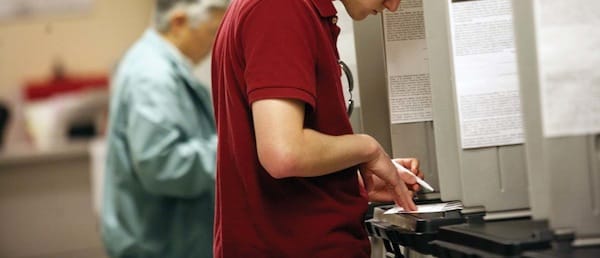
In June 2010 California radically changed the way candidates are elected to public office by passing the non-partisan "Top-Two" open primary ("Proposition 14"). Previously, candidates running for office appeared only on their party's ballot in the primary election. Then, the winner from each political party and any independents who qualified for ballot access would move on to the general election. In the November general election, voters could choose between one Republican, one Democrat, and any number of third party and independent candidates for almost every office contest.
Proposition 14 changed all that. Now, under the "Top-Two Open Primary Act," all candidates desiring to run for public office, regardless of party affiliation or preference, appear on a single combined ballot in the primary election. Likewise, all voters, regardless of party affiliation or preference, are permitted to vote for any candidate on this combined ballot. The two candidates who receive the highest and second-highest number of votes move on to the general election. This November, California voters will choose between the two candidates that came out at the top of the primary.
Candidates can choose whether or not to list their party affiliation on the primary and general election ballots.
Interestingly, the change does not apply to all offices. It only includes State-oriented offices, like US Senate, US House, State-wide offices, State Senate, and State House. The open primary system does not include county and local offices or the office of US President. Nonetheless, the new election process could be a seismic change in California’s democratic process. This election will determine the magnitude the change.
The number of office contests where the candidates are, and are not, of the same party in the Vote-CA.org November 6, 2012 California General Election Report provides a hint.
- For the U.S. Senate seat, there remains one incumbent Democrat and one Republican challenger.
- For the 53 U.S. House contests, 41 (77%) have one Republican and one Democrat, 6 (11%) have two Democrats, 2 (4%) have two Republicans, and 4 (7%) have an independent or no party affiliation with a Democrat (3) or Republican (1).
- For the 20 State Senate contests, 16 (80%) have one Republican and one Democrat, 2 (10%) have two Democrats, 0 have two Republicans, and 2 (10%) have an independent or no party affiliation with a Democrat.
- For the 80 State House contests, 58 (73%) have one Republican and one Democrat, 11 (14%) have two Democrats, 7 (11%) have two Republicans, and 4 (5%) have an independent or no party affiliation with a Democrat.
A more in depth look at the report will help voters decide the true statistical significance of these numbers.
About a quarter of the general election contests have candidates that would not have been on the ballot using the old system. Whether this is a "seismic" change will be determined by the outcome of the general election, but the fact that at least 5 partisan incumbents who never had a serious challenge under the old system are now facing potential defeat is alone an historical change.
Most importantly for voters, the open primary promotes a more democratic electoral process and leaves partisanship behind by pushing a candidate's character and record to the forefront of a race.