
Photo: South China Morning Post
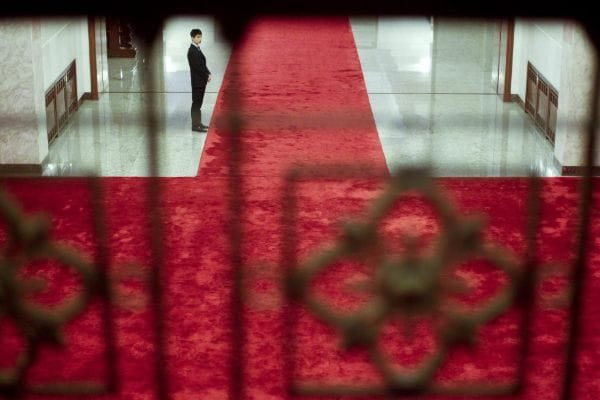
China’s 18th Party Congress began on Thursday, marking the beginning of a long and arduous process of a change in Chinese leadership which decides the direction of the country and officially names the country's next president.
The event brings delegates from all over China to Beijing to discuss the economy, appointments to the Politburo, and other urgent national issues. Current president Hu Jintao, addressed the delegates Thursday, promoting reform in the country but warning about the dangers of straying too far from “Mao Zedong thought.”
China hangs in a delicate balance between consumer-centric growth, inextricable from the global economy, and the sluggish inefficiencies of state owned enterprises and government corruption. Recently, China has been experiencing slowed growth, alarming some officials into being more receptive of reforms. Although there have been some signs of forward momentum in the economy, there isn’t a strong guarantee of stability.
Mao Zedong’s leadership in the mid-twentieth century left China in economic shambles. By the time Deng Xiaping took control in 1978, the people of China needed solution to their wide-spread, dire poverty. Deng Xiaping introduced sweeping economic reforms, including supporting meritocracy so that only the best and brightest made their way to the top of the government ranks, as well fostered good relationships with other countries, including the United States.
Xiaping learned from the USSR’s isolation, and noticed the damaging economic effects of such policies. His leadership brought a large number of Chinese citizens out of poverty and set the country up for the strong growth it is now known for.
However, according to Ezra Vogel, a professor at Harvard and author of Deng Xiaoping and the Transformation of China, China has strayed too far from the Deng Xiaoping reforms and has become entrenched in status quo policies. He writes in The New York Times,
"But in recent years China has lost its way. The public has become fed up with rampant corruption, the extravagant lifestyle of party leaders, the lack of full freedom and the inadequate procedures for correcting leadership abuses. Economic growth is slowing down while over a 100 million people still remain below the poverty line…China badly needs political and social reform."
The Chinese leadership seems to be recognizing that need, although experts warn that the American perception of the word “reform” could differ greatly from the meaning of “reform” in China. Many of the comments made Friday by delegate members addressed the economy. Guo Shuqing, the chairman of the China Securities Regulatory Commission said,
“Technological innovation in the United States, Britain, and France is supported by venture capital and startup investment. A positive environment for equity finance must be the foundation for innovation. This can push China to center sectors dominated by developed countries. The real economy is still focused on low-value-added production. It’s intimately related to the fact that our financial system is not developed. The real economy lags behind because financing is difficult and expensive.”
On Saturday, National Development and Reform Commission head, Zhang Ping, announced to reporters that China should double its 2010 GDP and per capital income by 2020, although he did not detail the reforms that would do so.
Zhang continued,
"We are fully confident that we can achieve the economic growth target for this year. In other words, we are able to maintain economic growth of above 7.5 percent…But we dare not lower our vigilance. The foundation of the economic stabilization is not solid enough...Under the backdrop of a persistent global financial crisis as well as a new situation and problems in the economy, we must make preparations for dealing with difficulties and challenges over the long term."
China was a foreign policy focus throughout the 2012 election season in the United States, particularly as it pertains to the American economy and its slowed growth. President Hu congratulated Obama on his reelection, citing improved relations over the last four years.
The Chinese administration also congratulated Joe Biden on retaining his post as vice president. Biden met with China’s next leader and current vice president, Xi Jinping, in hopes of developing a better relationship with China. The new leader is set to be announced this coming week and to begin his new position in March.
Xi Jinping is an interesting, although slightly mysterious, character in Chinese politics. His wife, a singer, is more famous than he is. As the son of a revolutionary general, he is described as a Chinese “princeling,” but he also spent long years as a cave-dwelling laborer in one of China’s poorest regions.
Xi Jinping’s close ties to the military could prove testy for China’s relationship to the US. Chinese nationalism is seen to be on the rise, and their ongoing (and increasingly urgent) territorial disputes could be tricky for American foreign policy to maneuver around.
Between the rather enigmatic Xi Jingping and the relative uncertainty surrounding China's economic future, a close eye on developments in the world's largest nation is warranted.