
Photo: Syrian Arab News Agency
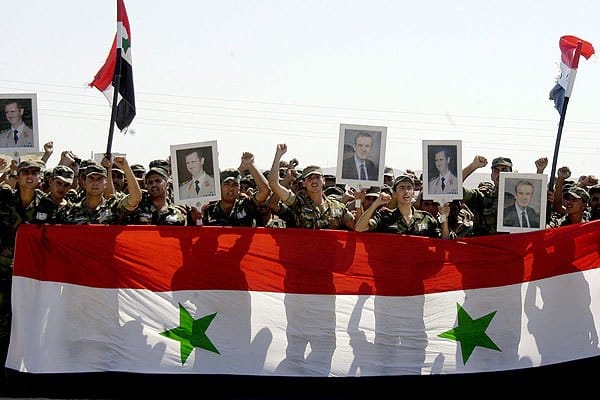
President Obama warned Syria's government earlier in the week that the use of chemical or biological weapons in the nation’s escalating civil conflict against the Syrian uprising might illicit a US military response. The president called the use of such weapons a “red-line” with “enormous consequences.”
Syrian foreign ministry spokesperson Jihad Makdissi confirmed that Syria possessed chemical and biological weapons in July when responding to international concerns that the country’s stockpile could fall into terrorist hands. Speaking on Syrian state television in July, Makdissi said:
"All of these types of weapons are in storage and under security and the direct supervision of the Syrian armed forces and will never be used unless Syria is exposed to external aggression."
The Syrian uprising began in the southwestern city of Darraa near the Jordanian border in March 2011 when officials arrested several children for writing anti-government graffiti at school. Protesters opposing the arrests demanded reforms and decried government corruption. Government soldiers fired on the demonstrators, which resulted in four deaths. Since then violence in Syria has escalated into daily battles between government forces and rebel militias.
In Monday’s impromptu White House press brief, President Obama told reporters that the use of biological and chemical weapons remained a concern to both the US and the NATO alliance:
"We have been very clear to the Assad regime, but also to other players on the ground, that a red line for us is we start seeing a whole bunch of chemical weapons moving around or being utilized. That would change my calculus."
CNN reported that Pentagon planners completed a preliminary blueprint for military intervention in Syria in June. The news outlet reported that military officials cited civil war, sectarian violence, humanitarian aid, and the securing of weapons of mass destruction as major military concerns.
Media reports over the last decade have speculated that Iraqi leader Saddam Hussein transferred WMD to Syria. Iraqi Air Force general under Hussein, Georges Sada claimed in a 2006 book that the Iraqi leader moved WMD to Syria on the eve of the 2003 invasion, while the Israeli newspaper Ha’aretz released high altitude photos of suspected Syrian chemical weapons sites in 2010. However, a fact-finding mission by the multinational Iraqi Survey Group concluded that Iraqi WMD did not end up in Syria.
The situation in Syria continues to complicate relations between the United States and the Russian Federation. The Syrian government remains host to the Russian navy in the port city of Tartus where Russia has operated a supply and maintenance installation since 1971. Russia also maintains an extensive arms trade with the Assad government.
Secretary of State Hillary Clinton accused Russia of sending attack helicopters to aid the Syrian government In June:
"We are concerned about the latest information we have that there are attack helicopters on the way from Russia to Syria, which will escalate the conflict quite dramatically."
Russia insisted that the hardware was moved under a contract signed in 2008 for overhaul in the Middle-Eastern nation. Speaking on the helicopters, Russian Foreign Minister Sergei Lavrov accused the United States of supporting the rebels:
"That contrasts with what the United States is doing with the opposition, which is providing arms to the Syrian opposition which are being used against the Syrian government."
However, the United States and Russia remain in agreement that the Syrian government should not secure chemical and biological weapons from terrorists groups.
Russian Deputy Foreign Minister Gennady Gatilov told reporters on Thursday that the Syrian government assured Russian officials that Damascus will not allow weapons to fall in to terrorist hands:
“We were assured a very strict control is exercised over the security of the chemical weapons storage and that there is no danger the situation might fall out of control.”
The situation in Syria also complicates the antagonistic relationship between Iran and the West. Western diplomats have repeatedly accused Iran of aiding the Assad government. The Irish Times reports that a UN investigation has implicated Iran in illegally providing support to Syria.
UN secretary general Ban Ki-moon told the UN General Assembly early this month that the conflict in Syria had become “a proxy war, with regional and international players arming one side or the other.”