
credit: Dell, Inc./Flickr
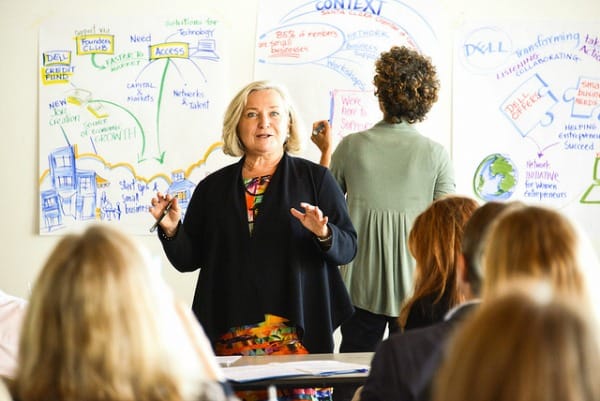
While most four year colleges and universities are retooling and transforming their institutions to prepare students for positions at top, large-scale corporations, community colleges are developing initiatives to help students find work with small businesses and startups.
A report released by the American Association of Community Colleges found that if community colleges partner with small business and startup initiatives, they have the ability to educate and train the next generation of entrepreneurs.
“Community colleges already have long had a reputation for being flexible, accessible, and responsive to local community needs," AACC states. "And now many are expanding their services to reach not only individuals who are pursuing business education, but also small businesses themselves.”
The report cites two main factors that make community colleges an incubator for small business development:
- Job Creation: AACC listed figures from the Small Business Administration that found that the 28 million small businesses that exist in the U.S. employ nearly 55 million employees, or 49 percent of the private sector. Small businesses also generate roughly two-thirds of net new jobs, and since the recession from mid-2009 to 2011, small firms have produced 67 percent of net new jobs.
- Industry-Driven Partnerships: As community colleges continue to work with the local business community, they build the coursework, faculty and academic resources specific to this niche market. Additionally, partnerships with workforce development programs, philanthropic organizations and corporations with small business initiatives, aid in providing the financial capital, mentoring, networking and targeted curriculum that enhance and grow these businesses.
Several community colleges have already produced results with entrepreneurial programs geared toward existing small businesses or new startups. The Virtual Incubation Network, funded by the Charles Stewart Mott Foundation and supported by the AACC, is a grant program that works with community colleges in disadvantaged areas to test new communication technologies to support entrepreneurs and foster small business development.
The North Iowa Area Community College in Mason City, Iowa established the John Pappajohn Entrepreneurial Center to offer comprehensive consulting services, network opportunities and access to capital to pre-venture, new and established business.
To date, NIACC has assisted 40 business startups and helped businesses raise $25 million as a recipient of the VIN grant.
Since 2009, Goldman Sachs and The Goldman Sachs Foundation developed the 10,000 Small Businesses program which provided $500 million in investment to existing small businesses to provide their owners with management education and capital for growth and job creation.
Two hundred million dollars of the fund gives owners the opportunity to get personal business coaching and increase their presence through greater access to local business organizations, professional services firms, and Goldman Sachs employees. The other $300 million will go to local community-based lenders to expand financial capital to small businesses in underserved communities.
For the last year, Houston Community College in Houston, Texas has benefited from the Goldman Sachs fund through offering support services and education to local business owners in the Houston area.
The partnership, which Houston Mayor Annise Parker touted as a way to “keep more of our local dollars here at home,” has already assisted small business owners in building better business, including a local architect who said that the program allowed her firm to re-energize.
AACC hopes to see community colleges become breeding grounds for new models of education to retool and reinvest in American-owned businesses. Community colleges can develop talent ready to serve local communities and can give adult learners and experienced professionals a cost-effective alternative to traditional colleges and universities.
These partnerships look to be the catalyst to create the next generation of jobs to pull the nation out of its struggling economy.