
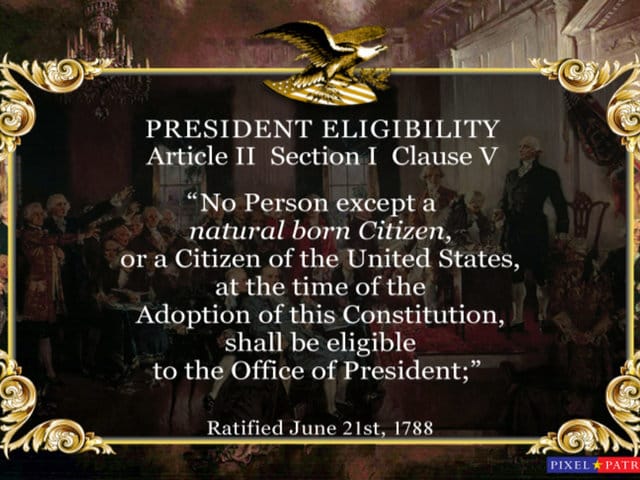
In order to qualify to be president, the U.S. Constitution states, "No Person except a natural born Citizen, or a Citizen of the United States, at the time of the Adoption of this Constitution, shall be eligible to the Office of President; neither shall any person be eligible to that Office who shall not have attained to the Age of thirty five Years, and been fourteen Years a Resident within the United States."
So what defines a "natural-born citizen"? The answer has not been so simple over the years. The framers left it fairly vague and up to us to interpret throughout our history, and it is an issue that has gone back and forth.
This has all been brought into question as a result of one man whom various media outlets have kept an eye on as a possible presidential candidate in 2016. The man in question is freshman U.S. Senator Ted Cruz (R-TX).
Cruz was born in Canada to an American mother and a Cuban father. His parents were working in the oil business there. Cruz's father did not become a U.S. citizen until 2005. So though he has made trips to Iowa and the media seems to be watching him quite closely, does he even meet the qualifications of being a natural-born citizen?
Section 1 of the 14th Amendment to the U.S. Constitution states, "All persons born or naturalized in the United States, and subject to the jurisdiction thereof, are citizens of the United States and of the State wherein they reside. No State shall make or enforce any law which shall abridge the privileges or immunities of citizens of the United States; nor shall any State deprive any person of life, liberty, or property, without due process of law; nor deny to any person within its jurisdiction the equal protection of the laws."
This still only leaves a very vague definition for what constitutes a natural-born citizen. So now we look toward Section 5 of the 14th Amendment which states, "The Congress shall have power to enforce, by appropriate legislation, the provisions of this article."
It should also be noted that under Article 1, Section 8, Clause 4 of the U.S. Constitution, Congress has authority to create law regarding naturalization which includes citizenship.
So now we know that Congress, under the 14th Amendment, can write legislation declaring what constitutes a natural-born citizen. And yes, that means that there will be legal challenges and the U.S. Supreme Court (SCOTUS) will have to make sure such legislation does not violate the Constitution in any way... including Section 1 of the 14th Amendment.
In the case Minor v. Happersett (1875), the court ruled, "The Constitution does not in words say who shall be natural-born citizens. Resort must be had elsewhere to ascertain that."
Minor v. Happersett
Though the Constitution is vague in what constitutes a natural-born citizen, Congress has stepped in to attempt to fill in the gap. Under Title 8 of the U.S. Code, Section 1401 defines the following as citizens of the United States upon birth... or natural-born citizens:
- Anyone born inside the United States. The person must be "subject to the jurisdiction" of the United States. (This would exempt the child of a diplomat, for example, from this provision.)
- Any Indian or Eskimo born in the United States, provided being a citizen of the U.S. does not impair the person's status as a citizen of the tribe
- Anyone born outside the United States, both of whose parents are citizens of the U.S., as long as one parent has lived in the U.S.
- Anyone born outside the United States, if one parent is a citizen and lived in the U.S. for at least one year and the other parent is a U.S. national
- Anyone born in a U.S. possession, if one parent is a citizen and lived in the U.S. for at least one year
- Anyone found in the U.S. under the age of five, whose parentage cannot be determined, as long as proof of non-citizenship is not provided by age 21
- Anyone born outside the United States, if one parent is an alien and as long as the other parent is a citizen of the U.S. who lived in the U.S. for at least five years (with military and diplomatic service included in this time)
By the conditions just laid out, it would appear that Senator Ted Cruz is not eligible to run for president as he would not qualify as a natural-born citizen since only one of the parents was a citizen of the U.S.
However, there still exists one more historical clause which will challenge this argument. The clause states, "a person born before May 24, 1934 of an alien father and a U.S. citizen mother who has lived in the U.S." is a citizen.
Does this change the argument? If it is grouped with Section 1401 of Title 8 of the US Code, then it would appear so.
Currently, citizenship in the U.S. is governed by the Immigration and Nationality Act of 1952. The most recent changes to statutory law was done by Congress in 2001. So since this most recent debate has circulated around Cruz, I am going to focus on one particular section... birth abroad to one U.S. citizen.
There are a certain set of rules for those born after November 14, 1986, but I'm focusing on the rules at the time of Cruz's birth, which are the rules that were in effect from December 24, 1952 - November 14, 1986. A person born abroad between those dates is a U.S. citizen upon birth if all of the following are true:
- The person's parents were married at the time of birth;
- One of the person's parents was a U.S. citizen when the person was born;
- The citizen parent lived at least ten years in the United States before the child's birth; and
- A minimum of 5 of these 10 years in the United States were after the citizen parent's 14th birthday.
By these very definitions of the law, it would appear that Cruz is a natural-born citizen and thus meets the qualifications to run for president if he decided to do so. This also does one more thing, as well.
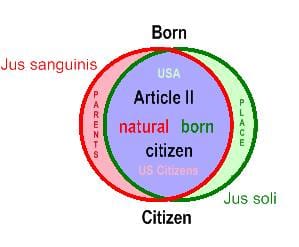
In regards to President Obama, if the "birther" theory had been proven correct (and I'm not saying that it is) in that he had been born in Kenya (instead of Hawaii) to his U.S. mother and his Kenyan father, he would still qualify as a natural-born citizen.
As I stated at the beginning, this issue is a complicated mess. The Framers left it vague when they wrote the Constitution. Did they do it because they couldn't foresee our future situations or was it so we could make such a determination as our nation progressed? One can only really speculate on that.
Regardless, we have done our best to set forth a definition, and one that holds for all Americans -- born here and born abroad. The laws have changed throughout our history, and they will probably change again in our future.
For now, we go by the laws which we have -- the laws in which we live by -- the laws that govern our society. They apply to us all equally. In this confusing mixture, I hope there has been some small sense to the issue and that now we can have a better understanding of it.