
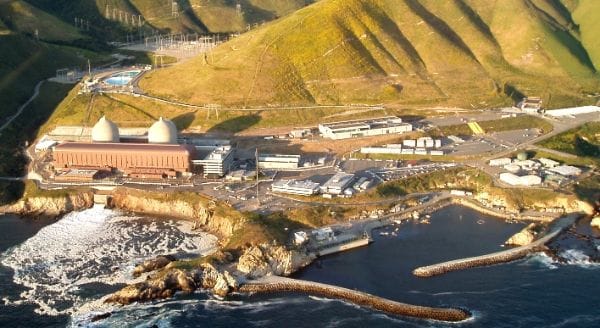
Nuclear power projects are often met with scrutiny when it comes to safety. The Diablo Canyon nuclear power plant, owned by Pacific Gas & Electric (PG&E), wants to undergo a 3D seismic survey for details on fault lines in order to assess the plant's safety. The California facility has already received on-shore and off-shore approval from the State Lands Commission. The utility will meet with the California Coastal Commission on Wednesday to seek their approval for the new off-shore research.
New regulations require that all nuclear plants in the country do seismic testing. PG&E has said that is plans to use the information from this research to support meeting these new requirements.
This type of research is performed around the world without harming marine life. However, PG&E's high energy proposal is under scrutiny because some of the testing may results in temporary disturbances within the region. In response to these concerns, PG&E, along with state and federal agencies, have developed several measures to make sure marine mammals are safe during the research.
The Diablo Canyon nuclear power plant, located in San Luis Obispo County, resides near regional fault lines. The US Geological Survey discovered the Shoreline Fault in November 2008. The Nuclear Regulatory Commission (NRC) was notified and deemed the plant's infrastructure safe for the fault's potential seismic activity.
The State of California called for a separate study of the newly discovered fault line. However, the California Coastal Commission is going to evaluate the environmental safety of the seismic tests that PG&E will propose. PG&E has completed several advanced studies to that end, and is looking to perform another to further their understanding of the seismic region.
Nuclear Regulatory Commission
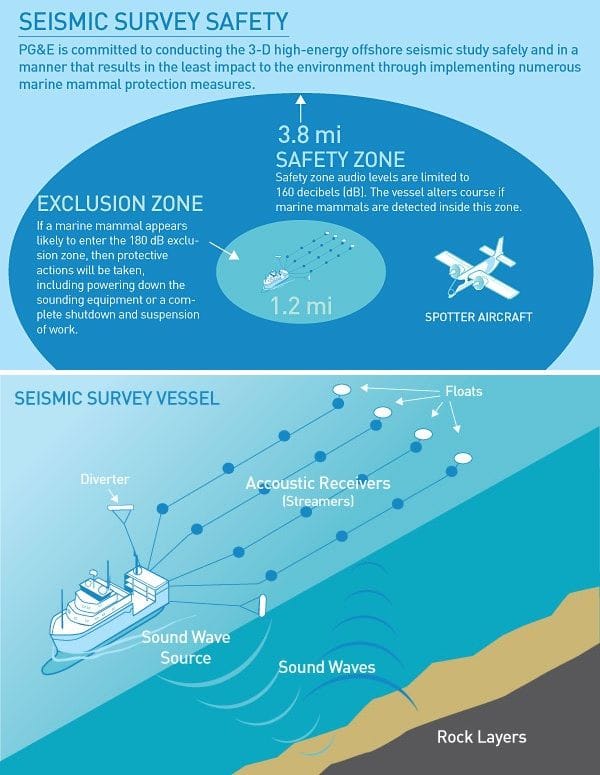
Research technology includes emanating sound waves from a National Science Foundation research vessel that will go to the earth's bottom and be reflected and recorded back to create a 3D image of the seismic faults in the region. The sound waves move towards the earth and then reflect a 3D rendering of the fault line. The PG&E website states that:
"This information from the study will help further define the ground motions that faults in the region are capable of producing, which PG&E will use as part of its ongoing work to continually assess and validate the seismic design of the plant."
The high energy off-shore testing is under scrutiny because it may disturb marine life. PG&E has come up with several measures to ensure marine life remains safe from the seismic testing zone. Experts will be on-board for marine observation with the National Marine Fisheries Service (NMFS). The plan includes acoustic and infrared observation of marine life during the course of the test. All work must stop if any harm to marine life is observed.
"Recent findings by federal agencies, which regulate the protection of marine mammals, have projected that the high-energy offshore research may cause a temporary disturbance, but no long-term impacts."
The Diablo Canyon nuclear power plant could be an important step towards independence from pollutant forms of energy.
"Its two units together produce approximately 2,300 net megawatts of greenhouse-gas-free electricity, about 10 percent of all electricity generated in California, and enough energy to meet the needs of more than 3 million Northern and Central Californians."
If approved, the high energy seismic tests will be conducted within the year.
Following the Fukushima nuclear power plant shutdown after Japan's tsunami in April of last year, nuclear energy companies are taking extra measures to ensure safety in the event of a natural disaster. The NRC will not renew the plant's operating license beyond 2024 until further seismic tests are completed and passed by the state.
PG&E released a statement to Reuters saying:
"As part of our strong commitment to safety, PG&E has and will continue to study the seismicity of the region to give us, our regulators and the public confidence that the plant remains safe."
Construction of the Diablo Canyon nuclear power plant began in 1968 and was completed in 1973. The site is in Avila Beach, California. The plant is constructed to withstand a 7.5 magnitude earthquake.
Here is visualization for the safety measures and testing procedures, provided by PG&E:
Click here to view the PG&E's seismic survey PDF.