
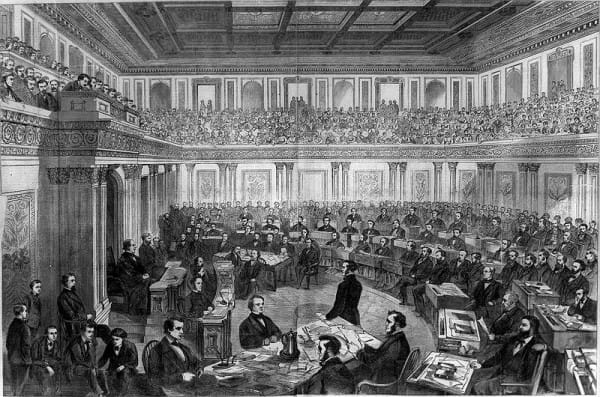
The landmark immigration reform, Bill S. 744 recently passed through the Senate 68-32 during the afternoon of June 27. It includes reforms which focus on border security, economic opportunity, and immigration modernization act, according to the US Senate’s website. But questions on the upper house’s ability to fairly legislate an issue in regard to its relevance in each selective state may have come up.
According to the Center for Immigration Studies, California, the state with the highest number of immigrants, had over 10 million immigrants in 2010. In contrast, the state with the smallest, Wyoming, had just under 16,000 immigrants the same year. With a difference roughly equaling California’s immigrant population, it would make sense that the Golden State has more say on the issue than others.
The four states just above Wyoming in immigrant population boast numbers barely exceeding 16,000. Likewise, the four states with immigrant populations just below California foster numbers in the millions. These astronomical differences in immigrant populations between the 50 states could suggest a flaw in the Senate’s overall efficiency in bettering America as a whole.

Out of the five states with the lowest immigrant populations, 3 of the 10 senators voted against the bill. Between the five states with the largest immigrant populations, 2 of the 10 opposed the reform. This concludes that the meat of the 32 oppositional votes stemmed from states falling in the middle of immigrant population sizes.
From another standpoint, when solely analyzing the ten states with the highest immigrant populations only 4 of the 20 representatives opposed the bill. In other words, those ten states provide only one-eighth of the oppositional vote. That being said, in this particular case the Senate’s overall decision reflected the voice of those states most affected by the issue.
With such a comprehensive immigration reform being decided by the 100 representatives, two from each state, one could be wondering why states with the smallest would get the same voting power on the issue. The US Senate contrasts the House in that it allows equal representation from each state regardless of population size.
The House, on the other hand, is made up of district representatives proportionate to the amount of citizens living in each of the fifty. Because of this difference, the Senate is more so a federal institution than the House, which acts as a divided representation of regional interests within state’s districts.
The bicameral legislature that makes up the US Congress was born in 1787 when the largest and populated states at the time wanted proportionate representation in congress while the smaller and less populated states sought equal representation. These states were worried that their more populated counterparts would end up controlling congress, since their more numerous voices would be heard louder.
Thus, the Connecticut Compromise was reached, which formed the upper lower houses of Congress. The Senate then, equally representing each state, is the house that deals more so as a federal entity than a state, which can become tricky for a subjectively pressing issue like immigration.
The bill was drafted by a bipartisan group of senators known as “The Gang of Eight." Half of the eight were representatives from one of the ten states with the highest number of immigrants, with another two being from Arizona, which is 11th on the list. This could be one of the reasons why just a fifth of representatives from the top ten states based on highest immigrant population opposed the bill; it was drafted by individuals surrounded by the issue.
Though this individual issue passed through the senate with seeming ease, not every proposed bill will have the fortune of being drafted by a bipartisan group like “The Gang of Eight." Likewise, it can’t be expected that those drafting every bill will be from states affected by the issue. However, this could potentially be a great way to modernize the upper house, assigning draftees based on their state’s connection to the issue. This could be a way to work around the equal representation in the senate. After all, what was an efficient compromise over two centuries ago doesn’t mean it will remain equally so in this modern age, does it?