Skip to content
Sign up free
News

European Austerity Measures Lead to Multi-Nation Strikes

European Austerity Measures Lead to Multi-Nation Strikes

By Ricky Gandhi

2-minute read

Credit: dailymail.co.uk
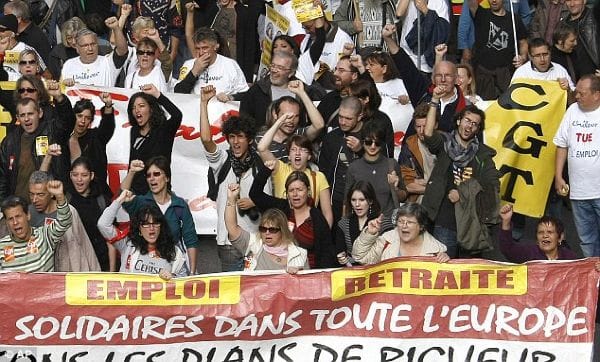
I, along with many others, did not have to go into work on November 14. Actually, we could not go into work. The 24 hour Train strikes spread all across Europe from 22:00 to 22:00 (10pm - 10pm). They were in response to the European austerity measures taking place in Spain, Portugal, Italy, and Greece. Subsequently, strikes occurred in those four countries as well as Belgium, Germany, France, the UK, some eastern EU states.

Luckily for me, I have not seen riots or dangerous situations where I currently reside. However, in areas such as Madrid, citizens saw a clash between protestors and police. In addition, airlines have been affected as well, leading to the cancellation of more than 700 flights. A great deal of businesses and schools had to close as well.

The European Trade Union Confederation, co-ordinators of the Europe-wide action, has urged workers to walk out. "Austerity is a total dead end and must be abandoned. Social protection and wages can no longer be sacrificed." stated the group.

My U.S. program director explained the situation to us students:

This train strike is part of an unprecedented, coordinated strike action by workers in many EU member states. These countries include: Greece, Spain, Portugal, France, Germany, the UK as well as some east European countries.The strike action is in protest against cuts in government spending and tax increases in countries such as Greece, Spain, and Portugal especially. Such so-called “austerity measures” are being blamed by workers and trade unions for prolonging Europe’s economic recession as they inhibit economic growth. They want to see such measures come to an end. Bear in mind these austerity measures are potentially destabilizing in the worst-hit countries (e.g. riots in Athens).Governments in Greece, Spain, and Portugal and Italy – which are all in the Eurozone – are imposing such measures in order to rectify their public finances. This means that their annual budget deficits and public debt levels are currently above EU limits (as set out in the Maastricht Treaty, 1992) and must be lowered. The EU has in recent years introduced a number of measures in order to increase the legal enforcement of such economic convergence criteria for Eurozone member states. The aim is to ensure the stability of the Euro.

It brings forth the traditional question in rough times - should the government cut or increase spending? Parallels to Europe's debt crisis are often drawn to the United States', and the results of one might influence the results of the other. It will be interesting to see where the Obama administration will go in dealing with not only our own fiscal crisis, but Europe's as well.

Tags: News

Adhere to the IVN etiquette

By posting a comment, you agree to adhere to our etiquette rules: No partisan attacks, no personal attacks, substantiate your sources, no self-promotion.

Get IVN’s Free Weekly Newsletter:Get IVN’s Free Newsletter

Get IVN’s Free Weekly Newsletter:Get IVN’s Free Newsletter

Nonpartisan Issues. Diverse Perspectives.

Check your inbox and click the link to confirm.

Republish this article

Republishing guidelines

Republish IVN articles for free. Independent Voter News articles may be republished online or in print under a Creative Commons BY-NC-ND 4.0 license, on these terms:

  1. Credit the author and IVN. Keep the byline ("By Author Name, Independent Voter News") and the attribution note at the end, which links to the original.
  2. Keep the meaning. You may update time and place references and apply your house style. You may trim for length, as long as the cuts don't change the meaning or misrepresent the author. Keep the headline. Mark any additions as your own (for example "Additional reporting by ...").
  3. Translations are welcome. Translate faithfully, add "Translated from English by [your outlet]", and tell us at editor@ivn.us.
  4. Keep the links, including the link to the original article.
  5. Keep the tracking image. The HTML includes a 1-pixel image that counts readers on your page. It collects no personal information.
  6. Photos and illustrations. Images credited to IVN may be used with this article only. Images credited to others (AP, Getty, Unsplash, Wikimedia and so on) stay under their owners' terms. Secure the rights or switch "Include images" off.
  7. Don't sell it. You can't sell our articles or sell ads specifically against them. Your normal site advertising is fine.
  8. No implied endorsement. Don't suggest that IVN or the author endorses you, your candidates or your causes, or that donations to you support IVN.
  9. Keep labels. Opinion or analysis pieces keep that label.
  10. Point search engines to the original. Set the canonical URL of your copy to the original IVN article (the HTML we give you includes the tag).
  11. No bulk or automated republishing, and don't submit our articles to aggregators (Apple News, Google News, MSN) as your own.
  12. Corrections and removals. Update your copy when we correct it, and remove it promptly if we ask. We'll contact you at the email you give us.
  13. Questions or print republication: editor@ivn.us.

IVN staff: fill in who you're inviting above, then create the invite.

Preparing the article

European Austerity Measures Lead to Multi-Nation Strikes

Choose a format
  • HTML
  • Email HTML
  • Markdown
  • Formatted (.docx)
  • Plain text
  • WordPress blocks
  • PDF
Choose a platform

Photos credited to others need their owners' permission.

To for

Republishing somewhere else? Questions? editor@ivn.us