
On June 9, 1903, USS Neckar was moored into Baltimore Port, completing its transatlantic journey from Bremen. For most passengers, it was the first time they set foot on American soil.
Their first act as immigrants to a new country consisted in responding to a 20 question survey which went through the following questions:
- Full name;
- Age;
- Sex;
- Marital status;
- Profession or occupation;
- Literacy;
- Nationality;
- Last place of residence;
- Final destination and whether they had already purchased the ticket to their final destination;
- The person who paid for the passage;
- If they were in possession of less or more than $30;
- If it was their first time in the U.S.;
- If they were joining a relative and the person’s name and address;
- If the person had ever been imprisoned or supported by charity;
- If the person was a polygamist;
- If they were under a labor contract in the U.S.; and
- What their health condition was and if they were deformed or crippled.
Source: http://www.dvhh.org/

On June 6, 2013, the American daily newspaper, The Washington Post, published slides revealing the existence of a program called PRISM, designed to collect data concerning American citizens and listing the information collected by the administration. These included the following: email, chat, videos, photos, stored data, VoIP, file transfers, video conferencing, notification of target activity, online social networking details, and special requests.
Credits: Washington Post
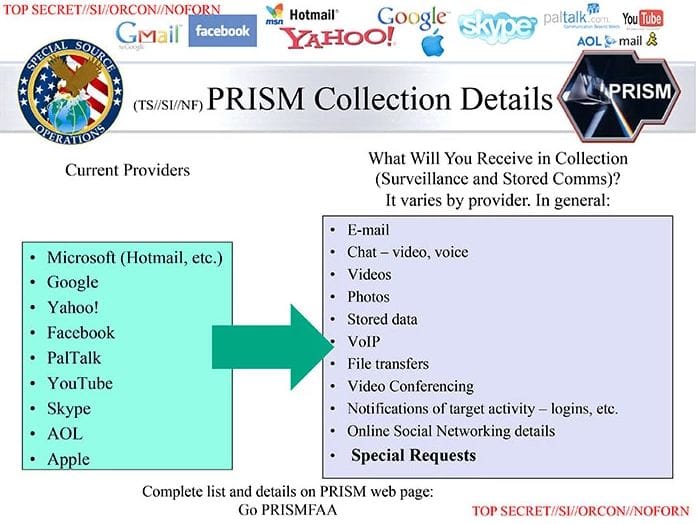
Both of these constitute examples of data collection on individuals on behalf of the state. Both illustrate the technological ability of the state to collect this information efficiently -- be it through a standardized questionnaire filled in by a clerk, or through information and computer technology. Both of these also display the state’s ability to keep track of its records, be it through an archive of records, or through a remotely accessible Internet network connection.
However, in the 110 years separating these two registries, a qualitative and a quantitative shift occurred in the processes of state data collection.
The quantitative shift is evident: in 1903, an immigrant arriving in America would provide one line of data, split in 20 columns. In 2013, the amount of data collected on a person is exponentially larger.
Technical ability and technological progress have, in this sense, developed the ability to store vastly superior amounts of knowledge on each individual beyond the wildest dreams of the clerk present at Baltimore Port to complete the survey.
But this development alone does not suffice to explain why these processes occurred as they did, although certainly a snow-balling effect did help the escalation of data collection on individuals. This unimaginable extension in the ability to draw up precise and extensive records is also the product of certain cultural choices and are, in this sense, the materialization of a certain ideology.
A Qualitative Shift
In order to perceive the essentially contingent and ideologically dependent nature of this formidable multiplication of data collection, one must look into the qualitative nature of the shift that occurred over the course of the 20th century.
Whereas in 1903, further data would be collected in the event of further contact with administration (most frequently state census and processes of naturalization), in 2013, further data can be collected at any given moment.
Whereas in 1903, this procedure of control by the state was reserved to the attention of immigrants of different nationalities, in 2013, it extended to all citizens of the state.
Whereas in 1903, information collected on individuals was gathered on a binary basis (columns being filled out from a limited amount of possible answers, usually two), in 2013, the inherently different nature of the data collected cannot be collated in a chart -- a development that paradoxically ran parallel to the increased reliance on binary code in computer and information technology.
Critical theory has recurrently attempted to supply the tools to interpret this shift and to supersede it, but has done so in a piecemeal fashion and, what is more, in a way that has contributed to the legitimizing ideology of technological progress and rationalization.
The specter of totalitarian control
One allegory that has often been employed to characterize recent developments in the field of data collection is that of George Orwell’s critique of totalitarianism 1984. The increasing controls of the state are often described as pertaining exclusively to a logic of surveillance of the civilian population. However, this is not strictly the case.
In the USA, mechanisms extending the grasp of state control and collection of data predate the Patriot Act and the war on terror. The extension of state census, the first attempt to constitute a database on the population of the United States, was a direct response to the demographic explosion following the Civil War and the need to maintain a demographically accurate representation of each state as stipulated by the Constitution.
Another key moment in this history occurred during the Great Depression. The policies of the Roosevelt administration to combat socioeconomic disarray provoked by the crash of 1929 relied heavily on the ability to maintain accurate socio-metrics on the living conditions of the unemployed to better target social policies of the New Deal.
If the logic of surveillance is present in the developments we are presently experiencing, these motives were never divorced from a logic of assistance. In fact, they became quite intertwined with the desire to preserve communities from the effects of unshackled capitalism and industrialization.
In fact, the critique of mass media and the totalitarian tendencies of western governments have tended to construct a powerful image which offered a fertile soil for the Internet and other new technologies to grow.
We are building a brave new world
The critique of forms of control and the corresponding mythology of what a free and participative form of community might resemble has led to the Internet being proclaimed as the tool that critical theory had outlined and that engineers had created.
Meant to provide a new democratic impetus to our increasingly controlled societies, the spread of computers, Internet and computer-literacy was largely perceived as creating a new forum for political ideas to challenge one another, a new social context for communities to build ties outside of the consumption society, and even as a platform for citizens to challenge and participate in policy-making (as is the case presently with the We The People Online initiative).
This initial utopia has become completely discredited: the Internet is not only perceived as supporting a general dumbing down of the population, it is increasingly seen as spawning a multiplicity of niche addictions -- to online shopping, to anti-social networking sites, to games (from Candy Crush to Sports Betting), to pornography – reinstituting the sovereignty of the consumption society over the digital landscape. However, the hopes that it bore initially set the technology on its path to universal ubiquity.
Materialized ideology
The critiques of centralized state control, both in the caricature they have drawn and in the hopes they have nurtured, have cleared the ground for a form of digital society of the kind we are experiencing.
Where control is diffused and jointly exercised across multiple agencies -- some of which belong to the private sector -- it cannot be tackled by the image of totalitarian power as it exists in our cultural imagery.
Where the citizen is allowed and indeed encouraged to voice his opinion across a broad network of forums and social networks, the critics of the ‘spectacle’ -- defined as the seizing of communal experience and its restitution in the form of a commercial image -- become the strongest supporters of the present order.
Harnessing technological progress, navigating the aspirations and the fears expressed by critical theory, age-old trends have been given a new garb, thus perpetuating the state’s propensity for control (malevolent as well as benevolent).
If the present extension of the state of exception is worrying, it is undoubtedly not novel. In this respect, a genealogical study of the state of exception and its relation to the state of law as attempted in Giorgio Agamben’s work might prove a decisive field of research. Not only could it provide a deeper understanding of the state’s propensity for increased power over its citizens, it could also provide an account of the genesis of Western civilization.